
CHAPTER 4: THE RESIDUAL SILENCE
The rough edge of the plastic card bit into Mark’s thumb as his grip tightened. Across the asphalt, the heavy garage door at 412 finished its mechanical climb, settling into its overhead track with a metallic clack-clack.
Mrs. Gable didn’t retreat into the shade of her workbench. She stepped off the lip of her garage floor, her orthopedic shoes making a slow, deliberate rustle over the dry leaves scattered along her apron. She still held the iron hedge shears against her apron, but her gaze wasn’t on the wet driveway where Evelyn’s boots had left two muddy streaks. Her eyes were fixed on the laminated card in Mark’s hand.
Mark didn’t pocket the card. He held it by its corner, letting the glare of the noon sun strike the faded ballpoint numbers written on the back.
“She’s been taking that binder to every door on the south loop since Tuesday,” Mrs. Gable said. Her voice lacked the frail tremor typical of her eighty years; it was dry, flat, and carried the unvarnished weight of someone who had lived in the subdivision before the developer poured the first curb.
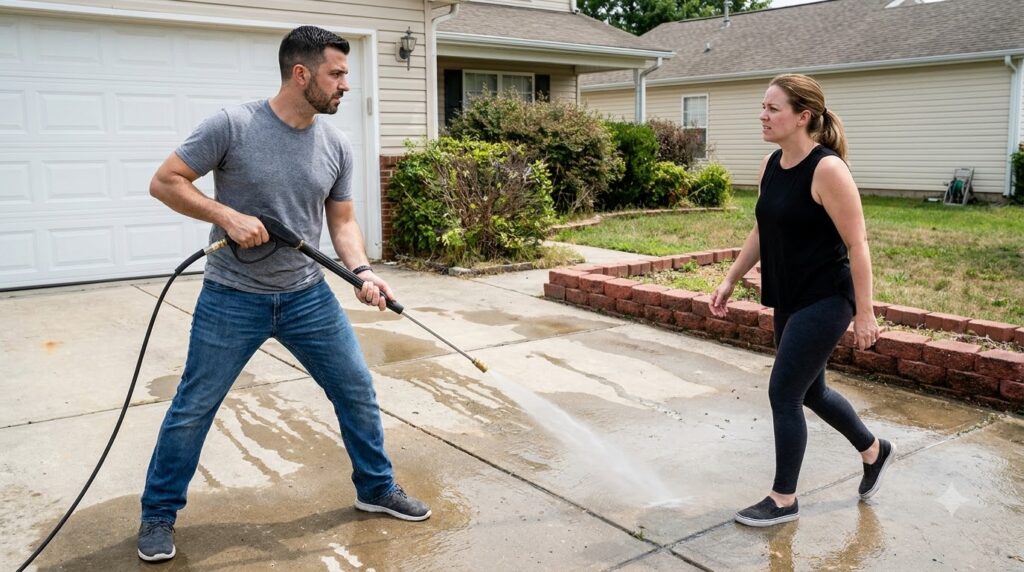
Mark walked to the brass spigot at the side of his house, coiled the black rubber hose over his shoulder, and uncoupled the high-pressure wand. Water dripped from the brass fitting, splashing onto his boot. “She claimed the county issued a lien against my parcel.”
“Evelyn claims a lot of things when the quarterly audit gets close,” Mrs. Gable replied. She stopped three feet short of the control joint, her eyes scanning the clean, pale concrete slab Mark had just blasted. The contrast between his washed driveway and the yellowed, oil-stained curb in front of her own house was stark. “Three years ago, she told the Miller family their oak tree was overhanging the utility easement. She brought a man in a plain white pickup with a chainsaw at seven in the morning. By noon, the oak was firewood, and two weeks later, the board approved an eight-thousand-dollar landscape improvement grant for the entrance island.”
Mark turned the card over again. “The entrance island uses dwarf boxwoods. Those don’t cost eight grand.”
“No,” Mrs. Gable said, her mouth setting into a thin, tight seam. “They don’t.”
She looked down at the puddle near the brick flowerbed where the pink paper had floated. A corner of the wet cellulose had torn off and stuck to the brick mortar, the bleeding purple ink leaving a faint, violet bruise against the red clay.
“You should turn off your main breaker before you go inside,” she added softly, nodding toward Mark’s utility box mounted on the side wall. “Evelyn’s brother-in-law is the regional supervisor for the water authority. When she gets soaked, she doesn’t just write fines. She looks for levers.”
Mark didn’t answer right away. He walked over to the edge of the flowerbed, reached down, and peeled the damp fragment of pink paper off the brickwork. The wet fibers disintegrated between his fingers, but the printed text remained legible: PARCEL BOUNDARY ADJUSTMENT / DRAINAGE EASEMENT CLARIFICATION.
It wasn’t a fine for gray-water runoff. It wasn’t even a standard covenant violation notice.
It was an administrative application to reclassify the two-foot strip along his driveway as dedicated municipal property—a legal mechanism that would give the HOA board the unilateral right to alter his property line without a vote of the full membership.
Mark smoothed the wet scrap of paper against the back of the plastic gate pass. The parcel numbers matched, but the county seal was misaligned by three millimeters—the signature mark of a document scanned on a home bed printer and assembled from two separate public records.
“She didn’t come here to stop the pressure washer,” Mark said, his voice dropping into the quiet, calculating cadence he used when reviewing fraudulent sub-contracts. “She came here to establish a record of non-compliance before the board meeting.”
“The meeting is Thursday night at the library,” Mrs. Gable said. She turned back toward her driveway, her shears clicking once in the still air. “She’s got three proxies signed by the snowbirds on the corner. If you aren’t standing in that room with something stronger than a garden hose, Mark, that tar line isn’t going to be your boundary by Friday morning.”
Mark watched her walk back under her garage door, the heavy shadow swallowing her slippers. He didn’t unhook the pressure washer motor from its frame. Instead, he pulled his phone from his back pocket, tapped the screen, and dialed the direct county tax assessor extension written on the back of the landfill pass.
The line rang twice before a dry, recorded voice answered: You have reached the Office of Records and Mapping. All boundary disputes and easement modifications are currently under administrative hold pending the annual grand jury audit…
Mark ended the call, his thumb hovering over his calendar app. He didn’t look at the wet driveway. He looked at the black tar seam running down the center of the concrete, where the water had pooled, refused to drain, and begun to seep into the soil on Evelyn’s side of the fence.








