
CHAPTER 6: THE STALEMATE ON THE DRIVEWAY
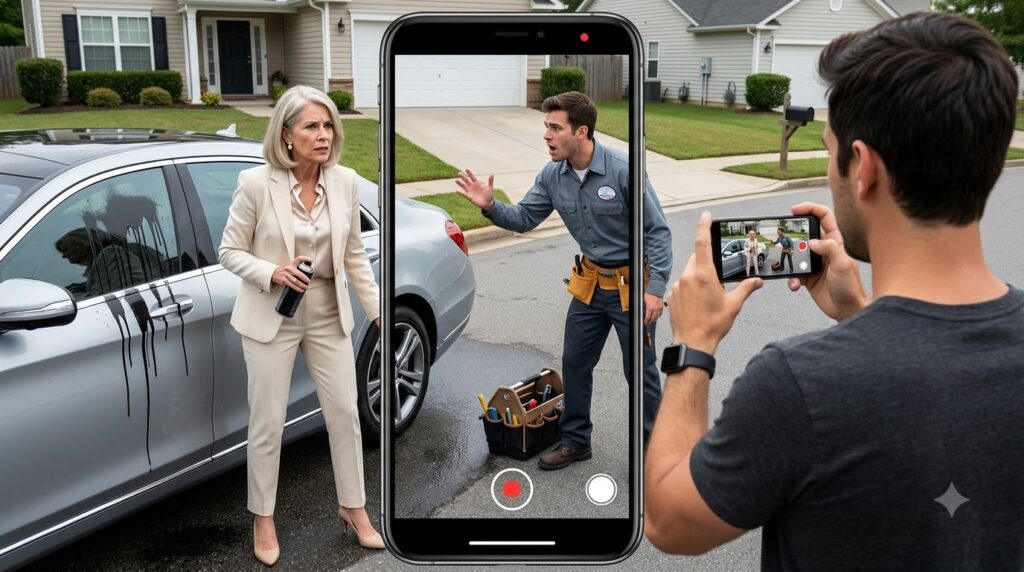
Evelyn didn’t drop the aerosol can to the concrete. Her white-knuckled fingers remained locked around the dark cylinder, lowering it only three inches until the nozzle pointed harmlessly toward her own beige heel.
“Do not move, Mr. Vance,” she whispered, her voice rattling with a frantic, paper-thin authority. Her dark sunglasses hid her eyes, but the pale, bead-slick skin around her jaw showed every tremor of her pulse. “You are actively aiding a property code violation. The police officer will resolve this administrative matter the moment he steps on this apron.”
“He’s not a municipal code inspector, Evelyn,” I said, staying planted firmly on the heat-softened concrete between her and the driver’s door. My hands remained out, open and visible at chest height. “He’s a patrol deputy. And he’s looking at three square feet of fresh paint dripping onto a ninety-thousand-dollar automobile.”
“It is an indicator tag!” she snapped, her chest heaving beneath the satin blouse. She shoved her wooden clipboard under her arm, the masonite corner digging into her ribcage while her left hand scrambled inside her suit pocket. “Under Ordinance 4-B, the association retains full power of physical distraint on default parcels!”
“Ordinance 4-B was struck down by the county court two years ago,” Ethan Reed called out from the middle of the street. He didn’t lower his smartphone by a millimeter. The phone’s screen showed a bright, stabilized frame—the wet black streaks, the aerosol can held at her hip, and the dark blue cruiser coming to a stop at the foot of the driveway. “I have the docket judgment pulled up on my screen right now, Evelyn. You know as well as I do that the board never had distraint authority.”
Evelyn’s head jerked toward Ethan, her pearl earring swinging wildly. “You have no standing here, Mr. Reed! You are a third party committing unlawful surveillance on a private residential lot!”
“I’m standing on the public asphalt,” Ethan said smoothly. “And I’m documenting a felony in progress.”
The driver-side door of the Ford Explorer opened with a heavy, mechanical latch-click. Officer Miller stepped out onto the driveway. He was in his late thirties, built like an anvil, wearing a dark blue tactical uniform dusted with white road salt around the boots. His sunglasses were tucked into his bulletproof vest strap, and his grey eyes swept over the scene with the cold, practiced efficiency of a man who dealt with suburban squabbles every day of his life.
He didn’t pull his sidearm. He didn’t sprint. He walked up the slight incline of the driveway, his heavy utility belt creaking softly with every stride, his gaze fixing first on the black aerosol paint dripping from the luxury sedan’s chrome trim onto the concrete.
“Alright,” Miller said, his voice a flat, gravelly baritone that cut straight through the humid air. “Nobody move. Everyone keep their hands where I can see them.”
“Officer!” Evelyn blurted out instantly, stepping two inches past my shoulder toward the policeman, her voice pitching up into a shrill, rehearsed cadence. “Thank goodness you arrived. I am Evelyn Prescott, vice president of the Oakridge Estates Executive Committee. I caught this unvetted contractor performing illegal commercial work without a township waiver, and when I attempted to apply a temporary administrative tag to this unauthorized vehicle, he became physically aggressive and blocked my egress!”
Officer Miller didn’t look at her face. He looked down at her right hand.
The black industrial spray can was still held tightly in her fingers, the red plastic spray tip glistening with wet black enamel.
“Ma’am,” Miller said quietly, stopping four feet away. “Set the can on the hood of my cruiser.”
Evelyn blinked behind her dark lenses, her mouth opening and closing like a landed fish. “Officer, you don’t understand the statutory background—”
“I asked you once,” Miller interrupted, his tone dropping an octave into a hard, non-negotiable command. “Set the spray can on the hood of the patrol vehicle. Right now.”
A long, suffocating silence descended over the driveway. Across the street, two curtains twitched in a second-story window of 418 Birchwood. The heat hummed off the silver sedan’s roof, smelling of volatile solvent and hot metal.
Evelyn’s composure shattered completely. Her shoulders collapsed inward, the illusion of board authority evaporating in the blinding midday sun. Slowly, with stiff, trembling movements, she turned around and set the heavy black aerosol can onto the white steel hood of Officer Miller’s patrol car.
“Now,” Miller said, pulling a small pocket notepad and a black ballpoint pen from his vest. “Who owns this vehicle?”
“It belongs to Dr. Aris Thorne,” I answered, stepping forward so my contractor patch was clearly visible. “He’s a visiting medical consultant staying with Dr. Clara Sterling. I’m Marcus Vance, the HVAC contractor hired by Dr. Sterling to overhaul her mechanical system.”
Miller glanced at my dusty work boots, the tool belt hanging off my hip, and the open tool tote sitting by the garage access path. Then he looked at the black streak covering the silver sedan’s driver-side window.
“And Mrs. Prescott,” Miller said, turning his gaze back to the woman in cream. “Who authorized you to apply paint to Dr. Thorne’s automobile?”
“The board,” she whispered, her hands scrambling against the edge of her clipboard as if searching for a document that could save her. “The master covenant… Article 7…”
“There is no Article 7 that permits paint, Evelyn,” Ethan said, stepping up to the edge of the driveway and holding out his phone to Officer Miller. “Officer, I have three unedited minutes of video from the moment she walked across the street with the can until Mr. Vance stopped her. You can watch it right now.”
Miller looked at Ethan, then at the phone screen, then back to the frantic woman standing beside his cruiser. The trap had closed, tight and absolute.








