
CHAPTER 4: THE THREAT OF TENSION
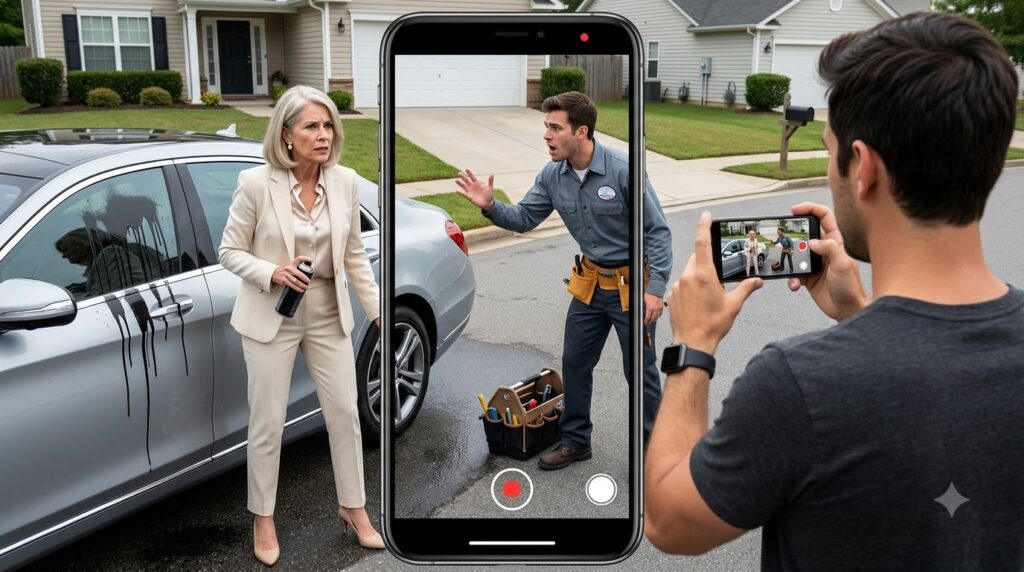
“A tow truck is already dispatched,” Evelyn said, her voice dropping into a tight, quiet frequency that barely carried past the front bumper of the silver sedan. She adjusted the heavy wooden clipboard, sliding a second sheet of paper to the top. “Private impoundment under Section 9 of the township municipal access act. You have ninety seconds to remove your service van, Mr. Vance, or your vehicle will be hooked right alongside this one.”
I didn’t step back. The heat off the hood of the luxury sedan radiated through my gray-blue work shirt, smelling faintly of hot oil, baked clearcoat, and the sharp, volatile chemical stink of black aerosol paint drying into a dull skin.
“Section 9 applies to public thoroughfares,” I said. My voice was measured, clipped, and completely stripped of pitch. I let my eyes ride down her posture—the rigid line of her jaw, the way her beige heels were pinned against the expansion seam of the concrete pad like she was trying to root herself to the land. “This apron is private residential real estate. Owned by Dr. Clara Sterling. The township line ends six inches past the curb.”
“The easement belongs to the association!” she shot back. She shoved the clipboard forward, the sharp aluminum corner missing my chest by three inches. “Look at the line! Look at the county plot map on page two! Every driveway in Oakridge Estates carries an unencumbered municipal utility and code access easement extending twenty feet from the road centerline!”
I reached out, my thick leather glove leaving a dusty smudge on the margin of her laminated paper as I held it steady in the glaring sunlight.
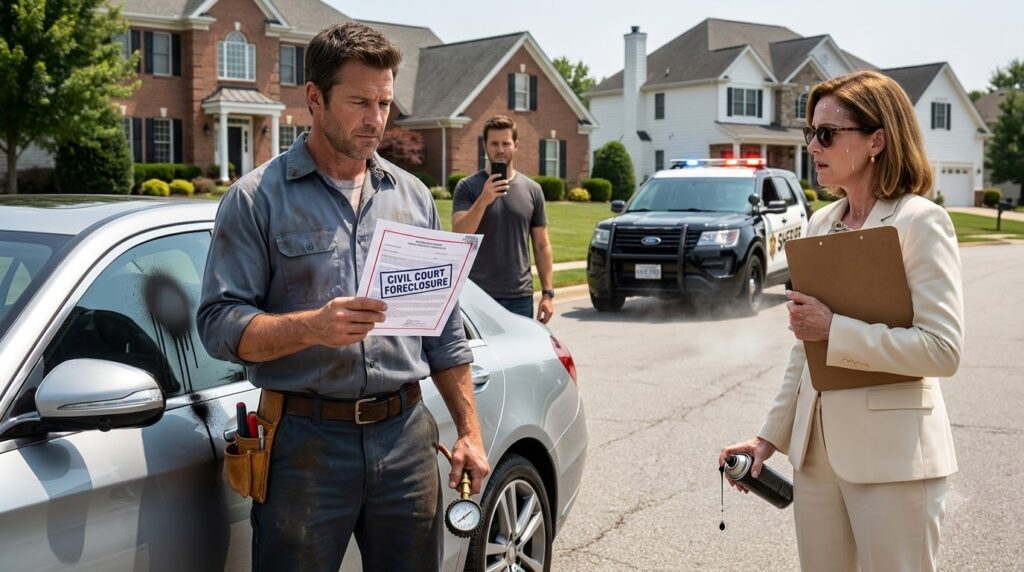
The paper wasn’t just an HOA violation slip. It was a printed county assessor map, overlaid with red ink lines that marched straight across Dr. Sterling’s front yard, slicing through the concrete apron and terminating right where the silver sedan was parked. But stamped across the bottom in dark blue ink was a case index number—a civil court filing mark from the County Court of Common Pleas.
My thumb ran across the cold, smooth laminate. “This isn’t a zoning easement,” I said softly, my eyes narrowing as I read the small print under the blue stamp. “This is an active foreclosure motion. Docket C-409. Filed four days ago.”
Evelyn’s thumb twitched on the frame of her board. A micro-flash of panic flickered in the tight muscles around her mouth before she pulled the board back against her chest like a shield.
“That is confidential board correspondence!” she hissed, her sunglasses slipping a fraction of an inch down her sweat-glistening nose. “It is a matter of record between the executive committee and the county sheriff’s civil division!”
“Dr. Sterling doesn’t have a civil judgment against her,” I said. I stepped closer, closing the distance until I could smell the sharp, metallic perfume clinging to her cream suit. “I checked the public land records when I pulled the mechanical permit for her new heat pump system yesterday morning. Her title is clean. Her tax parcel is unencumbered.”
“She’s four months behind on the capital reserve assessment!” Evelyn spat out the words, her voice rising into an unsteady, bird-like screech that echoed off the brick facade of 412 Birchwood. “The board issued an administrative lien in April! Under the 1994 master covenant, an unpaid assessment automatically converts to a priority land debt!”
“An administrative lien requires a judge’s signature,” Ethan Reed’s voice cut across the hot air. He had advanced to the middle of the cul-de-sac, his two-handed grip on his smartphone completely motionless. “And a certified notice delivered by registered mail. I work in legal compliance for a commercial bank, Mrs. Prescott. You can’t attach a priority lien through an HOA board vote without a public hearing.”
Evelyn didn’t turn around to face Ethan this time. She couldn’t. She was pinned between the front bumper of the ruined sedan, the weight of my presence blocking her exit path, and the approaching wail of the police cruiser as it turned the corner onto Birchwood Lane, its tires squealing against the hot pavement.
“I am the vice president of this association,” she whispered, her voice cracking under the pressure as her knuckles turned stark white against the wood of her clipboard. “I have maintained the integrity of this street for fourteen years. I will not let a surgeon and a grease-monkey tear down what we built.”
“You didn’t build this street, Mrs. Prescott,” I said, reaching into my tool belt and pulling out my brass air-line pressure gauge. The solid metal tool clicked against my palm with a heavy, lethal clarity. “You just live on it. And right now, you’re standing on private property holding the weapon you used to commit a felony.”
The white-and-black Ford Explorer patrol car swung into the cul-de-sac, its roof lights flashing silently against the blinding glare of the afternoon sun. The cruiser slowed, its tires crunching over the loose gravel near the gutter before turning its grill directly toward Dr. Sterling’s driveway, pinning all three of us in the stark, unblinking focus of law enforcement.
Evelyn stood frozen. The aerosol can dangled from her right hand, a single drop of black enamel clinging to the red plastic nozzle, ready to fall.








