
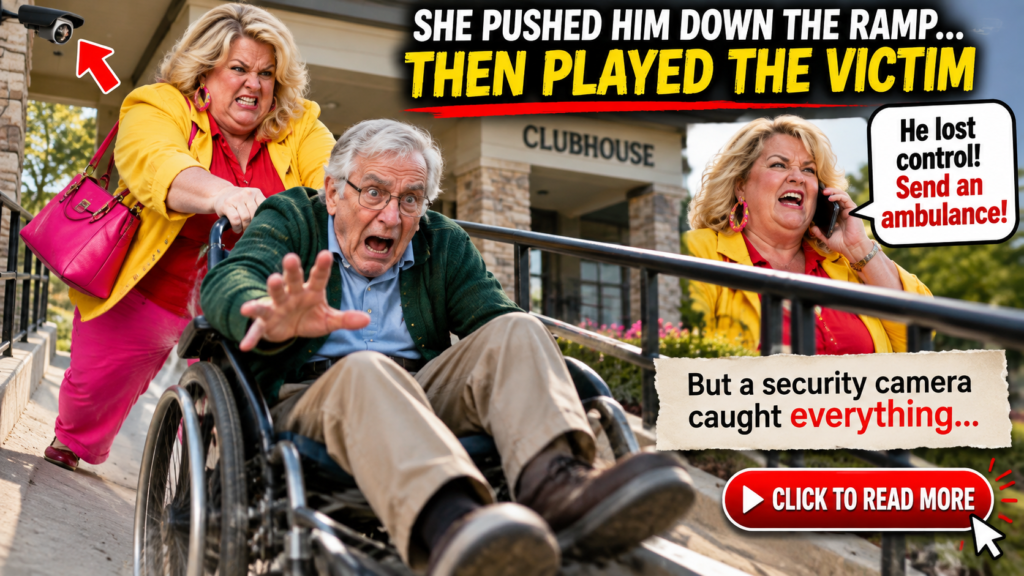
Chapter 5: What the Community Remembered
The formal review took two weeks.
During that time, Harold stopped using the clubhouse ramp.
Not because anyone had ordered him to.
Because he wasn’t ready.
He told Emily he hated needing to think about every person who came up behind him.
Before the accident, the ramp had been nothing more than concrete.
Now it felt like a place where trust had disappeared.
Emily offered to accompany him whenever he wanted.
Harold refused at first.
Then one Saturday morning, he asked her to come.
They approached the clubhouse together.
Harold stopped at the bottom of the ramp.
“I used to come here alone,” he said.
Emily nodded.
“I know.”
“I want that back.”
So they went inside.
What happened next surprised Emily.
People began stopping Harold.
Not to discuss Karen.
Not to gossip.
They simply told him they were glad to see him.
Margaret brought him coffee.
A neighbor from two doors down offered to walk beside him.
Another resident said the ramp needed better maintenance anyway.
Soon, the board approved improvements that had been discussed for months: brighter lighting, clearer sightlines, repaired pavement, and a visible sign reminding residents not to push or move another person’s mobility equipment without permission.
None of it erased what happened.
But it changed the space.
Harold could once again enter the clubhouse without feeling that he was entering hostile territory.
Meanwhile, Karen’s position became increasingly difficult.
The preserved video contradicted her original report.
Her written complaint contradicted parts of what she later told neighbors.
And her own statement to the board contained details that could only have been known by someone standing directly behind Harold.
The board did not need to argue with her.
The contradictions spoke for themselves.
Karen eventually received a formal notice that she was prohibited from assisting, moving, or physically handling another resident’s mobility equipment without consent.
She was also removed from the community safety committee.
Still, one question remained.
Why had she done it?
The board asked Harold whether he wanted an explanation.
He thought for a long time.
“No,” he said.
Emily looked at him.
“Dad?”
“I don’t need to understand why someone decided my independence was theirs to control.”
That answer stayed with her.
Because sometimes the deepest injury came from someone believing they had the right to decide what another person could do.








