CHAPTER 3: THE ORANGE OBSTRUCTIONS
The hydraulic hiss of the screen door behind me didn’t register as a voice, but the sudden density of the afternoon air told me she was watching from the porch shade. I didn’t look up from the front tire. I kept my weight settled low, balanced on the balls of my work boots, letting my fingers trace the buried iron plate through the fescue before pulling my hand back. The grit under my fingernails was gray, dry, and mixed with the bitter scent of crushed root systems.
By the time I stood up and closed the driver-side door of the sedan, the street had changed again.
Three heavy, sun-bleached traffic cones had been placed in a tight, unyielding line directly in front of my bumper. They weren’t standard residential markers bought from a hardware store. These were industrial-grade, twenty-eight-inch high-visibility pylons made of heavy injection-molded PVC, their orange bases stained with dried mud and tar from some long-abandoned commercial worksite. They sat in the gravel gutter lane like a row of small, jagged teeth, completely choking off the approach to the curb.
I walked to the first cone. The plastic was hot to the touch, sticky with melted road film under the glare of the three o’clock sun. When I wrapped my fingers around the square base to lift it, the weight dragged against the gravel, releasing a small puff of white dust that smelled of pulverized limestone.
“Those are structural markers,” her voice carried down from the top step. She hadn’t moved into the open yard yet, keeping her frame tucked safely beneath the overhang of the roofline. The cracked blue plastic folder was locked under her arm, the cheap spine catching the sharp glare of the afternoon light. “The lane is restricted for utility maintenance. You park there, you’re obstructing a designated right-of-way.”
I didn’t answer right away. I turned the cone over in my hands, tilting the wide base toward the light. The interior wall of the pylon wasn’t smooth. Someone had used a mechanical grease pencil to scrape a series of letters and numbers inside the lip: PROPERTY OF UTILITY DISTRICT 4 – DO NOT REMOVE. But the ink was fresh. It lacked the fine network of cracks that decades of sun exposure give to grease paint. It had been written within the last forty-eight hours, the thick black wax still soft enough to smudge under the pressure of my thumb.
“District Four doesn’t use pylon markers for unexcavated vaults,” I said, setting the cone down on her side of the grass line. The rubber base hit the sod with a dull thud, flattening a patch of her prized fescue. “They use brass plaques driven into the concrete flowline. And they don’t write their inventory codes with an office pen.”
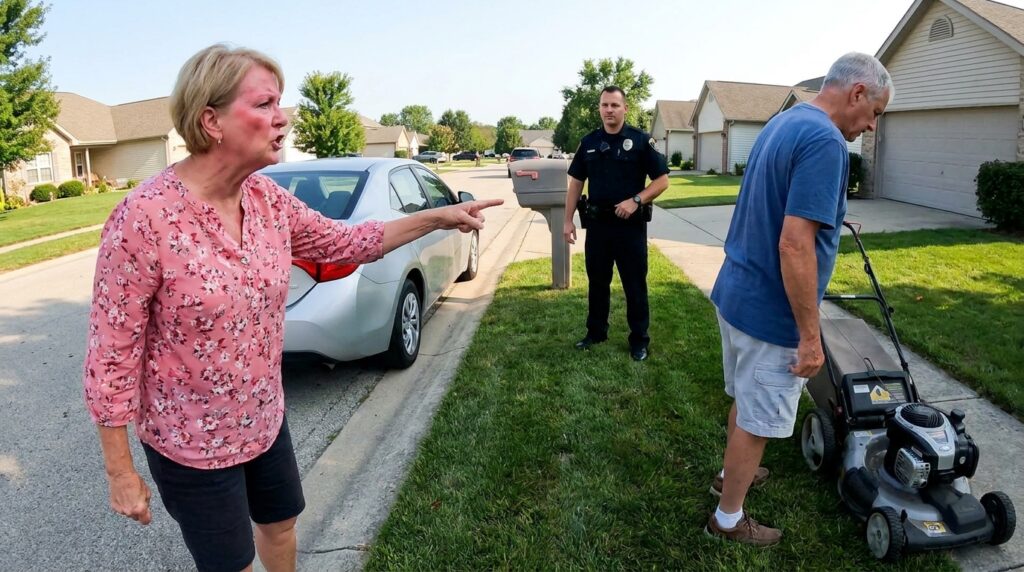
She stepped off the porch, her sandals crunching rhythmically against the dry gravel driveway. Her pink floral blouse caught the full force of the heat, the stiff fabric shaking slightly as her posture tightened. “I know the commissioners,” she said, her voice dropping into a flat, transactional hiss that didn’t rise above the drone of the distant highway. “I know how this loop is zoned. You think you can just bring your vehicle into a private residential grid and leave it wherever the asphalt is clear?”
Across the yard, near the shadows of the adjacent two-car garage, the neighbor in the blue shirt reappeared. He didn’t have his mower now. He was holding an old, notched garden spade, his boots stepping carefully along the edge of his own flowerbed as if he were looking for a place to dig. His chin was tucked low against his collar, his eyes shifting between the pylon in my hand and the locked front door of his own house. He was listening to the measurements. He knew what was buried three inches under the dirt line.
I moved to the second pylon, my boots grinding into the soft shoulder of the street lane. “The county records don’t show a private grid,” I said, keeping my fingers steady as I cleared the second obstacle, stacking it neatly inside the first. “They show a public right-of-way that was established before these foundations were poured. If you want these cones here, you’ll need an engineering permit signed by the board.”
“The board doesn’t need to sign anything for an emergency clearance,” she said, her pointing finger snapping out again, a rigid extension of her shoulder that trembled slightly from the exertion. She didn’t look at the stacked cones; she looked directly at the silver hood of my car, her face flushing a deep, mottled red under her styled blonde hair. “The line is hazardous. There’s an unstable structure under the turf. If your weight collapses that main, the county will hold you personally liable for every gallon.”
It was a functional counter-move, grounded in a specific kind of tactical bluff that usually worked on tenants or delivery drivers who couldn’t afford the time to check the maps. She was using the hidden iron plate—the very thing she had buried to extend her lawn—as a legal shield to prevent anyone else from claiming the spatial margin. She had built a false bottom into the property dispute, using a real utility vault to cover an illegal land grab.
I didn’t argue the point. I grabbed the final pylon by its tip, dragged it five feet across the gravel lane, and set the entire stacked pile right at the corner of her mailbox post. The wooden post was weathered, its gray cedar grain splitting down the middle where the moisture had warped the wood over twenty winters.
When the base of the cones hit the post, a small piece of paper fluttered out from a crevice behind the metal flag assembly. It was an old, faded compliance notice from the county development office, dated six years ago, its red lettering bleached into a pale, ghostly pink by the sun. The text was mostly unreadable, but the large stamp at the bottom was still clear enough to parse: APPLICATION INCOMPLETE – CHARTER PENDING RE-SUBMISSION.
I reached out to take it, but the sound of an engine turning the corner of the loop cut through the heavy air. It wasn’t a resident’s car. It was the low, steady rumble of a Ford Interceptor utility vehicle, its black-and-white panels covered in a fine layer of gray limestone dust from the county access road.
The cruiser didn’t activate its lights. It coasted along the curb lane, its heavy tires crunching over the loose gravel before coming to a stop six inches behind my rear bumper, its exhaust tailpipe puffing a warm, faint cloud of carbon into the midday glare.