CHAPTER 2: THE BASELINE MEASURE
The county clerk’s basement smelled of zinc and damp cardboard, a subterranean chill that did nothing to wash away the memory of the cul-de-sac’s white heat. I pressed my palm flat against the green laminate counter, feeling the slight vibration of the HVAC system hum through my skin.
The woman behind the desk didn’t look up from her screen. Her fingers moved with a rhythmic, heavy clack across a yellowed keyboard, each stroke echoing off the steel filing cabinets lining the back wall. Between us lay the heavy leather-bound ledger for Sector 4, its spine split at the bottom where the white mesh binding peeked through like dried bone.
“These lines haven’t been updated since the ninety-two widening,” she said, her voice thin and flat, matching the gray light of the fluorescent tubes overhead. She spun a heavy brass magnifying loupe across the page, its glass catching the reflection of the grid lines beneath. “If you’re looking for the municipal right-of-way, it’s recorded under the old county surveyor’s easement, not the developer’s plat.”
I leaned over the ledger. The paper was thick, fibrous, and smelled of old ink that had set before I was born. My thumb traced the boundary line of Lot 14—her lot. On the original draft, the line was a crisp, ruled stroke of black India ink, but where it met the curb of the road, someone had scratched a faint pencil correction. It was a cross-hatched box, barely larger than a postage stamp, labeled Muni-Util-Vault-04.
“What’s the offset on that vault?” I asked.
“Six feet from the flowline of the concrete gutter,” she muttered, finally looking up. Her eyes were small, watery behind thick lenses. “But that was before the road was re-paved in two thousand eight. If they shifted the crown of the asphalt during the scrape, the vault might be sitting beneath the sod now. It happens when the developers skip the final survey.”
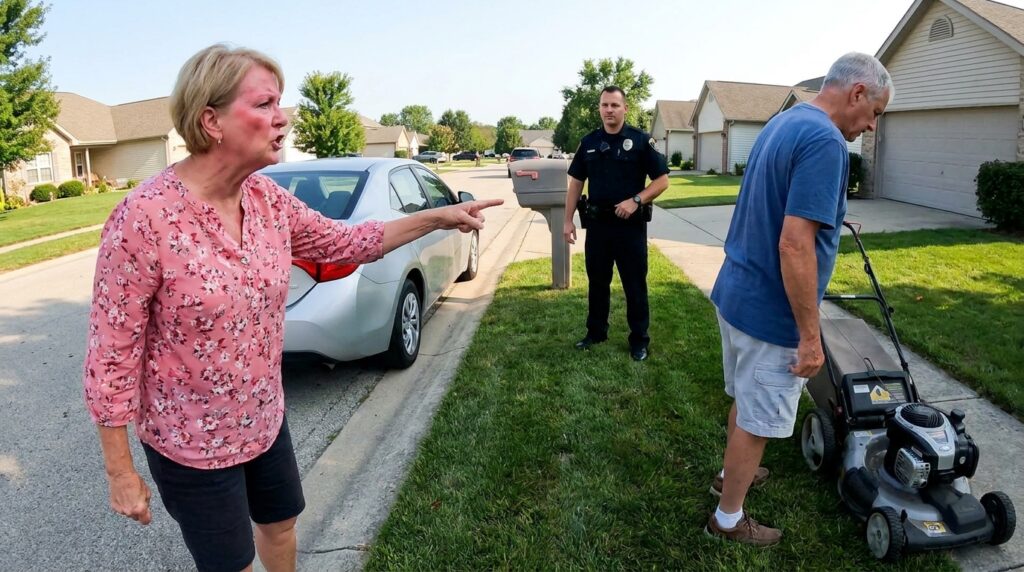
I took out my phone, comparing the screen’s high-resolution satellite imagery with the faded ink map. In the satellite photo, the frontage of Lot 14 looked perfectly uniform—a seamless carpet of dark green turf extending right to the gray lip of the asphalt. There was no vault cover visible. No iron plate. No concrete marker. There was only the manicured edge where her pink floral blouse had caught the glare of the afternoon sun.
A micro-mystery had traveled with her from the driveway. When she had shifted that cracked blue plastic folder against her hip, a loose sheet had slipped slightly out of alignment. It wasn’t a standard printout. It was a grid-paper sketch, hand-drawn in purple felt-tip ink, showing a series of small circles spaced precisely nine feet apart along the curb line. The numbers next to them weren’t city codes; they were handwritten measurements with arrows pointing back toward the foundation of her porch.
“If someone covered a utility access point,” I said, my finger resting on the pencil-marked box, “what’s the administrative penalty?”
The clerk let out a dry, rattling laugh that turned into a cough. “Penalty? The county doesn’t fine you for covering a box, son. They just send a crew out with jackhammers and a backhoe when the main line blows. They don’t look at the landscaping when they start digging. They just look at the map.”
She pulled the ledger toward her, closing it with a heavy thud that puffed a small cloud of silt into the air between us. The iron smell of the old binding hung in the space.
I thanked her, took my ligned notepad, and walked up the concrete stairs into the parking lot. The afternoon sun hit me like a physical blow, the heat rebounding off the hood of the sedan as I climbed inside. The steering wheel was hot enough to scorch bare skin, the black vinyl slick with oil.
I drove back toward the loop slowly, keeping the speed down to let the ancient air conditioner struggle against the cabin’s heat. The truck lanes of the county road were rutted, the tires groaning against the uneven asphalt where the heavy gravel haulers had deformed the surface during the spring thaw. Everything in this county was wearing out, shifting slightly under the weight of time, held together only by the inertia of old habits and unverified boundaries.
When I turned back into the subdivision, the stillness had returned, but it was a different kind of quiet now. The neighbor in the blue shirt was gone, his mower sitting on the concrete apron of his garage like a abandoned piece of artillery, the deck still caked with damp, clippings that were already turning brown and sweet in the humidity.
I parked the sedan in the exact same spot at the curb. The silver paint on the roof was hot enough to sizzle if a drop of water hit it. I stood on the asphalt, my shadow falling across the line where the public road met the gravel fringe of her yard.
I knelt down, pretending to check the pressure in my front tire, but my eyes were on the turf just beyond the concrete flowline. The fescue was dense, but about three inches into the sod, there was a subtle, linear dip in the earth—a slight depression that ran parallel to the road for twelve feet before disappearing beneath her manicured flowerbed. I reached out, my fingers sinking into the dry, stiff blades of grass until they struck something hard and cold just an inch below the surface.
It wasn’t rock. It was the rusted edge of an old iron plate, buried deliberately beneath a layer of shaved topsoil and sod.
Above me, the front door of Lot 14 creaked open. The screen door didn’t slam; it caught on its hydraulic piston, letting out a long, high-pitched hiss that sounded like a warning.