CHAPTER 6: THE RUSTED SETTLEMENT
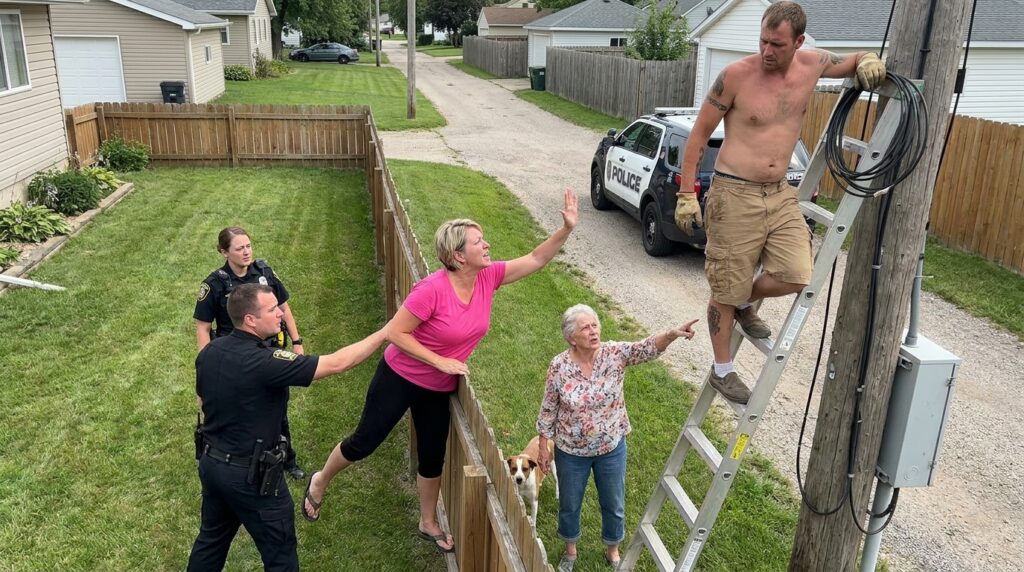
The work boots hit the alleyway blacktop with a solid, leaden thud that sent a small shudder through Mark’s calves. The gravel beneath his soles was hot, saturated with decades of leaked crankcase oil and the grey dust of limestone base. The air down here smelled different than it did twelve feet up; it was thick with the scent of roasted insulation and the sharp, chemical tang of the black dielectric fluid leaking from the split seam of the distribution housing.
He didn’t drop his wrench. His leather-gloved fingers stayed clamped around the iron handle, his skin slick with sweat where the tool’s industrial cross-hatching pressed into his palm.
“Let’s look at that work order,” Officer Davis said again. She didn’t move toward Evelyn. Her posture remained squared toward the alleyway lane, her fingers hooked loosely into the top of her tactical vest, her boots spaced to give her leverage if the situation reset itself into violence.
Mark reached into the worn leather pouch hanging from his side, his fingers brushing past the cold metal of his wire-strippers until they found the coarse, thumbed edges of the city permit book. The yellow carbon sheets were warped from the humidity, the purple indelible ink slightly smudged along the margins where his greasy thumb had pinned the page. He pulled the document free, the paper crisp and noisy in the sudden silence of the backyard boundary.
Officer Davis took the book, her eyes scanning the municipal registration code—7-44-A—and the embossed seal of the Department of Public Works. She didn’t look at Evelyn while she read. She tracked the legal description of the grid coordinates down to the bottom line, then raised her chin to glance at the wooden pole where the dark, bubbling line of transformer oil was collecting in the dry rye grass.
“It’s a clean drop,” Davis said, her voice carrying the flat, monotone weight of a person reading a serial number off a engine block. She handed the book back to Mark, her leather gloves clicking against the carbon paper. “The city owns the radius up to four feet from the centerline of the lane ditch. The pole sits exactly thirty-two inches inside the public zone.”
Behind them, Evelyn was still held by Officer Miller’s stocky arm. Her bright pink T-shirt was rumpled, the shoulder seam pulled tight against her collarbone where the officer’s fingers kept her anchored to the grass. Her oversized sunglasses had slipped a quarter-inch down her nose, revealing her eyes—small, pale blue, and bloodshot around the rims, blinking rapidly against the unshaded glare of the July sun. The fake HOA folder lay three feet away in the dirt, its gold seal covered by a fine layer of grey blacktop grit.
“The billing is wrong,” Evelyn said. Her voice didn’t have the loud, sharp bark left in it; it had dropped back into that low, rattling hiss, her chest heaving underneath the thin cotton fabric. “You don’t understand the ledger. The county clerk has been routing the entire sector three line loss through meter box forty-two since the substation upgrade in January. I’ve paid seven hundred and forty dollars every month since the freeze. If he pulls those fuses, the whole block goes dark, but my circuit stays live. I paid for the extra transformer capacity. It’s on my bill!”
Mark stopped his hand midway to his belt. He looked from her face down to the fresh, wet clay where the black conduit disappeared under her chain-link fence line. The truth didn’t arrive with a dramatic reveal; it came with the greasy, industrial reality of a municipal accounting failure. The city hadn’t re-routed the cables when they took over the bankrupt subdivision’s grid. They had simply left the old, irregular private transformer active, letting the primary meter run inside Evelyn’s house while forty other homes pulled their air conditioning load directly through her private transformer’s secondary bypass leg. She wasn’t an autocrat trying to steal public access—she was a broke woman who had been systematically drained by a bureaucratic glitch for ten years, and she had cut the city’s master lock because she believed that paying the bill made the iron hers to keep.
“Evelyn,” Mark said, his voice flat, the pragmatism of a field mechanic overriding the anger from his slipped footing. “The city isn’t billing you for the line loss because they think you own the pole. They’re billing you because the old developer tied your residential service panel directly into the primary distribution bus forty years ago. Every time Mabel turns on her stove, your dial spins. Cutting my lock didn’t fix the loop; it just kept the engineer from seeing the line error.”
Evelyn’s mouth stayed open, her lower lip trembling slightly against her teeth. She looked at the wooden pole, then down at the scattered linen stock of her fraudulent injunction, her shoulders dropping two inches as the rigid, forward-leaning tension left her silhouette.
Officer Miller slowly released his grip on her upper arm. He didn’t pull his handcuffs from his belt, but he kept his stocky frame between her and the aluminum ladder.
“Ma’am,” Miller said, his hand gesturing toward the parked white SUV. “We’re going to step back to the cruiser. You’re getting a citation for interfering with a public utility tech, and we’re going to have the county clerk verify those billing records. But you need to stay out of the alley lane while the lineman finishes the splice.”
Evelyn didn’t shriek. She didn’t pick up her blue folder. She walked deliberately toward the vehicle, her white-soled tennis shoes dragging through the dry chicory weeds, her eyes fixed entirely on the gravel at her feet as Officer Miller followed her flank.
Mark turned back to his truck. He reached into the bed, his gloves sliding over the scaling zinc plating of a fresh, unweathered three-phase isolation switch. He had a job to finish before three o’clock, and the block was still drawing juice through a burnt core. He looked over at Mabel, who was still standing by her fence line, her sleeveless blouse damp with sweat as she watched the cruiser’s doors click shut.
“Is the power coming back on, Mark?” she asked.
“It’ll be on in twenty minutes, Mabel,” Mark said, lifting the heavy iron replacement unit onto his shoulder. “And the city’s going to owe your neighbor a lot of money.”