CHAPTER 3: THE PAPER GRIDLOCK
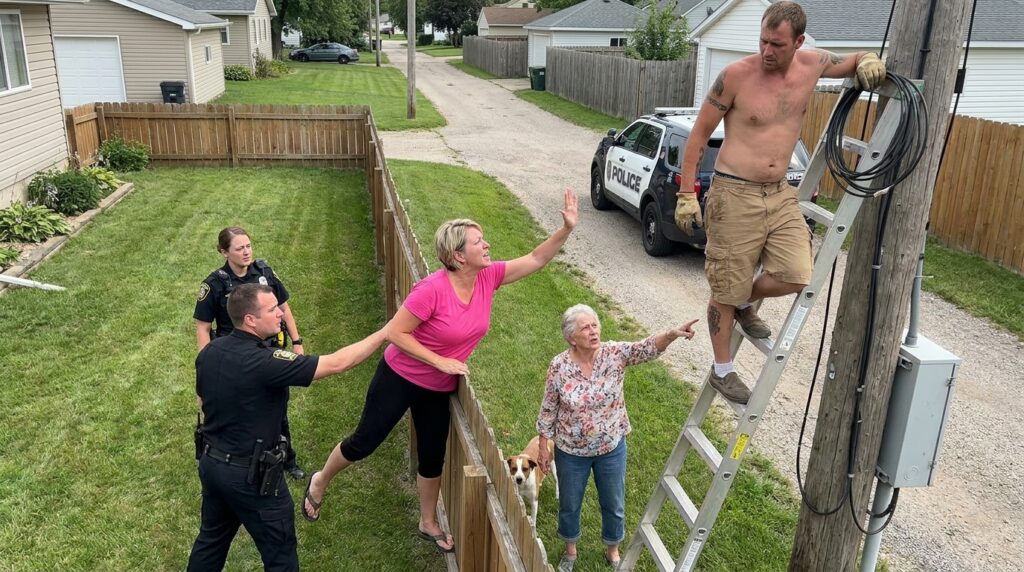
The weight of her palm against the aluminum vibrated straight up through the soles of Mark’s boots. It wasn’t a loose touch; she clamped her fingers around the side rail with a deliberate, calculated leverage, her polished nails clicking against the cold metal. Her knuckles were dead white under the glare of the noon sun. Up on his perch, Mark shifted his hips three inches to the right, his leather tool belt scraping against the dry cedar grain of the pole as he balanced the weight of his iron wrench.
“Take your hand off the rail, Evelyn,” he said. He didn’t raise his voice, but he dropped the words with the heavy, flat finality of a spade striking clay. “The safety manual says nobody stands inside the fall perimeter while the housing is unbolted. If this transformer slips its bracket, sixty pounds of iron and PCB oil will drop straight through your collarbone.”
Evelyn didn’t move her arm. Instead, she leaned her torso forward, her rigid blonde silhouette cutting across the gravel lane like an iron wedge. With her left hand, she brought the blue folder up, smacking the heavy linen stock against the lower upright of the ladder. The gold-leaf HOA seal caught the light, casting a tiny, jagged yellow reflection across the greasy toe of Mark’s left work boot.
“This is an immediate, binding administrative cease-and-desist,” she said. Her speech had slowed down, tightening into the practiced, bureaucratic cadence of someone who spent her Tuesday nights citing neighbors for using the wrong shade of mulch. “Paragraph three of the subdivision bylaws explicitly reserves the right of architectural review for all visible infrastructure attachments within thirty feet of a primary residential facade. Look at the signature line, contractor.”
Mark tilted his chin down, his green safety lenses tracking the paper sheet she was thrusting toward his knees. The document looked expensive—thick, eighty-pound cream stock, complete with a neatly typed legal description of the Elm Street plat and an official-looking corporate stamp at the footer. But Mark spent forty hours a week reading municipal blueprints and easement filings. He knew what real county seals looked like. The stamp on her paper didn’t have the raised, embossed edge of the county recorder’s press; it was a flat, purple ink-jet imitation, the edges slightly feathered where the ink had bled into the cheap cotton fiber of the page.
More importantly, the legal description was missing the standard northwest section marker. Someone had manually adjusted the coordinate links, shifting the public utility easement boundary exactly twenty-four inches to the east—just enough to push the entire wooden pole out of the city’s right-of-way and onto Evelyn’s private lawn plot.
“This text didn’t come from the courthouse clerk,” Mark said, his voice dropping into the gravelly rumble of an idling truck engine. He tapped the shaft of his wrench against the top rung, the ring of the steel cutting through the dense, humid air. “You typed this out yourself, Evelyn. You used the old ninety-two boundary layout before the county widened the alleyway for the fire lane.”
Evelyn’s chin jerked up. Her oversized sunglasses flashed, hiding her eyes behind twin circles of polished dark acrylic, but the muscle right below her jawline twitched twice, her lips drawing back into a thin, bloodless line.
“The Board signed that document at seven o’clock last night,” she said, her voice rising just enough to carry across the low wire fence into the neighboring yard. “We don’t recognize the county’s right to re-zone the back-alley easements without a unanimous vote from the property owners. My husband paid thirty-two thousand dollars for this lot extension in ninety-five. We own the ground, we own the fence, and we own the structural support lines that run across this grass.”
“You don’t own the wire, ma’am,” Mark said. He didn’t look down at her document again. Instead, his fingers went back to his belt, unhooking the worn leather pouch that held his official city permit book. He flipped it open with one hand, the grease-stained carbon sheets rattling in the hot draft. “This is a Department of Public Works work order, number seven-dash-four-four-alpha. It’s got the city engineer’s stamp and a direct signature from the regional grid administrator. If your board wants to contest it, you’ll have to do it in the municipal civil court on Monday morning. But until three o’clock, I’m the one with the wire-cutters.”
Down in the chicory weeds, Mabel’s dog stopped its sniffing. The animal’s head went up, its floppy ears lifting as it turned its gaze toward the far end of the alleyway. A low, dull vibration was beginning to rumble through the packed gravel—the heavy, rhythmic throb of a standard six-cylinder diesel engine shifting down into second gear as it turned off the main avenue.
Evelyn didn’t turn around to look at the alley entrance. She kept her weight pressed hard against the aluminum rail, her fingers digging deeper into the metal as if she could keep the ladder anchored by her own determination.
“I don’t care about your carbon paper, boy,” she whispered, her voice dropping into a razor-thin hiss that didn’t carry past the ladder base. “You take that splice box apart, and you’ll find out exactly what this neighborhood does to contractors who think a city badge means they can touch a private system.”
Mark didn’t answer her. He let his gaze drift past her shoulder toward the cedar pole’s connection line. Right where the black conduit plunged into the dry dirt near her fence, the earth was slightly discolored—darker, wetter than the surrounding gravel, as if someone had been digging around the primary ground rod within the last twelve hours.