
Chapter 3: The Question Behind the Question
By sunset, the emergency vehicles had begun leaving.
The smoke had thinned.
The forest remained closed.
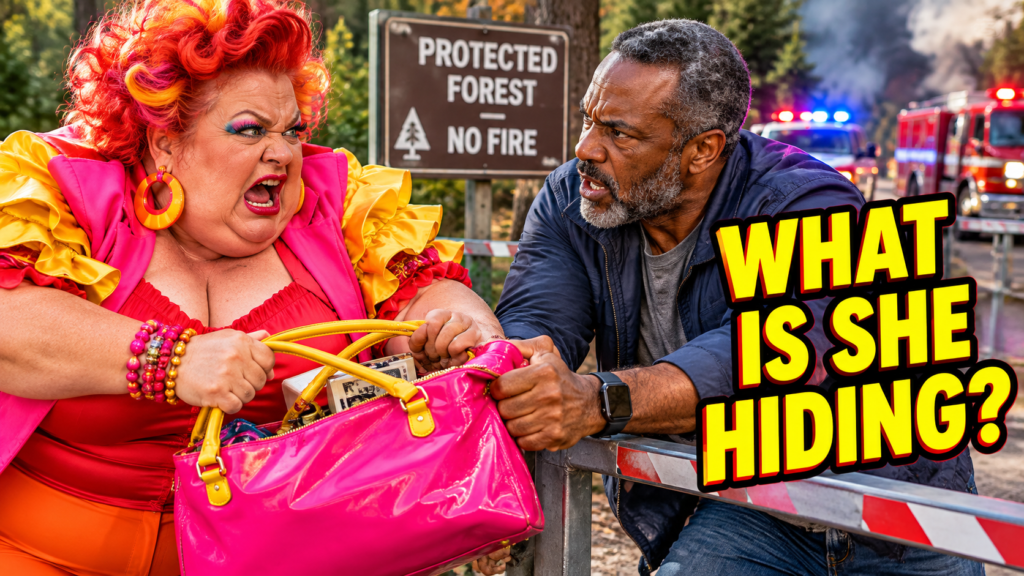
Karen sat alone on a wooden bench near the roadside, staring at her handbag.
Inside was the small personal item she had refused to identify.
The Neighbor approached but stopped several feet away.
He no longer held the same aggressive posture.
“You really weren’t looking for anything related to the smoke?”
Karen didn’t answer immediately.
“No.”
He nodded.
Then he surprised her.
“I believe you.”
Karen looked at him.
It was the first peaceful sentence between them all afternoon.
But peace didn’t last.
He explained why he had been watching the gate.
Earlier that afternoon, he had noticed Karen near the restricted path.
He had already been concerned because emergency crews had been called to the forest after smoke was reported.
He had taken out his phone because he wanted a record of who entered and left the area.
Karen’s eyes narrowed.
“So you decided I was guilty before you knew what I was doing.”
“No,” he said. “I decided something serious was happening.”
“That isn’t the same thing?”
“No.”
She looked away.
For someone who had spent years living in the same suburban community, Karen knew how quickly suspicion could become reputation.
One accusation at a neighborhood gathering could follow a person for years.
She had seen it happen.
She also knew she had made herself easy to accuse.
She had crossed a restricted barrier.
She had refused to explain herself.
And she had fought to keep her handbag closed.
But there was another detail that bothered her.
She looked at his phone.
“You said you were watching the gate before the smoke appeared.”
“Yes.”
“How long?”
He hesitated.
“Maybe twenty minutes.”
Karen stared at him.
“Why?”
The Neighbor rubbed his jaw.
“Because I saw someone else.”
Karen straightened.
“Who?”
He looked toward the road.
“I don’t know.”
“What did they look like?”
“I couldn’t see their face.”
That answer should have ended the conversation.
Instead, it changed it.
He explained that before the smoke became visible, he had noticed a vehicle parked farther down the service road.
It left before he could approach.
He had not recorded the vehicle clearly.
But he remembered something.
A distinctive county access sticker on the windshield.
Karen’s expression tightened.
County personnel had legitimate reasons to use that road.
But Daniel had already told them that only authorized crews were supposed to enter during the closure.
Karen stood.
“Did you tell the officer?”
“I did.”
“And?”
“He said they’d check.”
Karen looked toward the forest.
Her father’s missing case suddenly seemed less important than it had an hour earlier.
Someone had apparently been near the old maintenance area before the emergency response.
And now her father’s belongings might be missing.
The Neighbor looked at her handbag.
“If that case is really yours, maybe what’s inside can tell us where it went.”
Karen shook her head.
“You still don’t understand.”
“What?”
She touched the handbag.
“My father kept copies of everything.”
The Neighbor waited.
Karen finally opened the bag.
She removed the small personal item.
It was an old brass key.
Nothing dangerous.
Nothing dramatic.
Just a worn key attached to a faded wooden tag.
The Neighbor stared.
Karen turned the tag over.
There was handwriting on the back.
A date.
And a location.
The location was not the storage box.
It was the old maintenance office.








