CHAPTER 5: THE WEIGHT OF A HEAVY PALM
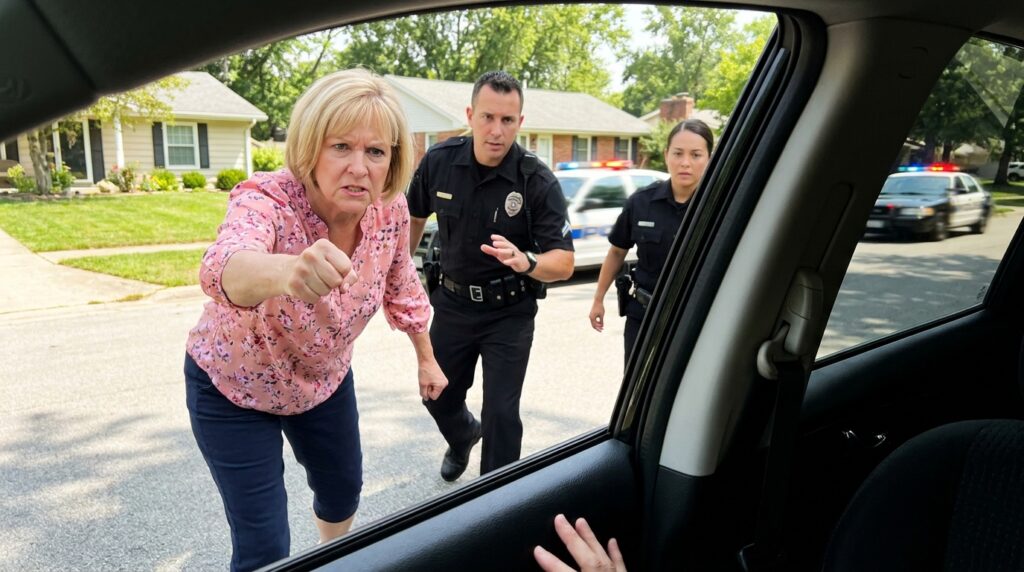
Evelyn’s knuckles scraped against the sun-baked grit of the driveway as she pulled the scattered white sheets inward, her fingers twisting and tearing the edges in her rush to clamp them beneath her chest. Her pink floral blouse was dark with sweat across the spine now, the bright fabric smeared with a gray streak of oil from where it had brushed my front tire during her lunge.
“Ma’am, sit back on your heels and keep your hands flat on the concrete,” the responding officer commanded, his tone dropping into a lower, heavier register that vibrated through the floorboards of my cabin. He didn’t bend down to help her. His shadow stayed wide, fixed, and unyielding across her shrinking frame, his black leather-gloved palm dropping low to hover four inches above her shoulder—not touching her, but setting a ceiling she couldn’t cross.
“They’re not public,” she choked out, her face tilted toward the dirt, her stiff blonde bob finally unraveling as graying strands hung damp against her temples. “The audit isn’t final until the third quarter. The president said if we cleared the outstanding easement infractions on the western circle, the committee would extend the grace period before the lien was recorded at the county seat.”
I shifted my weight toward the passenger seat, my eyes fixed on the single green sheet that had escaped her frantic sweep. It lay face-up against the base of my front tire, held down by the dead weight of a chunk of road gravel. The blue-white beam of Officer Miller’s tactical flashlight passed over it once, illuminating the stark, legal block text that outranked any neighborhood warning. It was a formal corporate foreclosure notice from the subdivision’s own developer-backed master association, demanding immediate satisfaction for a balance totaling five digits, or the immediate vacancy of the plat.
The decoy of her petty clipboard kingdom had cracked completely open. She wasn’t fighting for the integrity of the cul-de-sac’s setback rules; she was an asset-trapped resident weaponizing the board’s architectural guidelines to save her own home from the very institution she pretended to represent.
“Vance,” the responding officer said, his voice cutting through the dry, mechanical idle of the cruisers behind him. He didn’t turn his head away from Evelyn, but his eyes shifted slightly toward the open gap in my window. “You have the certified survey plat from the June filing. Does that document explicitly note the legal boundary coordinates for the western common-use easement?”
“Section Three, page four,” I answered, my voice steady, stripped of any transactional filler. “The registrar marked the original iron datum pins. The boundary doesn’t slide based on committee grace periods. Her rear fence encroaches thirty-six inches onto my deeded property line, and the common-use easement ends at the concrete curb stamp behind her shoulder.”
Evelyn let out a low, ragged sound—a dry, rattling breath that sounded like a shovel striking gravel. Her fingers lost their tension, her palms slipping against the crumpled white parking logs she had spent three months compiling. “If the fence comes down, the appraisal drops below the secondary mortgage threshold. The bank won’t carry the gap if the square footage drops.”
Officer Miller didn’t look back down at the boxwood hedge. She stepped around the front fender, her heavy utility boots clicking with a slow, deliberate cadence that ended right beside the fallen green paper. She bent at the waist, her stiff leather duty belt groaning under the movement, and pinched the edge of the corporate notice from beneath the stone.
“Officer,” Evelyn whispered, her chin trembling as she looked up through her tangled hair at the responding officer’s unyielding cap line. “We can settle this within the committee. It’s a internal administrative matter. The police don’t have jurisdiction over the architectural covenants.”
“We don’t enforce the covenants, ma’am,” the officer said, his hand remaining low, his shadow dark enough to turn the pink of her blouse into a muddy purple. “But we do enforce the penal code regarding criminal trespass, physical intimidation, and the falsification of municipal civil records to slide a boundary line. Officer Miller, call the county supervisor’s office to verify the active civil filing on this plat.”
The female officer didn’t answer with words; she simply reached for the small, black radio pinned to her shoulder strap, her thumb hitting the toggle with a sharp, static click that cut through the midday heat like ice.
Evelyn stayed on her knees, her empire of violation sheets pinned beneath her shins, completely displaced from the window frame she had tried to trap me in. The absolute final truth of what she had hidden behind her clipboard was laid bare on the hot asphalt, but as Officer Miller’s radio began to hum with the supervisor’s incoming data, a new name crackled through the small speaker—one that didn’t belong to Evelyn, and didn’t belong to the local association board.