CHAPTER 3: THE PULSE ON THE ASPHALT
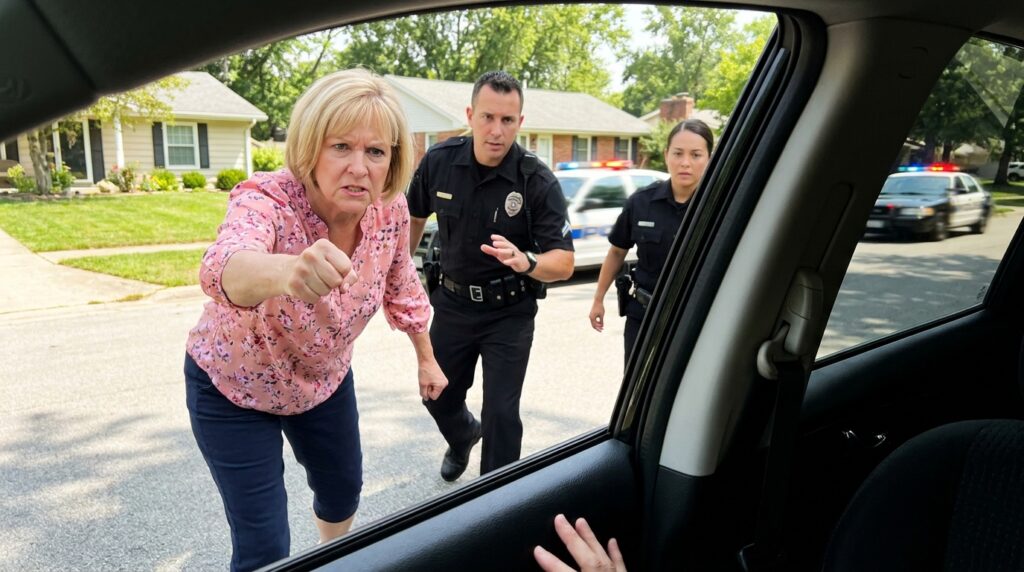
“Keep your hands right where I can see them on that frame, ma’am,” a new voice commanded from behind the vehicle. It was flat, unhurried, and carried the heavy weight of someone who spent ten hours a day climbing in and out of a utility cabin.
Evelyn didn’t move. Her shoulders pulled inward, the stiff, lacquered blonde bob tilting forward as if she could hide her profile from the rearview mirrors. The flashing lights from the two cruisers parked at the mouth of the cul-de-sac were already beginning to wash out the noon-day glare, turning the dry dandelion heads on the parkway into tiny, violet targets. The rhythm of the strobe was a silent, relentless metronome against the neighborhood’s brick facades.
I shifted my weight slightly, my fingers easing off the smartphone screen but keeping the lens angled perfectly through the gap. In the door mirror, the tall silhouette of the responding officer solidified. His black uniform looked heavy, thick with the density of synthetic weave and the iron bulk of a duty belt that clicked with every deliberate step. Behind him, a second officer—a woman with her dark hair pinned flat against her skull—moved along the outer rim of the driveway, her palm resting naturally on the butt of her holster.
“He’s overlapping the easement, Officer,” Evelyn said quickly. The nasal frequency of her voice was gone, replaced by a brittle, defensive register that cracked around the consonants. She didn’t let go of the weather stripping; her fingers seemed stuck to the black rubber trim like iron filings to a magnet. “I have the log sheets right here. Twelve feet from the shared boundary line. Section Four clearly dictates that no commercial displacement—”
“Ma’am, I didn’t ask about the log sheets,” the responding officer interrupted. He stopped two feet from her elbow, his frame wide enough to block out the remaining sunlight on the passenger side. His clean-shaven jaw was set, his skin gray under the shadow of his uniform cap. He didn’t look at her paper folder. His eyes were locked entirely on her right hand, the knuckles still white against my door frame. “I asked you to keep your hands still. Sir, roll the window down far enough so we can communicate.”
I tapped the toggle. The glass dropped four more inches with a heavy, mechanical groan, letting in the full, unvarnished roar of the cruiser engines idling thirty feet away. The heat inside the cabin vanished instantly, swallowed by the harsh smell of unburned diesel and the parched scent of the neighborhood’s over-treated dirt.
“State your name for the log, please,” the officer said, looking past Evelyn’s shoulder directly into the dark interior where I sat.
“David Vance,” I said. My voice sounded flat in my own ears, entirely clear of the frantic velocity that was currently vibrating through Evelyn’s frame. “I’m parked inside my deeded boundary. My front tires are clear of the common asphalt by eighteen inches.”
Evelyn let out a sharp, wet hiss through her teeth. “He’s using old plat data from the ninety-eight widening. He knows the architectural committee revised the setback requirements when the north ridge drainage was put in. The fence line has been established for twenty-six years!”
The female officer stepped into the gap near the front fender, her boots crunching over a small pile of dried lawn clippings. She didn’t look at Evelyn either; she looked down at the base of the boxwood hedge where the rusted brass benchmark sat wedged beneath the roots. Her hand moved to her utility belt, pulling a small, heavy tactical flashlight from its sheath. She clicked it on, the blue-white beam cutting through the midday heat to illuminate the green oxidation on the ancient metal pin.
“Officer Miller, check the curb stamp,” the responding officer said, his voice remaining down in that low, professional register that treated every suburban crisis like a broken piece of concrete.
I reached forward with my left hand, keeping my movements deliberate and visible to both pairs of eyes outside. My fingers hooked into the plastic latch of the passenger-side glove box. It dropped with a soft, weighted click, revealing the thick, blue-bound folder issued by the county registrar’s office three weeks ago. The paper inside was heavy, the ink smelling of stale toner and the dry cellar where the municipal records were kept.
“I have the certified copy of the plat map right here,” I said, my voice steady against the low thrum of the engine beneath my feet. “The one that shows the three-foot encroachment on her side of the current vinyl barrier.”
Evelyn’s hand finally left the weather stripping, her arm dropping to her side as if the bone had suddenly lost its density. Her clipboard tilted, a single white sheet slips from the zinc teeth and drifting down toward the hot asphalt. She looked down at the paper, then back at the rusted brass stake in the mud, her mouth working silently as if she were trying to find a rule in the bylaws that could rewrite the physical placement of the earth.
“That map doesn’t account for the lean,” she muttered, her voice so low it was nearly swallowed by the vibration of the cruiser’s radiator fan. “The board knows about the lean. They promised it would stay private.”
The responding officer took one step forward, his boot pinning the fallen sheet of paper to the driveway before the hot breeze could carry it across the lawn. He didn’t pick it up. He just looked at her, his head tilting slightly as he read the pale, sweating lines on her face.