
CHAPTER 3: THE FORGED BLUEPRINT
Officer Miller didn’t look up from his vinyl clipboard as Mark approached the foot of the driveway. The summer sun was beating down on the blacktop, radiating waves of dry, oppressive heat that made the asphalt smell like fresh tar.
“I have a formal civil nuisance complaint,” Miller said, his thumb flicking against the steel clip. “Dumping of heavy waste into an active stormwater easement, along with unpermitted earthworks blocking a designated watershed flow.”
“There is no easement on my south boundary,” Mark said, stopping four feet short of the officer’s front bumper. His hands were loose at his sides, the mason jar resting in his right palm like a piece of cold ammunition.
Evelyn took a step forward, smoothing the front of her white blouse with two manicured fingers. She produced a folded sheet of heavy, yellowed paper from under her arm—a document that looked older than the neighborhood itself.
“Officer,” Evelyn said, her voice dripping with practiced, civic concern, “Mr. Miller is mistaken. When the Oakridge division was platted in 1998, a six-foot public utility and drainage corridor was established right along his south line. He’s been digging up the ditch line all morning, causing toxic runoff from his yard to back up onto my property. I had to clear the overflow myself just to keep it from seeping into my foundation.”
She unfolded the paper with a sharp, crisp snap, holding it out for Miller to inspect.
Mark stepped closer, his eyes narrowing as he scanned the ink lines. It was a municipal blueprint map—or a very convincing copy of one. Bold blue lines traced the boundaries of Lots 12 and 13, and right along the dashed line representing the cedar fence was a shaded hatch mark labeled 6′ PUBLIC DRAINAGE EASEMENT – COUNTY REG #98-402. At the bottom corner sat an official-looking circular rubber stamp in faded red ink, bearing the county engineer’s seal.
Miller leaned in, squinting at the stamp. “Looks like a registered conveyance, Mr. Miller. If you’ve been filling in a drainage trough on a recorded easement, that’s a Class B civil violation with an immediate cease-and-desist order.”
Mark didn’t reach for the paper. He knew every inch of his deed. He knew every line item, every tax parcel map, and every survey marker recorded in the county courthouse when he bought the house five years ago. There was no easement. There had never been an easement.
“May I see the stamp date?” Mark asked, his voice steady as a plumb line.
Evelyn’s grip on the edge of the paper tightened slightly, her knuckles turning pale against the yellowed margin. “It’s a certified copy from the 1998 master filing, Officer. He has no right to question official county records.”
“Hold it steady, ma’am,” Miller grunted, pulling a small magnifying loupe from his breast pocket. He leaned down, placing the lens an inch from the red ink seal.
Mark watched Evelyn’s jaw muscles flex. She wasn’t sweating, but her breathing had shifted—shallow, tight, and controlled.
“This stamp,” Miller murmured, rubbing his thumb over the red ink, “the ink isn’t offset. It’s an inkjet print on heavy bond paper. And the county engineer signature at the bottom… Harvey Vance didn’t take office until 2004.”
Evelyn pulled the document back with a quick, defensive snap of her wrists, folding it in half before Miller could take a second look. “It’s a working reference draft provided by the original developer’s estate,” she insisted, her voice rising half an octave. “The point is the water flow, Officer! He redirected the water! He dumped soil, and I had to push the sludge back onto his side before it ruined my lawn!”
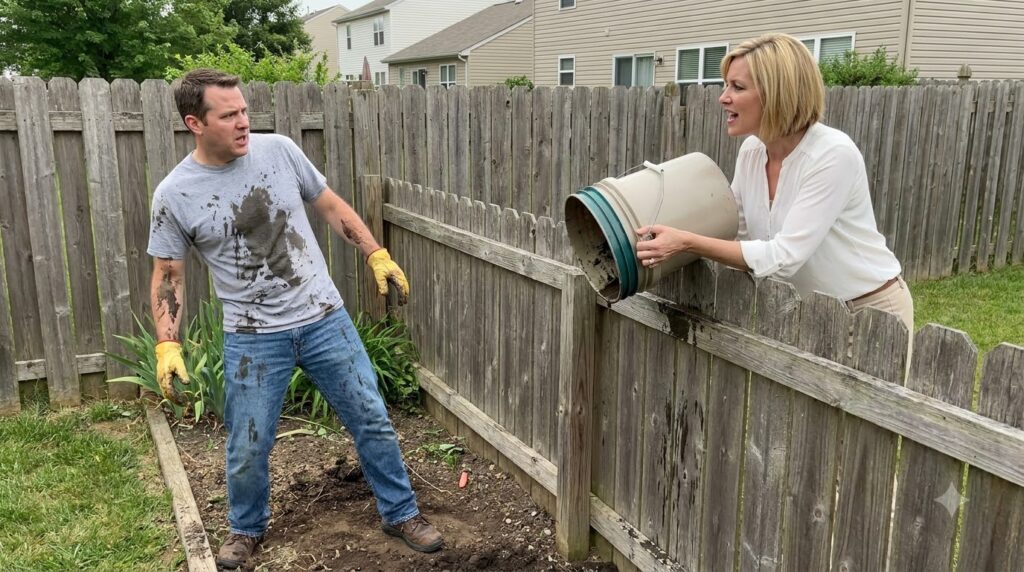
“You didn’t push anything back, Evelyn,” Mark said, stepping into her line of sight. He held up the mason jar. Under the harsh sunlight, the dark liquid inside separated into two distinct layers—a murky black sediment at the bottom, and a thick, iridescent golden sheen floating on top. “You carried two nested buckets of used motor oil mixed with stagnant gutter water from your garage, lifted them over my cedar fence, and dumped them directly onto my chest while I was kneeling in my garden.”
Evelyn’s eyes flashed with cold, sharp malice. “That’s an absurd lie! You’re trying to cover up your illegal excavation!”
“Officer Miller,” Mark said, ignoring her completely, “I have dual 4K security cameras under my eaves. They record at sixty frames a second with full directional audio. The entire incident—from the moment she walked up to the fence with the buckets to the moment she told me to ‘learn to stay on my side’—is saved on a local drive.”
Miller looked from the mason jar in Mark’s hand to the folded blueprint tucked under Evelyn’s arm, then back to Mark’s unreadable face. The tired, bureaucratic routine had evaporated from the officer’s eyes, replaced by the grim realization that he had walked into a legal landmine.
“Show me the footage,” Miller said.
“Follow me to the side yard,” Mark replied, turning on his heel. “And you might want to call Deputy Callahan from the sheriff’s department while we walk. Because this isn’t a code dispute anymore—it’s a crime scene.”








