CHAPTER 2: THE GREASE AND THE DEED
The rusted washer felt cold and sharp against Mark’s bare palm. It wasn’t an accidental pebble from a compost pile or gravel from a garden path. It was a half-inch galvanized lock washer, coated in a thick, tacky film of black engine grease that smelled of scorched petroleum and old iron.
He didn’t drop it. He carried it into the garage, his boots making heavy, damp thuds on the stained concrete floor. He placed the washer on his workbench under the harsh white glare of an overhead LED strip, right next to the brass casing of his digital caliper.
Outside, the neighborhood returned to a brittle, deceptive quiet. A lone crow called from the power lines over the cul-de-sac, but the space beyond the cedar fence remained dead air. No buckets clattered. No doors slammed. Evelyn was already indoors, likely sitting behind her polished mahogany desk with a cup of herbal tea, reviewing whatever unwritten rule she believed gave her domain over the earth.
Mark pulled off the ruined gray T-shirt, dropping it into an empty steel bucket. The dark stain on his chest was already drying into a stiff, dark crust that smelled faintly of sulfur and burnt oil. He grabbed a rag soaked in mineral spirits and wiped the dark film from his ribs and forearm. The solvent stung where the grit had chafed his skin, the sharp friction bringing a dull, steady warmth back to his muscles.
He didn’t waste time on anger. Anger was a useless engine—it burned dirty and ran hot without turning a single gear. Instead, he pulled up his workstation monitor on the corner bench, bringing the home security interface out of sleep mode.
The local server interface was clean, devoid of unnecessary clutter. He navigated straight to the timestamped file from twenty minutes prior: Cam_02_SouthBoundary_1432.mp4.
He hit spacebar. The 4K feed was razor-sharp, captured at sixty frames per second under the unblinking glare of afternoon light.
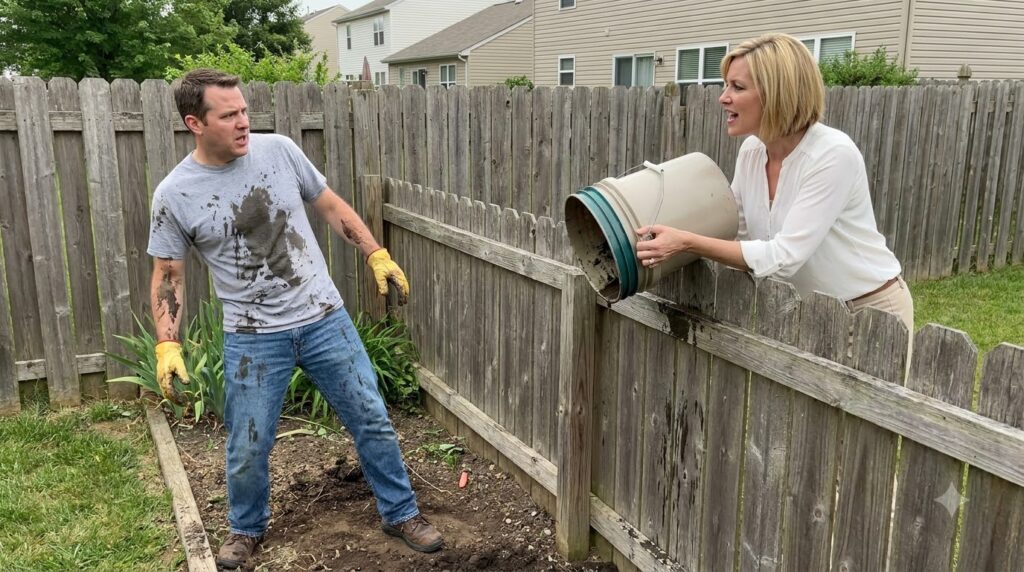
On screen, Mark saw himself from the high eaves—crouched in the dark dirt, quiet, working with the steady rhythm of a man who measured his life in quiet labor. Then came the shadow. Evelyn’s blonde hair caught the sun first, followed by the white fabric of her blouse. She didn’t stumble. She didn’t trip over a root or struggle with a heavy load. Her movements were deliberate, rehearsed, and swift. She hauled the nested plastic buckets over the cedar rail with a sharp, levering motion of her elbows, aiming directly for his upper torso before tipping the lip.
Mark paused the frame at 14:32:08.
The stream of sludge was mid-air, a dark, viscous curtain suspended in the sunlight. Droplets bounced off the top of the fence post. He zoomed in 300 percent. The resolution held up, revealing the interior of the primary bucket. It wasn’t garden soil mixed with rain. The bottom of the white bucket was coated in a dark, sludge-thick residue with distinct rainbow sheens running through the slurry—hydrocarbons.
He pressed play. The audio captured every decibel. The heavy slap of the waste hitting his gray shirt, the rattle of the plastic handles, and then Evelyn’s voice, clear as a bell: “Maybe now you’ll learn to stay on your side of the fence!”
Mark clicked export, saving three separate copies—one to the local encrypted drive, one to a hardened offsite cloud partition, and one to an external thumb drive he pulled from his desk drawer.
He stood up, pulled a fresh black cotton shirt over his head, and walked back out onto the patio. The air was turning cooler as the sun dipped behind the western pines, casting long, sharp shadows across the grass. He walked down the side path to the garden bed, his eyes scanning the ground.
The dark waste had pooled in the loose, tilled earth where he meant to plant his native clover and shrubs. The soil beneath it was ruined for the season; the oil would leach down into the root layer if he didn’t excavate it immediately. But as he bent down with a clean flathead trowel to scrape a sample into a glass mason jar, he noticed something else.
Along the base of the cedar fence posts, two inches above the turf, were three small, fresh drill holes. The wood around the holes was bright, pale, and unweathered, small piles of sawdust clinging to the grass blades below.
Evelyn hadn’t just dumped waste over the fence. She had been boring into the support posts from her side of the line.
A soft crunch of gravel echoed from the front driveway. Mark didn’t jump. He capped the mason jar, tightened the metal ring with a mechanical click, and walked slowly around the corner of the garage to see who had arrived on his ground.
A white county code enforcement sedan was idling near the curb, its yellow roof bar dark but present. The driver’s door opened, and a officer in a tan uniform stepped out, a thick vinyl clipboard gripped in his left hand. Behind him, stepping off her front porch with the smooth, practiced stride of a woman about to deliver a verdict, was Evelyn.
“Mr. Miller?” the officer called out, his voice flat, tired, and accustomed to suburban misery. “Code Enforcement Officer Miller. We received a priority report regarding an unpermitted hazardous earthworks obstruction blocking a municipal drainage corridor.”
Evelyn stopped three paces behind the officer, her hands folded neatly over her stomach, her face a mask of solemn, civic duty.
Mark stood on his driveway, the glass mason jar in his hand, his eyes locking onto hers with the cold, unyielding weight of iron.