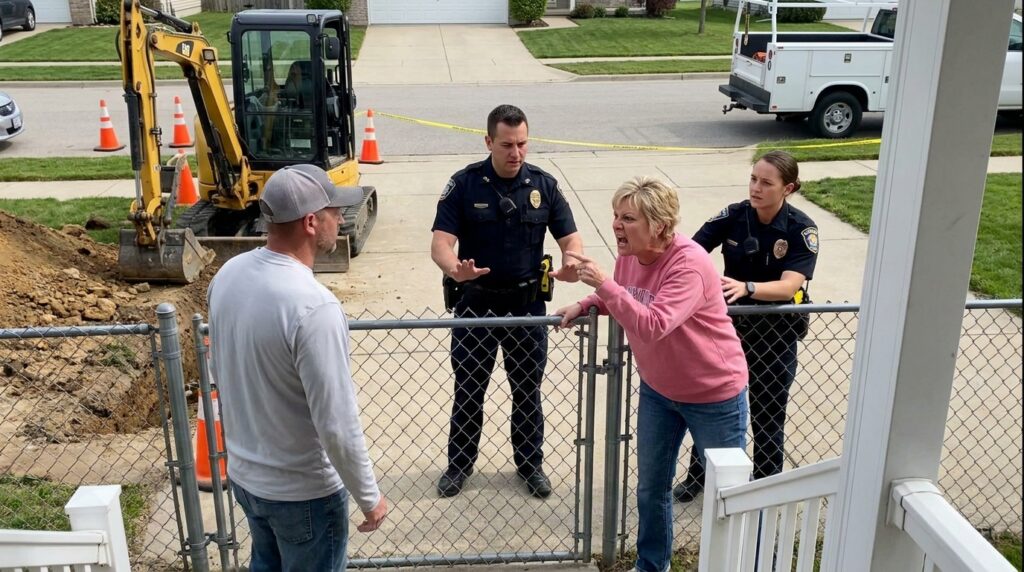
CHAPTER 7: THE UNYIELDING EARTH
The heavy steel bucket bit again, six inches deeper into the exposed red clay. A low, shuddering vibration traveled through the asphalt of the driveway, straight into the thick rubber soles of Artie Miller’s work boots.
He didn’t move away from the chain-link gate. He watched the bucket teeth hook under a massive section of crushed, rusted corrugated pipe—the fifty-year-old steel culvert that Harold Vance had tried to claim, cover up, and control with forty feet of illegally poured asphalt and a hand-drawn paper sketch.
With a slow, wet suction noise, the hydraulic arm swung upward, lifting the corroded metal pipe free from the trench. Black, stagnant water that had been trapped behind the blockage for eighteen months suddenly found its channel. It surged forward through the newly cleared gravel bed, flowing clean, fast, and unhindered down toward the township catchment basin at the end of Oak Ridge Lane.
“Look at that pipe,” Marcus called out from the cab, his hand resting on the throttle as he lowered the bucket. “It was ninety percent collapsed, Artie. Another heavy rain, and her entire front lawn would’ve washed into your basement.”
Artie didn’t answer right away. He stood quietly, his gray cotton shirt catching the crisp morning breeze, his hands tucked loosely into his back pockets. The yellow plastic job folder sat safely on the hood of his truck, the stamped 1994 county plat map gleaming under the clear suburban sunlight.
Across the property boundary, forty feet back on her front porch, Evelyn Vance sat on a green wicker chair. She was still wearing the bright pink fleece sweatshirt, but her posture was no longer pitched forward in aggressive challenge. She sat stiffly, her hands folded over the yellow citation slip resting on her lap.
Her front screen door clicked open. Mrs. Gable walked down her own driveway from across the street, holding a glass jar of cold water. She didn’t look toward parcel forty-two. She walked straight past the yellow caution tape, stopping three feet from Artie’s gate.
“Morning, Artie,” Mrs. Gable said quietly, setting the jar on the flat wooden fence post. “Looks like the water’s moving again.”
“Morning, Clara,” Artie replied, nodding once toward the jar. “It’s moving. Line’s clear.”
“Good,” she said, her eyes shifting for a fraction of a second toward the pink fleece sitting motionless on the porch across the fence line. “We’ve needed this line open since ninety-eight.”
She turned and walked back across the street without another word. There was no victory speech, no triumphant shouting, no viral spectacle for the cul-de-sac to chew on. There was only the steady, unyielding sound of water running through a proper drainage channel, guided by thirty-year-old stamped paper and three inches of blue spray paint.
Artie walked over to his utility truck, picked up the yellow weather-resistant folder, and zipping it tight, placed it behind the bench seat of his cab. The 1994 municipal deed would go back into the steel filing cabinet in his home office, right where it belonged—ready, preserved, and completely indifferent to whoever tried to claim the dirt above it.
He stepped back toward the trench where the crew was already laying down the new three-foot concrete drainage conduit.
“Get the gravel bedding level first, Marcus,” Artie said, adjusting the brim of his gray cap as he looked down at the exposed earth. “The dirt doesn’t care about complaints, complaints don’t move water, and a paper in a fence post doesn’t change who holds the deed.”