CHAPTER 3: THE OBSTRUCTION AT THE CURB
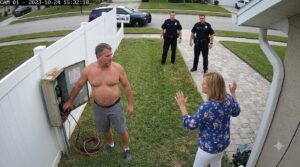
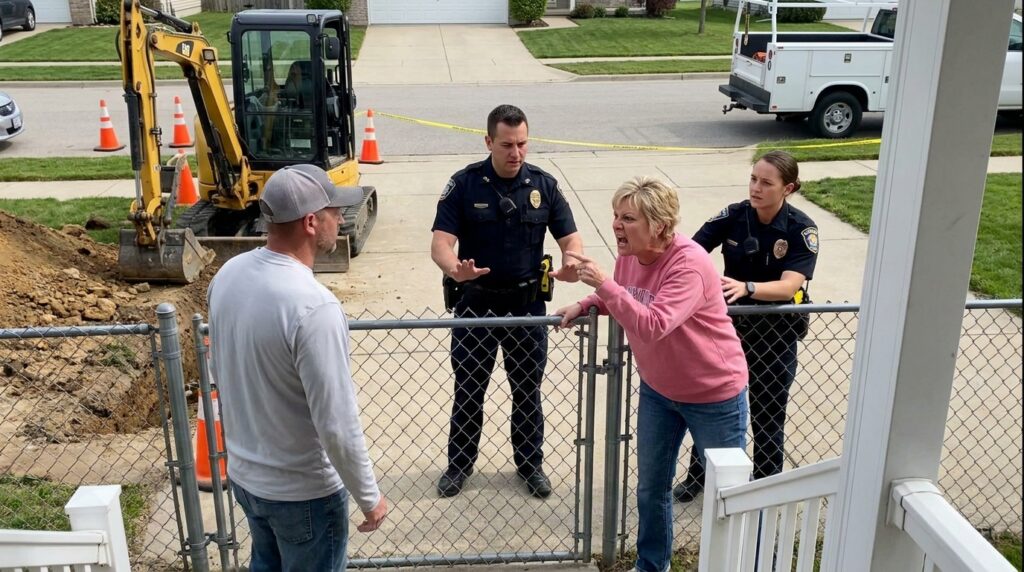
Officer Daniel Reyes swung his boots out of the cruiser before the engine had fully died, the heavy click of his utility belt signaling the arrival of a trained spatial boundary. He adjusted his dark cap with a single movement, his eyes already sweeping the narrow throat of Oak Ridge Lane—taking in the idling yellow excavator, the blue spray paint cutting across the asphalt, and the bright pink fleece sweatshirt moving at a fast clip toward his front bumper.
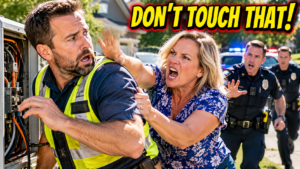
“Officer! Thank God you’re here,” Evelyn called out, her voice dropping an octave into a forced, breathless cadence as she reached the edge of the driver’s side door. “I called dispatch five minutes ago. They’re attempting to breach my property boundary without authorization. Look at this work zone—there’s no safety setback, no official township signage, and they’re threatening to tear up my driveway!”
Reyes didn’t immediately respond. He stood to his full height, his solid frame blocking her path to the curb while his partner, Officer Sarah Chen, stepped out from the passenger side, her eyes scanning the perimeter with disciplined neutrality.
“Ma’am,” Reyes said, his voice flat, low, and anchored in procedural routine. “Step back from the vehicle door, please. Give us room to clear the roadway.”
Evelyn blinked, her forward momentum checking against his posture, but she didn’t retreat. Instead, she pivoted, pointing a sharp, rigid finger back toward the white utility truck parked three feet off the curb line. “That truck is parked over my drainage outlet, Officer. They didn’t just bring heavy machinery onto a residential street; they’re actively obstructing my right-of-way. Tell that man to turn off the engine before he damages my foundation.”
At the truck bumper, Marcus held his clipboard against his chest, his jaw set as he looked to Artie for cueing.
Artie didn’t rush forward. He moved with the deliberate, slow gait of a man who knew that in any land dispute, the first person to run was the first person to look guilty. He walked down the incline of his driveway, his steel-toed boots making a dry, crunching sound against the loose gravel at the boundary line. He held the yellow plastic folder flat against his thigh.
“Morning, Officer,” Artie said, stopping two paces short of the caution tape Evelyn had ripped down. “I’m Arthur Miller. It’s my property permit on the line.”
“Artie,” Reyes acknowledged with a brief nod. He had worked the township sector long enough to know Artie’s background—thirty years with the water authority meant Artie knew the underground utilities better than the county engineers who drew the maps. Reyes turned back to Evelyn, his hands resting lightly near his duty belt. “Ma’am, Mr. Miller called in the underground utility locator two days ago. Dispatch has a record of the work ticket.”
“A work ticket is not a deed, Officer!” Evelyn’s voice climbed back into its sharp, strident register. She pulled a folded piece of paper from her fleece pocket—a worn, yellowing copy of the hand-noted 1999 amendment her late husband had drawn up. She shoved it toward Reyes’ chest. “Look at the survey markers! Harold recorded this private maintenance line with the clerk in ninety-nine. Parcel forty-two holds exclusive drainage maintenance rights over this entire five-foot strip. He has no right to put a trenching bucket into this ground without my signed release!”
Reyes took the paper, unfolding it with a single hand while Chen stepped in closer, her boots quiet against the pavement, positioning herself subtly between Evelyn and the open driver’s cabin of the excavator. Reyes skimmed the shaky, blue-ballpoint lines—the hand-drawn arrows pointing to the chain-link post, the neatly lettered note claiming private jurisdiction.
For a long second, the only sound on Oak Ridge Lane was the low, rhythmic thud of the diesel engine idling in the driveway.
Artie watched Reyes’ eyes track across the paper. He knew what Reyes was seeing: a document that, on its face, looked like a legitimate property covenant. It had a signature. It had a date. To an officer trying to keep the peace on a Tuesday morning, it presented just enough legal ambiguity to make him consider calling a halt to the job until the civil courts could sort it out.
“This note mentions a private maintenance agreement, Artie,” Reyes said, his thumb resting on the corner of the faded paper as he looked up. “Does the township have a record of this ninety-nine amendment on the master plat?”
Evelyn leaned in, a tight, triumphant smile touching the corners of her mouth. “It’s on file at the municipal building, Officer. My husband made sure of it. If Miller touches that asphalt today, he’s committing willful property destruction under an active covenant.”
Artie didn’t lose his temper. He reached into his yellow plastic folder, his fingers sliding past the blue-ink 1994 plat map to pull out a second piece of evidence—a high-resolution photo he’d taken forty-eight hours ago.
He held it out to Reyes. The photo showed the base of the chain-link fence post, where the dirt had been scraped away to reveal a notched steel survey pin driven deep into the ground, buried two inches beneath a thin layer of settled asphalt.
“That pin was driven by the county surveyor in June of ninety-four, Officer,” Artie said, his voice as unyielding as the iron marker in the photograph. “Harold drove his fence post four inches inside the municipal line to avoid paying for a professional land boundary survey. That paper in your hand isn’t a recorded covenant. It’s a private sketch that was never ratified by the board—because you can’t record an amendment over a dedicated public easement.”
Evelyn’s face paled, the triumphant smirk vanishing as her eyes locked onto the photograph in Reyes’ hand.
“That’s a lie,” she breathed, her voice cracking as she took a half-step toward Artie. “He took that photo on my side of the fence! He was trespassing!”
“Reyes,” Chen interrupted quietly, her radio crackling softly at her shoulder as she gestured toward the driveway entrance. “We’ve got a line of cars backing up behind the utility rig. We need to clear this lane or lock the site down.”
Reyes looked from the hand-drawn 1999 paper to the photograph of the notched steel pin, then directly at Evelyn. The air between them tightened, the quiet, technical reality of county boundaries pushing hard against twenty years of loud suburban illusion.
“Ma’am,” Reyes said, his tone dropping into an absolute, unyielding line. “I need you to step off the driveway asphalt and stand behind the curb line right now while I verify this plat number with dispatch.”
Evelyn didn’t move. Her hands curled into tight, white-knuckled fists at her sides, her chest heaving as she glared at the idling excavator. “I am not moving an inch until that machine is turned off.”