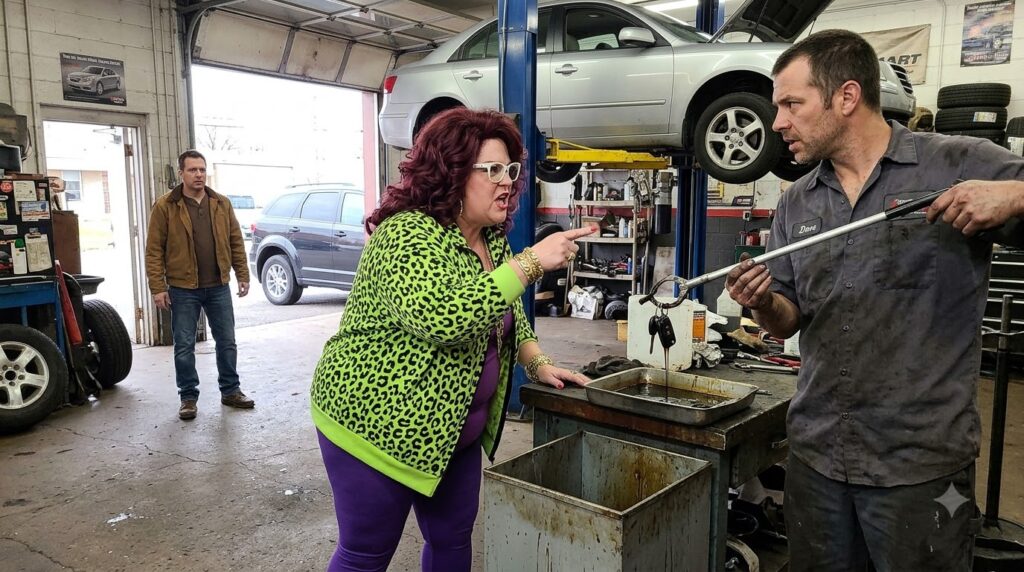
Chapter 6: A Pattern Nobody Had Connected
The woman who called Mercer Auto Repair on Monday morning introduced herself as Margaret Bennett.
She was sixty-three and managed a small neighborhood hardware store about three miles away.
She had seen the security footage circulating online.
More importantly, she recognized Patricia Caldwell.
Margaret asked whether she could speak privately with Thomas Mercer.
Thomas had known Margaret for years. Their businesses belonged to the same local merchants association.
He invited her to stop by.
She arrived shortly before lunch, carrying a folder.
After greeting Thomas, she explained why she had come.
Six months earlier, Patricia had entered her hardware store demanding an immediate refund for a pressure washer purchased several weeks before.
The machine had been used extensively and returned without its original packaging.
The store’s policy required an inspection before approving a refund for used equipment.
Patricia refused to wait.
She shouted at an employee, accused the store of discrimination, and threatened to post negative reviews.
Margaret eventually reviewed the purchase records and offered the remedy permitted under the store’s policy.
Patricia rejected it.
The next day, a negative online post appeared accusing the hardware store of deliberately cheating older customers.
Margaret had saved screenshots.
Two months later, a similar dispute occurred at a family-owned appliance repair business.
Patricia demanded that a technician abandon scheduled appointments to inspect her refrigerator.
When the owner refused, she threatened to report him for unsafe business practices.
Margaret had learned about that incident through the merchants association.
She was careful not to claim that every accusation Patricia made was false.
But the repeated pattern concerned her.
Patricia seemed to believe that public embarrassment was a legitimate way to force small businesses into giving her priority.
Thomas listened quietly.
He recognized the pressure.
Small business owners often depended on goodwill and local recommendations.
A single public accusation could cost them customers before anyone investigated whether it was accurate.
Margaret opened her folder.
“I brought these because I thought you should know this wasn’t the first time.”
Daniel looked through the screenshots.
The language was strikingly similar.
In each dispute, Patricia described herself as a mistreated customer.
In each, she accused the business of disrespect.
In each, she demanded an immediate concession.
Daniel felt angry.
But he also understood that past disputes would not automatically prove what happened in his garage.
Fortunately, he already had direct evidence of that.
He thanked Margaret and asked permission to share her information with his attorney.
She agreed.
That afternoon, Daniel met with the attorney to discuss the growing case.
The attorney explained that the earlier incidents might help them identify potential witnesses or understand the broader dispute, but their strongest evidence remained the security video, repair invoices, police report, and documented financial losses.
The key issue was straightforward.
Patricia had intentionally interfered with another customer’s property.
Her actions had caused expenses.
Then she had made accusations that appeared inconsistent with the recorded events.
Daniel asked whether the shop should sue her.
The attorney advised patience.
First, they would seek reimbursement for the key replacement and related costs.
They would also formally dispute her allegations and request that she stop making unsupported claims about the shop.
If the situation escalated, they could evaluate additional legal remedies.
Thomas supported the approach.
He wanted accountability, not a public feud.
But Patricia was not finished.
Two days later, a complaint arrived through a state consumer protection channel.
It repeated her claim that Mercer Auto Repair had refused to perform an emergency repair and had treated her unfairly.
The complaint required a response.
Daniel spent another evening organizing records.
He included the appointment schedule, the shop’s written service procedures, the police incident number, and the security footage.
He also provided a factual timeline showing that Patricia had never authorized a diagnostic service or left her SUV for repair.
By the time he finished, the garage was dark.
Thomas sat across from him at the office desk.
The older man looked exhausted.
“Sometimes I wonder if keeping this place open is worth it.”
Daniel looked up sharply.
His father had never said that before.
Thomas stared toward the service bay.
“I built this business because I wanted to work for myself and treat people fairly. I never imagined we’d spend more time defending our reputation than fixing cars.”
Daniel felt something shift inside him.
For years, he had thought of the garage as his father’s achievement.
Now he understood that preserving it would require more than repairing vehicles.
It would require standing up for the values that had built it.
He reached across the desk and closed the folder.
“We’re not letting one person decide what this place stands for.”
Thomas studied his son.
Then he nodded.
The following week, Patricia received a formal demand for reimbursement.
She refused to pay.
And the dispute moved toward court.