Chapter 5: When the Trouble Followed Him Home
Robert Ellis had spent twenty-three years working for the same regional distribution company.
He began on the loading dock, became a forklift operator, and eventually moved into warehouse supervision.
He was not wealthy.
He and Linda lived in a modest brick house with a small backyard, a vegetable garden, and a mortgage they were finally close to paying off.
They had raised two children there.
Their oldest son lived in Ohio with his wife and young daughter. Their youngest, Emily, was twenty-one and attending community college while working part-time.
Robert valued privacy.
He did not post much online. He avoided arguments with strangers. He believed that a person’s home and workplace should remain separate from unnecessary public conflict.
Patricia Caldwell apparently disagreed.
After the security footage appeared online, she had begun searching for information about the people involved.
Someone in a neighborhood discussion had mentioned that Robert worked at a distribution warehouse.
Patricia found the company’s public phone number and called its front office.
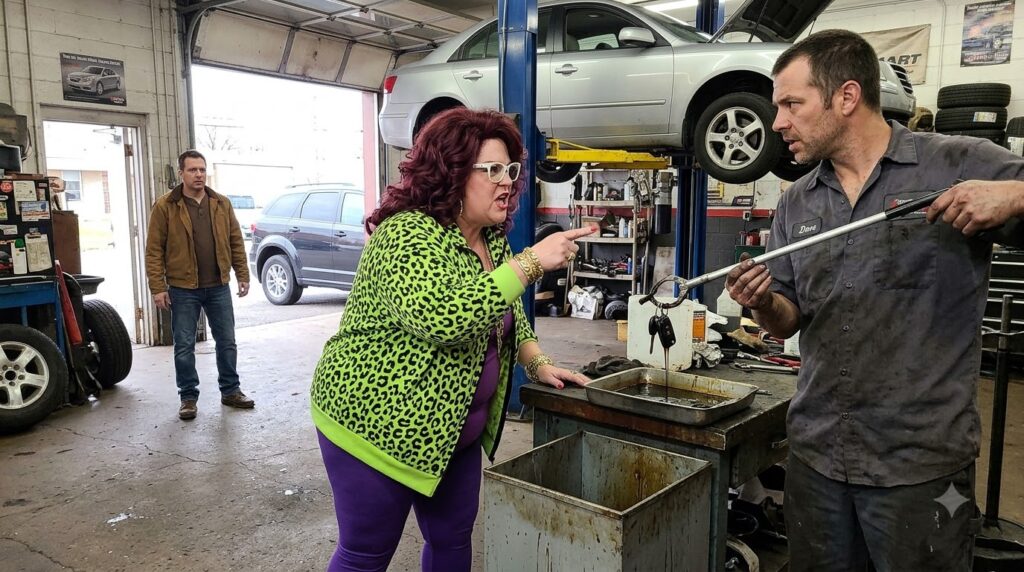
She claimed Robert had threatened her during an incident at an auto repair shop.
She demanded that his employer investigate his behavior.
The receptionist transferred the message to human resources.
Fortunately, Robert’s supervisor knew him well.
He had worked alongside Robert for more than a decade and found the accusation inconsistent with his character.
Still, company policy required the complaint to be documented.
Robert was asked to provide a written account.
He spent part of his lunch break explaining an incident that had nothing to do with his job.
That angered him more than the ruined key.
A stranger had interfered with his family’s transportation.
Now she was interfering with his livelihood.
When Robert told Linda what had happened, she sat quietly at their kitchen table.
Then she asked whether Patricia knew their home address.
Robert didn’t know.
The question unsettled him.
Linda had been recovering from a knee replacement and was still attending physical therapy.
The last thing she needed was a stranger appearing at their front door.
Robert contacted Officer Hayes and reported the workplace complaint.
Hayes explained that he should preserve any messages, screenshots, or records of unwanted contact.
She also advised him to call police if Patricia threatened him or appeared at his home.
Robert followed that advice.
He saved the social media posts and asked his employer to retain the complaint.
Then he called Daniel.
Daniel listened, increasingly troubled.
The original incident had been outrageous enough.
Now Patricia was attempting to shift the consequences onto the person whose property she had damaged.
Daniel apologized for the trouble.
Robert stopped him.
“Don’t apologize for her behavior.”
Daniel appreciated the words.
But the situation was becoming more complicated.
The following morning, Thomas received a letter from Patricia’s attorney.
It demanded that Mercer Auto Repair remove the security footage, issue a public apology, and compensate Patricia for what the letter described as reputational harm.
It also alleged that the garage had refused to address a dangerous mechanical condition in her SUV.
Thomas read the letter twice.
Then he handed it to Daniel.
Daniel felt a familiar tightening in his chest.
Patricia was no longer simply shouting in the driveway.
She was threatening legal action.
The shop’s attorney reviewed the letter that afternoon.
He pointed out that Patricia had no automatic right to immediate service and that the available footage contradicted key parts of her public account.
Still, the attorney warned Daniel not to dismiss the matter casually.
Even a weak claim could consume time and money.
He recommended preserving all records and responding through counsel.
Daniel agreed.
But another issue bothered him.
Patricia had repeatedly claimed that her SUV had a dangerous mechanical problem.
If that were true, she should not have been driving it around town while demanding immediate service from an unwilling garage.
Daniel wondered whether she had taken it somewhere else.
Luis supplied an unexpected answer.
His cousin worked at a nearby tire and service center.
According to him, Patricia had brought the SUV there the previous afternoon.
The shop had performed a preliminary inspection.
Daniel did not ask Luis to obtain private service records.
But he encouraged his attorney to pursue any relevant information through appropriate channels if the dispute proceeded.
Several days later, Patricia’s attorney contacted the shop’s attorney again.
This time, the tone was different.
Patricia had reportedly authorized an inspection at another repair facility.
And the problem with her SUV was not the emergency she had described.
It was a routine maintenance warning.
That discovery raised an uncomfortable question.
If Patricia’s vehicle was never in immediate danger, why had she been so determined to force Daniel to abandon another customer’s repair?
The answer emerged from an unexpected source.