Chapter 5: The Evidence She Never Expected
Karen stared at the laptop.
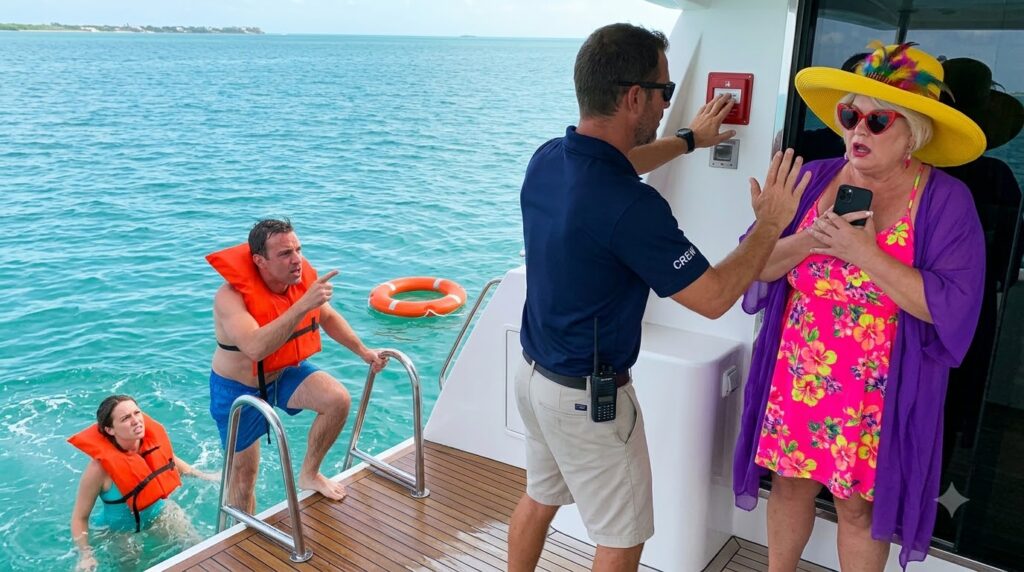
The image showed her standing beside the emergency station.
Her yellow feathered sunhat was unmistakable.
So was the black smartphone in her hand.
Susan Bell sat across the table.
Captain Hale stood nearby.
Marcus had joined them to answer questions about the emergency response.
Susan explained that another passenger had provided footage showing the events before Karen activated the alarm.
Karen immediately demanded to know who had recorded her.
Susan declined to turn the meeting into a dispute about the witness.
The relevant issue was what the recording showed.
Karen insisted that she had never intended to hurt anyone.
Susan acknowledged that intent to injure was different from intent to deceive.
But the evidence clearly showed deliberate deception.
Karen had positioned her camera.
She had removed safety equipment.
She had activated an emergency alarm.
And she had shouted a false warning that caused two people to jump into the water.
Those facts were not in dispute.
Karen shifted in her chair.
Her purple cover-up slipped from one shoulder.
For the first time, her elaborate outfit seemed less like a costume of confidence and more like something she could hide behind.
She tried a different argument.
The passengers had chosen to jump.
Nobody had forced them.
Susan answered carefully.
The passengers had responded to a reported emergency. Their decisions had been made under false information that Karen knowingly supplied.
That was the central problem.
The company would document the incident, review its operating procedures, and determine what further action was appropriate. Any legal consequences would be left to the relevant authorities.
Karen was informed that she would not be permitted to book another excursion with the company.
She was also asked to preserve her recording while the incident was being reviewed.
Karen protested that the company had no right to control her personal phone.
Susan clarified that she was not demanding access to the device or claiming ownership of it.
She was asking Karen not to destroy potentially relevant evidence.
The distinction frustrated Karen.
She preferred arguments in which the other person became angry enough to say something foolish.
Susan remained composed.
Then Robert placed a written statement on the table.
It came from Melissa.
Karen glanced at the first paragraph.
Melissa had described the moment she heard the alarm.
She had believed someone was drowning.
Her professional training had made the decision immediate.
But the statement was not primarily about the jump.
It was about what happened afterward.
Melissa wrote that being deceived was frightening, but being publicly mocked for trying to save a life was deeply painful.
She worried that the video might discourage someone else from helping during a real emergency.
Karen read that sentence twice.
For a moment, she said nothing.
Then she pushed the paper away.
She claimed Melissa was being dramatic.
Susan watched her carefully.
The meeting ended shortly afterward.
Karen left the office convinced that she had been treated unfairly.
Outside, the late-afternoon sun was beginning to soften.
The marina was busy with returning boats, dockworkers, and tourists carrying shopping bags.
Ordinary life continued around her.
Karen checked her phone.
Her video had crossed another milestone.
But something else had changed.
A new clip was spreading online.
It was not hers.
The opening frame showed Karen adjusting her camera before touching the life ring.
The caption identified it as footage recorded by another passenger.
Evelyn’s video had reached the public.
And it told a very different story.