Chapter 10: What the Ocean Remembered
By the end of the year, the incident aboard the Sea Haven had largely disappeared from public attention.
The viral clips stopped circulating widely.
The angry comments faded.
New scandals replaced old ones.
That was the nature of the internet.
But the people involved remembered it differently.
For Daniel, the experience became a reminder that doing the right thing sometimes carried unexpected consequences.
He had been mocked for responding to a false emergency.
Yet he never regretted jumping.
If he heard a genuine call for help tomorrow, he would still act—while following the safest available procedures.
For Melissa, the incident became part of a larger understanding of compassion.
Working in emergency medicine had already taught her that people were not always grateful.
Some were frightened.
Some were angry.
Some misunderstood the intentions of those trying to help.
But she had never believed kindness should depend on receiving praise.
The yacht incident strengthened that belief.
She continued her work.
She continued helping people.
And she gradually stopped thinking about the video.
Evelyn returned home with photographs of the Florida Keys and a story she would eventually tell her grandchildren.
She did not describe Karen as a monster.
She described her as a woman who had made a selfish, dangerous decision and then struggled to accept responsibility.
That distinction mattered to Evelyn.
After a lifetime in education, she believed people should be held accountable for their actions without pretending they were incapable of change.
Karen’s life had changed too.
The consequences of the incident did not vanish because she apologized.
She lost access to the yacht company.
She lost a business opportunity.
Her reputation suffered.
And her relationship with Michael required more attention than a single phone call could repair.
But she began making different choices.
She stopped filming strangers without considering their privacy.
She abandoned the confrontational prank videos that had brought her the most attention.
She volunteered occasionally at a community food pantry, initially at Michael’s suggestion.
The work was ordinary.
There were boxes to unpack, shelves to organize, and families who needed assistance.
Nobody applauded when she finished a shift.
Nobody counted views.
Nobody asked her to perform.
At first, she found the lack of attention uncomfortable.
Then, gradually, she began to appreciate it.
One afternoon, an elderly man dropped a bag of groceries near the pantry entrance.
Oranges rolled across the pavement.
Karen instinctively reached toward her handbag, where her phone was tucked away.
Then she stopped.
She bent down and helped collect the fruit.
The man thanked her.
She smiled.
There was no recording.
No audience.
No joke.
Only a small act of decency.
It did not erase what she had done aboard the yacht.
But it was something better than another excuse.
Months later, Captain Hale received a holiday card from Evelyn.
Inside was a photograph of the second voyage.
Daniel and Melissa stood smiling near the rear deck, with the ocean stretching behind them.
Evelyn had written a short note thanking the crew for restoring her faith in the experience.
Robert placed the card in the wheelhouse.
He kept it there through the winter.
Occasionally, a new crew member would ask about the photograph.
Robert would explain that it came from a difficult day that eventually led to something good.
He never told the story as a joke.
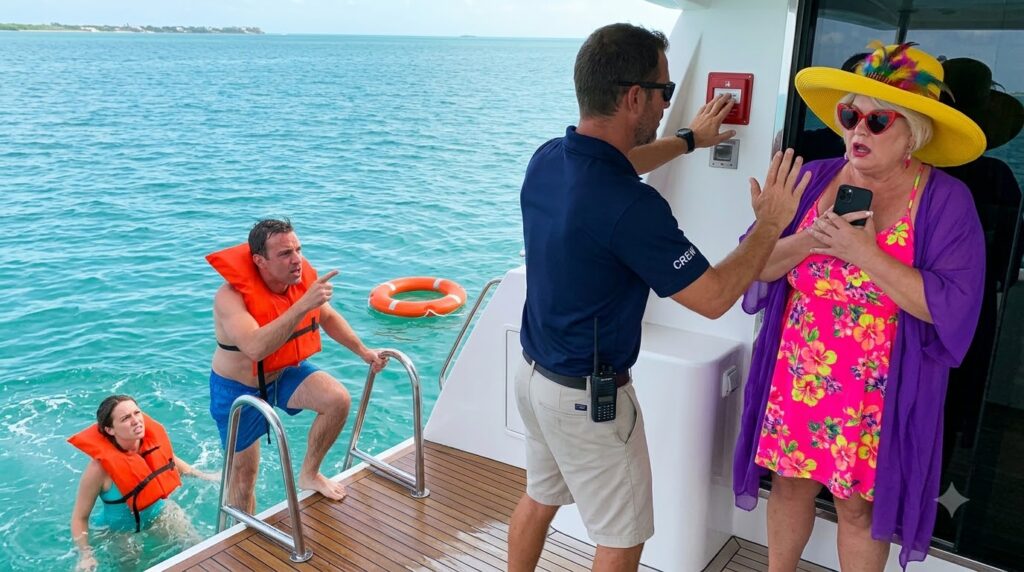
Because the lesson was not about a ridiculous woman in a feathered hat.
It was about the difference between attention and respect.
Karen had wanted strangers to panic so she could make people laugh.
Daniel and Melissa had believed someone needed help, and they acted.
One choice had been driven by selfishness.
The other by compassion.
And when the truth emerged, the people aboard the yacht had made another choice: to defend those who had tried to do the right thing.
On a quiet afternoon in the Florida Keys, the Sea Haven sailed past the same stretch of turquoise water where the false emergency had occurred.
The orange life ring hung securely beside the rear deck entrance.
The emergency alarm remained silent.
Passengers relaxed beneath the sun.
And the ocean, indifferent to viral fame and public embarrassment, rolled gently against the hull.
What remained was not the laughter Karen had hoped the world would remember.
It was the courage of two strangers who believed a life was worth saving.
And the simple truth that helping someone should never be a reason for shame.
The End.