
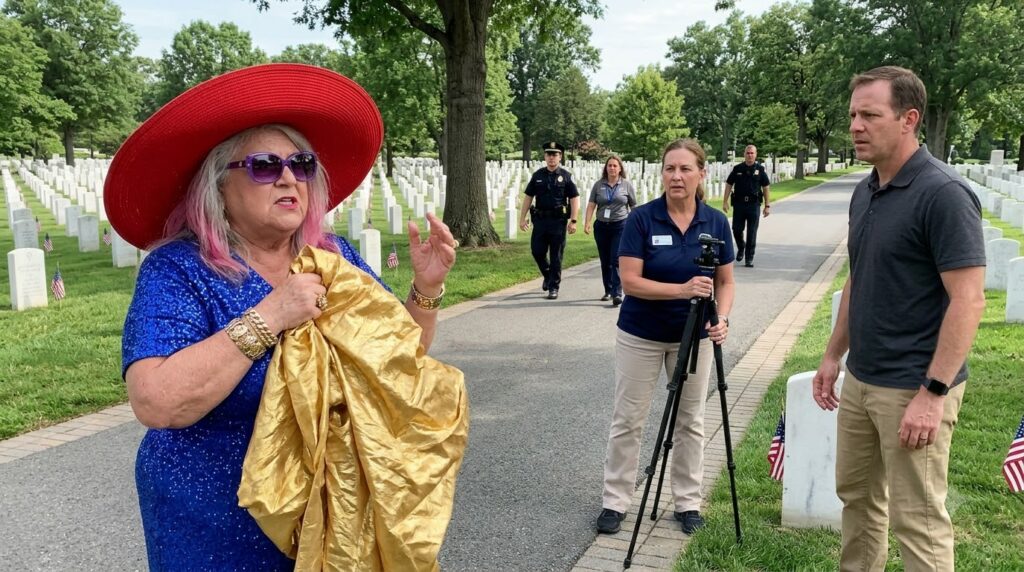
Chapter 9: The Cost of Being Right in Your Own Mind
The consequences did not arrive all at once.
They came through letters, telephone calls, canceled invitations, and the gradual disappearance of people Patricia had assumed would always support her.
The Commonwealth Heritage Circle formally removed her from its event committee.
Its board issued a statement clarifying that the cemetery photography project had never been approved by the organization.
The treasurer reviewed the group’s records and confirmed that no organization funds had been authorized for Patricia’s private reception.
People who had paid Patricia directly were advised to seek repayment from her.
Most received their money after repeated requests.
One disputed payment required assistance from the payment provider before it was resolved.
The cemetery completed its own administrative review.
The documentation included staff reports, witness statements, photographs, and the chronology of Patricia’s visits.
Thomas Reed notified Patricia in writing that her commercial photography activities at the cemetery had been unauthorized and that she was not permitted to resume them.
The notice also made clear that any future visit must comply with cemetery rules and staff directions.
The matter was referred for further review where appropriate.
No dramatic arrest occurred.
No judge delivered a speech.
There was no instant punishment designed to satisfy an audience.
The consequences were quieter and more practical.
Patricia could no longer pretend she had permission.
She could no longer claim that the heritage organization supported her project.
She could no longer use Vanessa’s business name without facing an immediate objection.
And the people whose money she had accepted were demanding answers.
Her social standing suffered as well.
Invitations became less frequent.
Committee members stopped calling.
Several acquaintances who had once tolerated her behavior began declining requests to participate in her projects.
Patricia blamed everyone except herself.
She blamed Daniel for interfering.
She blamed Margaret for embarrassing her.
She blamed Samuel for abandoning her.
And she blamed Vanessa most of all.
For several weeks, mother and daughter barely spoke.
Vanessa found the silence painful.
Despite everything, Patricia was still her mother.
Vanessa remembered childhood birthdays, holiday dinners, and the way Patricia had once stayed awake all night sewing a costume for a school performance.
There had been generosity in her mother.
There had also been a lifelong need to control how others perceived her.
Vanessa had spent years accommodating that need.
Now she understood how much it had cost.
She began rebuilding her studio’s reputation.
She contacted affected customers, maintained records of the unauthorized promotions, and made her booking procedures clearer.
She also offered discounted portrait sessions to several older couples whose original appointments had been disrupted.
One couple had been married fifty-eight years.
The husband was a retired Navy mechanic.
During their session, he struggled to stand for long periods.
Vanessa brought him a chair, adjusted the lighting, and worked at his pace.
When the photographs were finished, his wife cried.
Not because the images were grand.
Because they looked like the people she loved.
Vanessa thought about her mother’s golden fabric.
She had wanted photographs that looked important.
But importance was not something a photographer could create by placing expensive decorations around strangers’ memories.
It came from the people themselves.
Meanwhile, Daniel returned to his normal routine.
He worked as a facilities manager for a regional medical company.
He spent weekends repairing things around his house.
He called his daughter every Sunday.
And he continued visiting his father’s grave.
But something had changed.
During one visit, he noticed an older man struggling to carry a folding stool along the walkway.
Daniel offered to help.
The man accepted.
His name was Frank Delaney.
He had served in the Army during the Vietnam era and was visiting his wife’s grave.
They talked briefly about military families, aging, and the strange way grief changed over time.
Frank told Daniel that he sometimes felt embarrassed needing help.
Daniel remembered his father’s years volunteering as a driver.
He told Frank that accepting help was not a failure.
It was part of allowing people to care for one another.
The conversation stayed with him.
A week later, Daniel contacted Thomas Reed about ways to support cemetery visitors.
Thomas explained that any organized assistance on the grounds would need to follow cemetery procedures and avoid interfering with operations.
He suggested that Daniel consider working through an established veterans’ support organization.
Daniel began exploring the idea.
He spoke with Margaret.
He spoke with Frank.
He spoke with several local volunteers.
What began as anger over one grave slowly developed into a desire to help people who came to remember their loved ones.
Then, nearly two months after the incident, Daniel received an unexpected letter.
The return address belonged to Patricia Caldwell.
He opened it cautiously.
Inside was a single handwritten page.
There were no legal threats.
No demands.
No complaints about unfair treatment.
The letter began with an apology.
But Daniel had learned enough about Patricia to know that words alone were not the same as change.








