Chapter 6: The Evidence Nobody Expected
By the end of the week, Thomas Reed had gathered enough information to establish a timeline.
Patricia had visited the cemetery on at least three separate occasions connected to her photography project.
The first visit appeared to have been a location survey.
The second involved decorative materials and folding chairs.
The third was the confrontation with Daniel.
The staff could not prove every allegation.
They could, however, document specific activities, identify witnesses, and establish that Patricia had continued attempting to use the cemetery after being told that the proposed commercial activity was not permitted.
Thomas referred the materials for administrative review and appropriate follow-up.
He was careful about what he promised.
The cemetery could protect its grounds, enforce applicable rules, and document misconduct.
It could not simply impose whatever punishment an angry visitor wanted.
Daniel appreciated that distinction.
His father had believed in rules because rules were supposed to protect everyone equally.
Daniel did not want Patricia treated unfairly.
He wanted her held accountable for what she had actually done.
Then an unexpected witness came forward.
His name was Luis Ortega.
He was sixty-one and worked as a cemetery groundskeeper.
Luis had been employed there for nineteen years.
He knew the property with the familiarity of someone who had spent thousands of mornings caring for it.
He could identify areas by the slope of the land, the shape of the trees, and the way sunlight moved across the rows of stones.
Luis had seen Patricia during her second visit.
At the time, he had been trimming grass near a section of older graves.
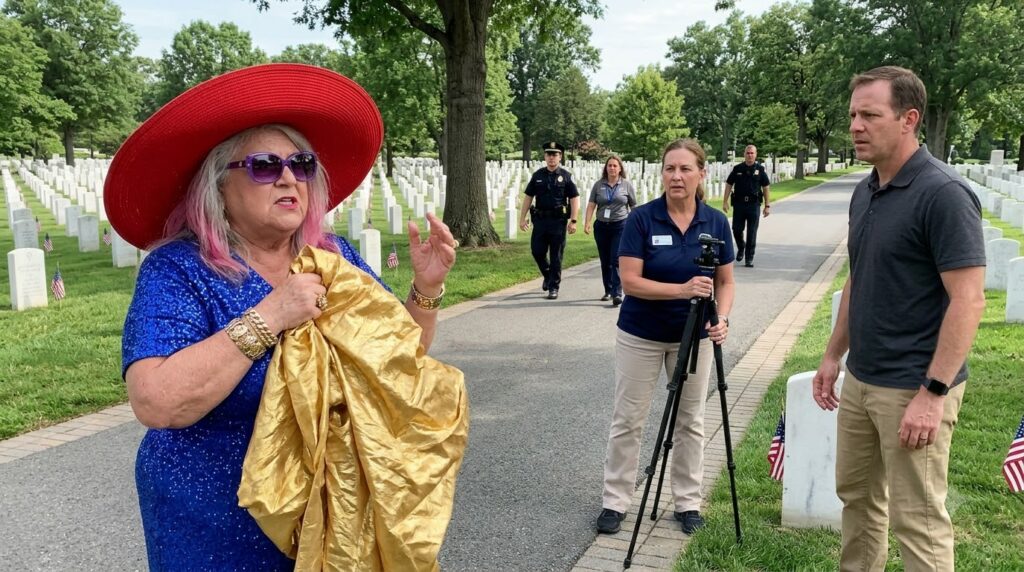
He remembered the red hat.
He remembered the gold fabric.
And he remembered a woman arguing with another visitor about where she could stand.
Luis had approached and asked Patricia to keep her equipment on the walkway.
She had complied reluctantly.
But after he moved to another section, he noticed her returning toward the headstones.
He reported the incident to his supervisor.
Now, after reviewing the photographs, Luis recalled something else.
Patricia had not been working alone that day.
A younger man had accompanied her.
He carried a camera bag and helped arrange the folding chairs.
Thomas asked whether Luis could identify him.
Luis was uncertain.
But he remembered that the man had worn a dark green jacket with a distinctive white logo on the back.
Vanessa recognized the description.
It sounded like a jacket belonging to a freelance photography assistant named Brian Keller.
Brian had occasionally worked for her studio.
Vanessa contacted him.
Brian admitted that Patricia had hired him privately.
She had told him the session was a preliminary location test for a charity project.
He had assumed she possessed permission.
When Luis instructed them to move the equipment, Brian became uncomfortable.
He had suggested leaving.
Patricia insisted they were almost finished.
Brian had taken several photographs before departing.
He still had the files.
Vanessa asked him to preserve them and provide copies to the appropriate reviewers.
Brian agreed.
The photographs were revealing.
They showed Patricia arranging fabric beside military headstones.
They showed folding chairs positioned on the grass.
They showed the same decorative gold ribbon later found near William Ellis’s grave.
One image captured Patricia standing beside a headstone while Margaret Ellis approached in the background.
Another showed Brian beginning to move a chair after Luis arrived.
The photographs did not prove every detail of Margaret’s account.
But they strongly supported the sequence she had described.
More importantly, the files contained timestamps.
The chronology was now much clearer.
When Samuel Whitaker reviewed the material, he made a difficult decision.
The heritage organization would formally withdraw from Patricia’s proposed photography project.
It would notify invited guests that the private reception was unauthorized.
And it would ensure that no funds collected under its name were retained for an event it had never approved.
Vanessa began contacting customers again.
She was able to identify four payments Patricia had received for the proposed portrait sessions.
Patricia initially resisted returning them.
She claimed the money had been spent on supplies.
But when customers demanded refunds and Vanessa explained that the transactions had never been authorized by her studio, Patricia reluctantly agreed to repay the deposits.
That resolved the immediate financial complaints.
It did not resolve the damage to Vanessa’s reputation.
Nor did it answer the question of what Patricia intended to do next.
The answer arrived the following Friday.
Despite the committee’s cancellation notice, Patricia sent a new message to her invitees.
She announced that the reception would proceed as a private event at her home.
She promised that the photographs would be displayed.
And she described the controversy as an attempt to silence her artistic vision.
Samuel received a copy.
He forwarded it to Vanessa.
Vanessa opened the attachment and stared at the promotional image.
It showed a white military headstone partially concealed behind a golden curtain.
The stone was unmistakably Robert Mercer’s.
Patricia had used the very image that caused the confrontation.
And she intended to exhibit it publicly.