
CHAPTER 6: THE EMPTY CART AND THE QUIET STREET OUTSIDE
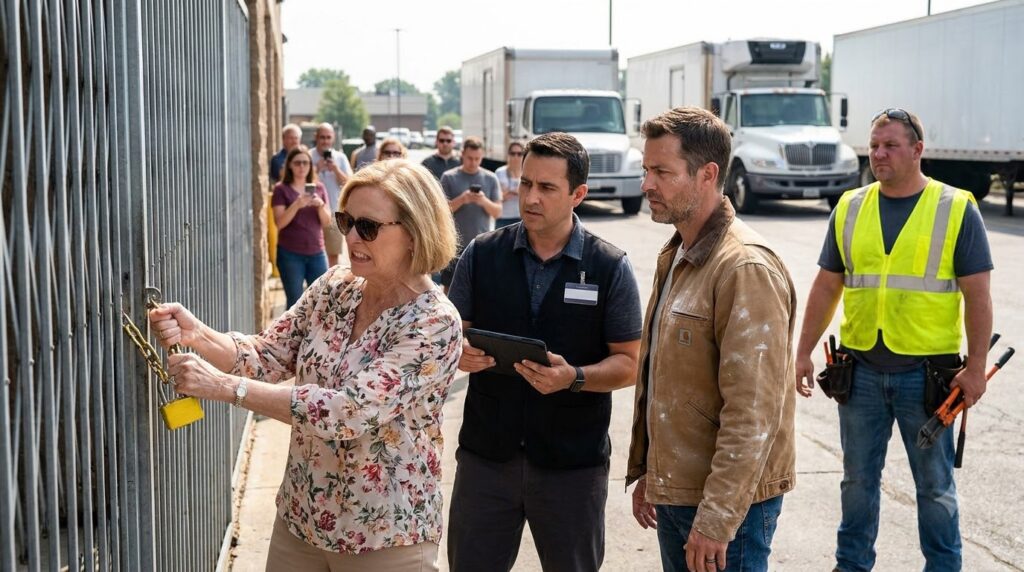
The tension on the loading apron tightened until the air itself felt brittle, humming with the low-frequency vibrations of three diesel engines idling in tandem. Brenda Gable did not blink behind her tinted sunglasses, but the slight twitch at the corner of her left eyelid betrayed the calculation unraveling inside her head. She had gambled everything on the forty-five-minute administrative hold, assuming that corporate hesitation would buy her enough time to salvage her fading authority before Tuesday’s district committee election.
“Corporate clearance doesn’t override local district zoning,” Brenda said, her voice sharpening into a thin, brittle edge as she reached out to slap her palm against the yellow padlock chain. “The nuisance petition bears the signatures of seven registered property owners. Until a formal council quorum reviews the validity—”
“The petition is null, Mrs. Gable,” Marcus interrupted, his voice dropping into a flat, bureaucratic monotone that brooked no further debate. He held up his store tablet, displaying an automated digital confirmation stamped by corporate legal just four seconds prior. “Section twelve of our commercial lease explicitly exempts primary logistics contractors from district nuisance filings unless accompanied by a verified county magistrate warrant. You don’t have a magistrate warrant. You have a photocopied committee memo with a forged routing code.”
The word forged hung in the humid morning air like a dropped wrench.
Around the perimeter of the asphalt apron, the circle of onlookers—delivery drivers, early-morning shoppers, and two local residents who had paused near the recycling bins—shifted their weight simultaneously. The murmur of voices stopped entirely. Brenda’s hand remained frozen against the padlock chain, her fingers splayed out over the yellow steel as if she were trying to hold back a rising tide with an open palm.
Julian stepped closer, his boots making a dull, heavy scrape against the concrete. He didn’t gloat. He didn’t smile. He looked at Brenda with the dispassionate focus of an engineer inspecting a structural crack in a retaining wall.
“You didn’t build these rules to protect a community, Brenda,” Julian said quietly, his voice carrying clearly across the silent loading bay. “You built them to wall out anyone who wouldn’t bow to a clipboard. But a wall built on fake paper doesn’t hold when the weight hits it.”
Brenda’s jaw tightened until the skin across her cheekbones turned chalk-white. For a fraction of a second, the polished mask of civic entitlement fractured completely, exposing the raw, desperate panic of a woman realizing her entire kingdom was nothing more than an empty parking lot. She opened her mouth to deliver a final, blistering condemnation, but no sound came out—only a shallow, ragged intake of breath.
Miller didn’t wait for permission. He stepped past her with the heavy, rhythmic tread of a working man who had schedules to keep, sliding a bolt-cutter from the side pocket of his tool vest. With a single, sharp contraction of his forearms, the iron jaws snapped shut on the shackle of the yellow padlock. The metal gave way with a dry, ringing clack, and the heavy chain unspooled from the gate, clattering against the concrete apron.
“Bay’s open,” Miller muttered, hoisting his clipboard. “Let’s roll these tubs before the sun bakes the yeast.”
As Miller’s rig rolled forward, its tires hissing against the damp concrete of the loading bay, Brenda staggered back half a step, her heel catching on the uneven seam where the asphalt met the drainage gutter. Her grip on her straw handbag slipped, and her clipboard tipped forward, hitting the ground with a sharp crack as the brittle plastic hinge shattered. Papers spilled across the oil-stained pavement—expired district notices, blank election ballots, and draft complaints scrawled in hurried blue ink.
She looked down at the scattered papers, then up at the gathering crowd of neighbors and strangers who stared down at her with quiet, unblinking indifference. No one stepped forward to help her gather the sheets. No murmurs of sympathy rose from the sidelines. The performance was over, and the audience had turned their backs.
Without a word, Brenda turned on her heel, bypassed her pristine sedan, and walked rapidly toward the perimeter sidewalk, her head ducked low beneath the afternoon sun, her floral blouse fluttering like a tattered flag of a defeated garrison.
Julian watched her go until she disappeared around the corner of the brick storefront, swallowed by the ordinary traffic of the main road. Then he turned toward the open loading dock, where the cool interior air of the warehouse drifted out to meet him, carrying the sharp, clean scent of unbleached flour and fresh cedar. He walked back to his truck, climbed into the cab, and shifted the gear into drive. The tires crunched softly over the scattered gravel as he pulled away from the bay, leaving the empty gate wide open to the valley beyond.








