CHAPTER 5: THE DOUBLEDOWN AND THE SHIFTING MURMURS
“The routing code prefix on this paper is for a residential variance inquiry, Mrs. Gable,” Marcus said, his thumb pressing firmly into the wet paper of the notice taped to the gate chain. “It isn’t a municipal injunction. It holds zero legal weight on a private commercial loading bay.”
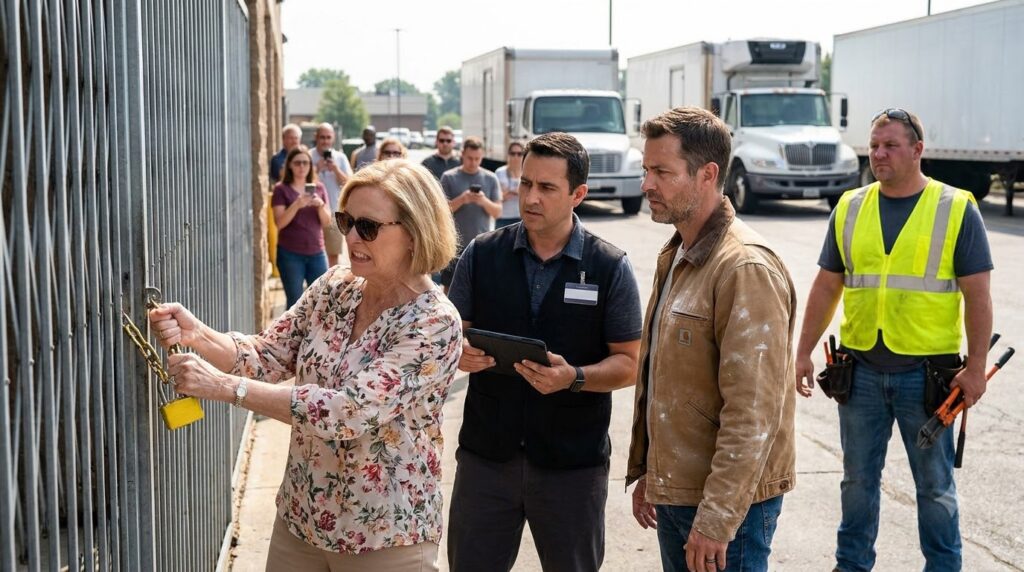
Brenda did not flinch. She did not look down at the paper, nor did she reach to retrieve her clipboard. Instead, she adjusted her posture, planting her low heels into the seam where the asphalt met the loading apron. Her sunglasses caught the low morning glare, reflecting two blinding discs of pale white light directly into Marcus’s eyes.
“Then look at the docket attachment, Marcus,” Brenda replied, her voice dropping into a chilling, measured register. “Page two. Subsection C.”
Marcus flipped the laminated sheet with a crisp, wet snap. Tucked behind the forged cover letter was a second document—a printed multi-party nuisance petition bearing seven signatures from legacy property owners whose parcels flanked the corridor road. It alleged chronic commercial noise, easement degradation, and unauthorized heavy freight transit during pre-dawn hours.
“Under Harvest Market’s regional development covenant with Cedar Ridge District,” Brenda said, her voice dripping with bureaucratic precision, “a formal nuisance petition signed by more than five contiguous deed-holders triggers an automatic forty-five-minute operational hold on freight transfers. The bay stays locked until corporate legal in the state capital verifies the petition’s validity.”
Julian stood five feet away, watching the mechanics of the trap close. The calculation was ruthless. Brenda knew the forgery wouldn’t survive a formal legal audit, but she didn’t need it to last a week. She only needed forty-five minutes.
Fifty yards down the access road, idling on the soft gravel shoulder, sat Julian’s refrigerated delivery rig. Through the side mirror of the cab, he could see the driver, a contractor named Miller, leaning his arm out the window, tapping his watch. Inside the climate-controlled container was six hundred pounds of specialized artisan sourdough starter and temperature-sensitive specialty yeast cultures imported from a regional mill. If those tubs sat in the unventilated box under the rising August heat for another half-hour, the fermentation curves would spike, ruining a full month’s production schedule for Julian’s bakery.
“You knew my supply truck was on the access road,” Julian said, his voice quiet, carrying the hard, metallic edge of a blade drawn across stone.
“I know that commercial operations in this district must abide by community covenants,” Brenda countered, taking a single, deliberate step closer to the chain. “If your logistics are too fragile to survive standard regulatory oversight, perhaps you shouldn’t have opened a commercial bakery in a historic corridor.”
Julian stared at her, his mind stripping away the surface noise. He looked at the seven signatures on page two. He recognized the names: Vance, Miller, Gable, Thorne—the old-guard families who had held large agricultural tracts along the ridge for sixty years. This wasn’t about an upcoming committee election next Tuesday. That was the decoy, the superficial panic of a local politician losing her seat. The real engine beneath Brenda’s obsession was a deeply entrenched, silent pact among the legacy landholders to systematically render property unviable for any newcomer who refused to submit to their informal authority. They weren’t fighting over rules; they were executing a slow, legalistic land war.
Marcus pulled his store tablet from his belt, his knuckles pale against the rubberized casing. “I’m calling corporate compliance right now, Mrs. Gable. If this petition contains invalid signatures, store legal will hold you personally liable for spoiled inventory and supply chain interference.”
“Call them,” Brenda said, her lips curving into a thin, bloodless smile. “Let them process the paperwork. The forty-five-minute hold is mandatory under section four of the store’s own lease agreement. Cut that lock before legal responds, Marcus, and I’ll have a county sheriff here in twenty minutes for private property trespass.”
A low, rumbling murmur echoed from the access road. Miller had killed the truck’s engine to save fuel, and the sudden silence underscored the steady, ominous tick of the cooling manifold. Two other delivery drivers—local independent contractors hauling produce for Harvest Market—had pulled up behind Miller’s rig, their idling engines creating a wall of low-frequency exhaust noise.
Miller stepped out of his cab, wiping his grease-stained hands on a shop rag as he walked up the apron toward the gate. He was a broad-shouldered man in his fifties, his face weathered by thirty years of regional haul routes.
“What’s the holdup, Marcus?” Miller asked, his eyes traveling from the yellow padlock to Brenda’s rigid silhouette. “I’ve got three other stops down the valley, and my refrigeration unit is drawing max power off an auxiliary battery.”
“The gate is under a temporary administrative review, Miller,” Brenda interjected before Marcus could speak, her tone dripping with patronizing dismissiveness. “You’ll have to wait on the shoulder until corporate verifies the corridor petition.”
Miller didn’t look at her clipboard. He looked at Julian, then down at the chain, then at the forged municipal notice taped to the iron bar. He let out a short, dry laugh that sounded like gravel grinding in a steel bucket.
“Administrative review?” Miller spat, turning toward the two drivers who had followed him up the concrete ramp. “Hey, Frank! Ray! Come take a look at this. Mrs. Gable’s holding up the morning freight line because she didn’t like the flour Julian bought yesterday.”
The two drivers stepped onto the apron, their heavy boots thudding against the concrete. Behind them, several early-morning shoppers leaving the store’s main entrance paused near the perimeter sidewalk, drawn by the gathering cluster of work jackets and high-visibility vests. Phones were lifted again, screens angling to catch the standoff at the loading bay.
Marcus looked down at his tablet, then pulled an unfiled internal memo slip from behind his clip-ledger—a corporate legal notice issued to Harvest Market management two months prior regarding community easement disputes. His eyes scanned the fine print, a sharp, sudden spark of realization crossing his features.
“Section four of the lease agreement applies to external delivery contractors, Mrs. Gable,” Marcus said, his voice ringing out across the apron with sudden, ironclad clarity. He pointed a long finger at Miller’s truck. “Miller isn’t an independent third-party vendor. He’s an exclusive logistics contractor under direct corporate retainer with Harvest Market.”
Brenda’s smile faltered, her fingers twitching against the plastic edge of her clipboard. “That’s a semantic distinction—”
“It isn’t semantic,” Julian interrupted, stepping directly into her line of sight, his canvas jacket brushing the yellow chain. “It means your forty-five-minute hold doesn’t apply to this vehicle. And every minute you stand between that truck and the bay, you are physically obstructing corporate freight.”
The crowd at the edge of the parking lot moved closer, a ripple of sharp, audible whispers cutting through the humid morning air as Brenda’s iron trap began to fracture under its own weight.