
Chapter 4: The Report
Walter survived the emergency.
But his recovery would take time.
Emily visited him every day at the hospital.
Karen stayed home.
For several days, she avoided the sidewalk whenever she saw Emily’s car.
Then a certified letter arrived.
This one came from the city.
Karen sat at her dining table and opened it carefully.
Inside was a copy of the emergency incident report.
She expected criticism.
What she saw instead was worse.
It was factual.
Cold.
Simple.
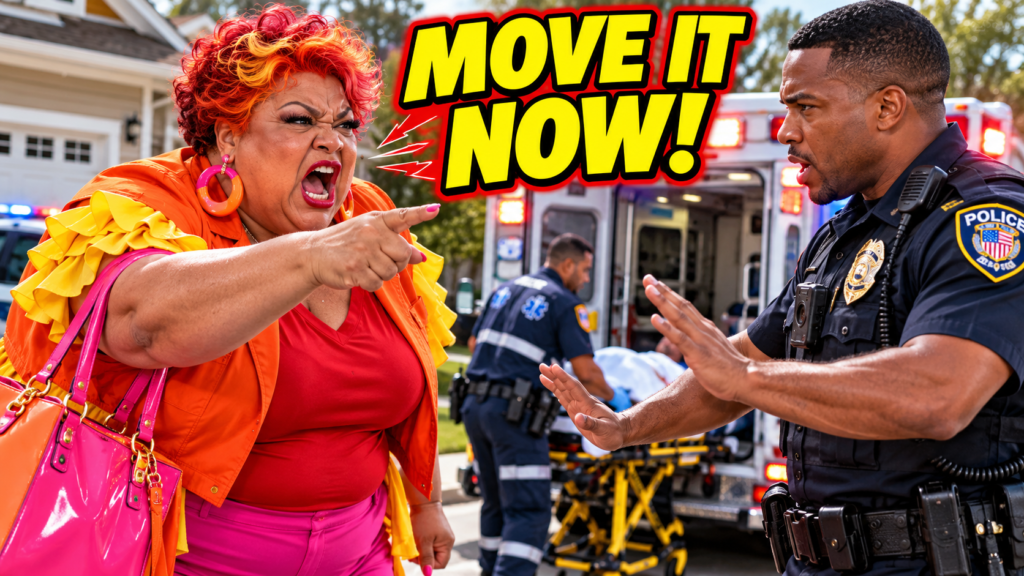
The report documented the location of the ambulance, the position of the stretcher, the emergency boundary, and Karen’s repeated movement toward the restricted area.
There were no insults.
No dramatic language.
Just a timeline.
At one point, the report noted that the ambulance crew had paused while officers managed the obstruction.
Karen read that sentence several times.
She remembered thinking the ambulance was taking over her property.
The report made clear that the crew had been trying to save someone.
Her property had never been the emergency.
Walter had been.
Karen put the report down.
For years, she had treated her home as a fortress.
Every parking space.
Every patch of grass.
Every inch of driveway.
Every person who crossed a line she believed belonged to her.
She had told herself it was about standards.
About respect.
About protecting what she had worked for.
But now she wondered whether she had confused protecting her home with controlling everyone around it.
That evening, she heard a knock.
Officer Brooks stood outside.
“I wanted to check on something,” he said.
Karen stared at him.
“Am I being charged?”
“That’s not why I’m here.”
He handed her a small envelope.
Inside was a handwritten note from Walter.
His handwriting was shaky.
There were only a few lines.
Tell Karen I wasn’t angry about the ambulance.
I know she cares about the neighborhood.
She just needs to remember that sometimes a home is safest when you let people help each other outside its walls.
Karen read the note twice.
Then she sat down on the porch.
For the first time in years, she didn’t look at the driveway.
She looked at the street.
And she noticed something she had never paid attention to before.
The neighborhood wasn’t a collection of properties.
It was a collection of people.








