
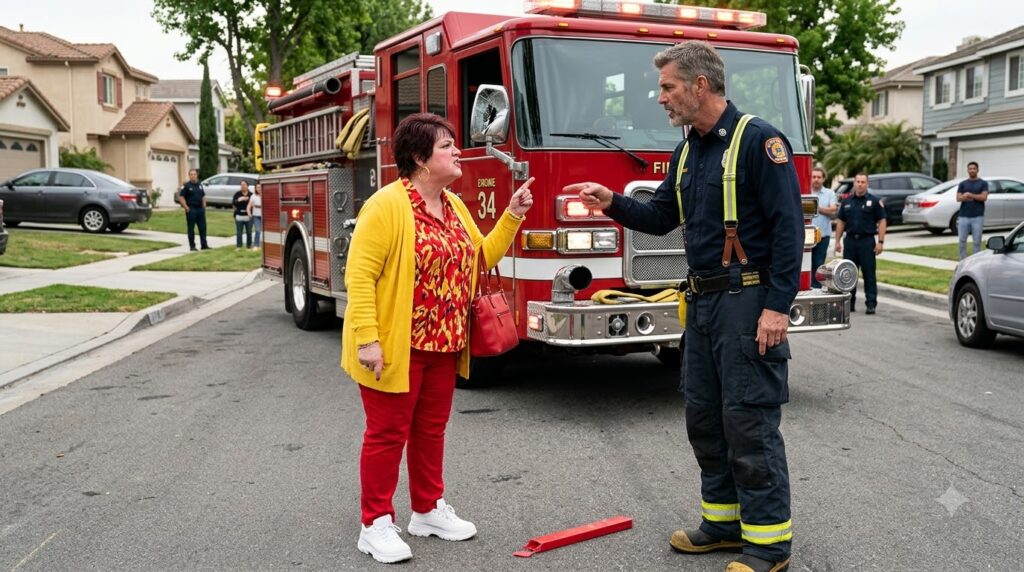
Chapter 5: The Cost of Being Right
The neighborhood expected a dramatic ending.
Instead, what followed was quieter.
The fire department repaired the mirror.
The incident report recorded that the damage occurred after Marla struck the mirror with the yard marker.
The department did not pursue the matter beyond what was required.
Marla paid for part of the repair.
The HOA removed the warning notice from her door after she agreed to keep the emergency-access lane clear.
For some residents, that was enough.
For others, Marla remained the woman who had hit a fire truck and blamed the firefighter.
She could feel their judgment whenever she walked outside.
At first, she resented them.
Then something changed.
She realized she had spent years demanding that people respect her without always extending the same respect to them.
That realization did not erase what had happened.
But it gave her somewhere to go from it.
A week later, she removed the decorative planters from the access lane.
She replaced them with smaller containers well inside her property line.
Harold noticed.
“You finally surrendered?” he asked jokingly.
Marla looked at him.
“No.”
She smiled faintly.
“I finally read the rules.”
Harold laughed.
It was the first time anyone had seen her laugh about the incident.
Still, the most important conversation happened between Marla and Elise.
They stood together in the driveway one Saturday morning.
Elise told her mother that she admired her for correcting the story.
Marla shook her head.
“I didn’t do it because I’m brave.”
“Why, then?”
“Because I was tired of defending something I knew wasn’t true.”
That sentence stayed with Elise.
Marla had always believed dignity meant never admitting weakness.
Now she was beginning to understand the opposite.
Sometimes dignity meant being strong enough to say, I was wrong.
The neighborhood eventually moved on.
Children rode bicycles past the fire station.
Residents watered lawns.
Garbage trucks came and went.
The emergency lane remained clear.
And Ryan continued driving his fire truck through the neighborhood.
Several weeks later, he passed Marla’s house.
She was standing outside.
He slowed.
She raised one hand.
Ryan waved back.
There was no grand apology.
No dramatic reconciliation.
Just a small gesture between two people who had once stood on opposite sides of a damaged mirror.
Then the fire truck continued down the street.
Marla watched it disappear around the corner.
She looked at her house.
For the first time in a long time, it still felt like hers.
But it no longer felt as though everyone outside it was her enemy.








