
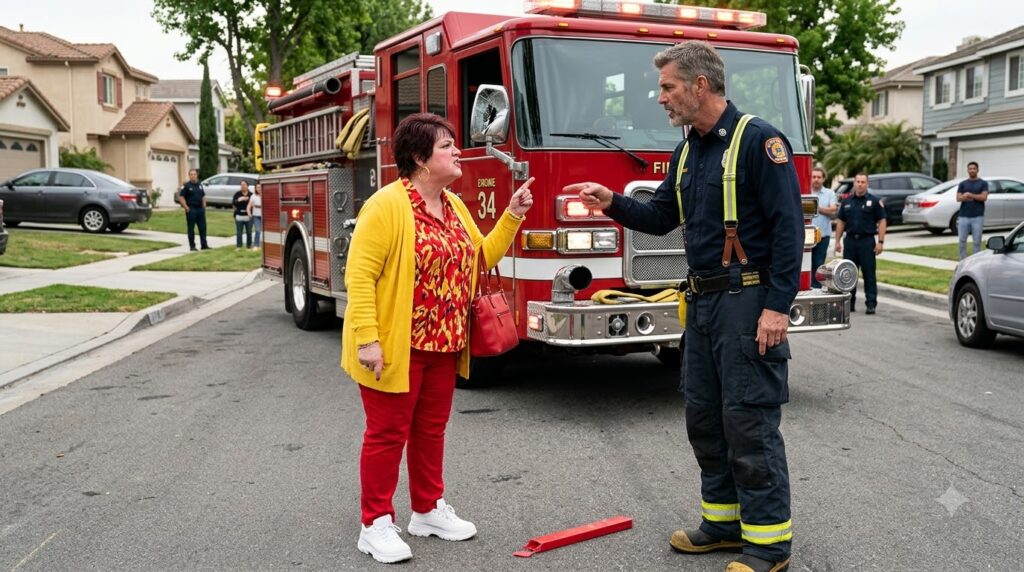
Chapter 3: The Lane Everyone Needed
The street had a narrow emergency-access area running along one side of the neighborhood.
Residents rarely thought about it.
Most days, it was simply empty pavement beside lawns and driveways.
But the fire department did.
The lane existed so emergency vehicles could move through the neighborhood when every second mattered.
That afternoon, Marla had placed two decorative planters near the edge of the access area.
She insisted they were on her property.
The homeowners association had previously asked residents to keep the area clear.
Marla had disagreed.
She considered the request another example of people telling her what she could and could not do around her own home.
Earlier that day, she had argued with a neighborhood maintenance worker who moved one planter back.
According to Harold, she had been furious.
Then came the fire truck.
Ryan’s crew had been responding to a training call nearby and was driving slowly through the neighborhood as part of an emergency-access inspection.
That was why the truck had been close to Marla’s lawn.
Not because Ryan was trying to intimidate her.
Not because he was speeding.
And not because he was looking for a fight.
The discovery didn’t immediately settle anything.
Marla still insisted she had been frightened.
That part might even have been true.
But being frightened did not explain striking the mirror.
Nor did it explain accusing Ryan of hitting her afterward.
The next morning, Ryan’s department reviewed the truck’s onboard camera.
The footage was clear enough to show the sequence.
The truck approached.
Marla stepped toward the curb.
She raised the red marker.
She struck the mirror.
Then she stepped backward.
The footage did not show the truck touching her.
It showed the opposite.
Ryan watched the video twice.
He felt no satisfaction.
He had spent more than three decades responding to emergencies, and he had learned that proving someone wrong was rarely the same thing as solving a problem.
He wanted the record corrected.
That was all.
Meanwhile, Marla was facing a different problem.
Her daughter, Elise, had seen a photograph of the damaged mirror posted in the neighborhood discussion group.
She called her mother.
Elise was forty-two and lived twenty minutes away.
She knew her mother’s stubbornness.
She also knew something most neighbors didn’t.
Marla had been under enormous pressure since her husband died two years earlier.
The house had become more than a home.
It was the last place that still felt completely hers.
Every complaint about the yard, every HOA notice, every suggestion that she change something felt to her like another piece of control being taken away.
Elise understood that.
But understanding her mother did not mean excusing what she had done.
When she arrived that evening, she found Marla sitting at the kitchen table.
The red yard marker was still there.
Except now it was broken.
Elise picked it up.
She turned it over.
A tiny section of the plastic was missing.
Her expression changed.
“Mom.”
Marla looked away.
“What?”
Elise held up the marker.
“You told me the truck broke this.”
Marla said nothing.
And that silence told Elise more than any argument could have.








