Chapter 7: What Being There Really Means
Several weeks later, the forest entrance reopened.
The damaged area had been marked for restoration.
The county maintenance crew replaced the faulty equipment.
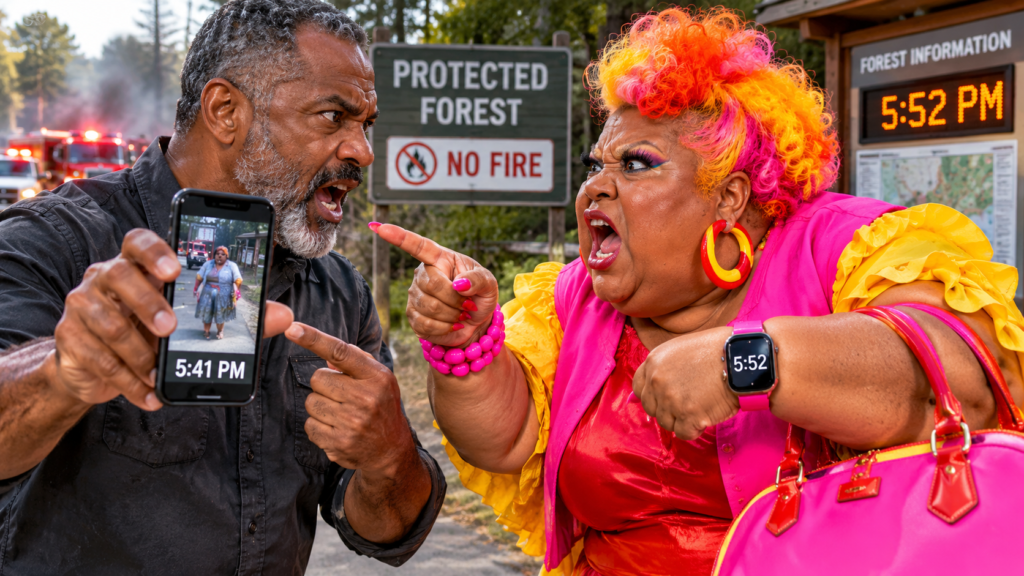
The neighborhood association installed a new official time display and added a notice explaining that digital security-camera timestamps could require verification.
The neighborhood group also changed.
Not dramatically.
Not overnight.
But enough to matter.
People began asking questions before sharing accusations.
Daniel stopped using the phrase “I saw it on camera” as if that ended every discussion.
Karen became slightly less defensive when someone challenged her.
She still had a temper.
She still carried her enormous neon handbag.
And she still had no patience for people who treated confidence as a substitute for evidence.
But something in her had changed.
One Saturday morning, she and Daniel walked along the public boundary of the forest.
There was no argument.
No accusation.
No phone held between them.
Only the sound of wind moving through the trees.
Daniel stopped beside the new sign.
“You know,” he said, “your question that day stuck with me.”
Karen looked over.
“The one about being there?”
He nodded.
She smiled faintly.
“Being there isn’t the same as doing something.”
Daniel looked toward the forest.
“But being there can still matter.”
Karen nodded.
“That depends on what you do with the truth afterward.”
They continued walking.
Karen never received a grand public celebration.
There was no dramatic punishment.
No one was marched away in handcuffs.
The real consequence was quieter.
A neighborhood learned to distinguish what a camera showed from what people assumed it meant.
Karen regained something more valuable than a cleared accusation.
She regained control over her own story.
Daniel gained something too.
He learned that evidence was not merely something that supported what you already believed.
Sometimes, real evidence required you to admit you were wrong.
And Emily kept the photograph.
Not because it proved Karen’s innocence by itself.
But because it reminded her of a lesson she would carry for the rest of her life:
A timestamp can tell you when something was recorded.
It cannot, by itself, tell you what happened.
And sometimes the difference between those two things is the difference between accusing someone and understanding the truth.