Chapter 9: The Apology That Couldn’t Undo Everything
Karen’s correction appeared at 6:15 p.m.
It was shorter than her original video.
There was no dramatic music, no angry caption, and no accusation against the salon.
Karen sat in her living room with Princess curled beside her.
She looked uncomfortable.
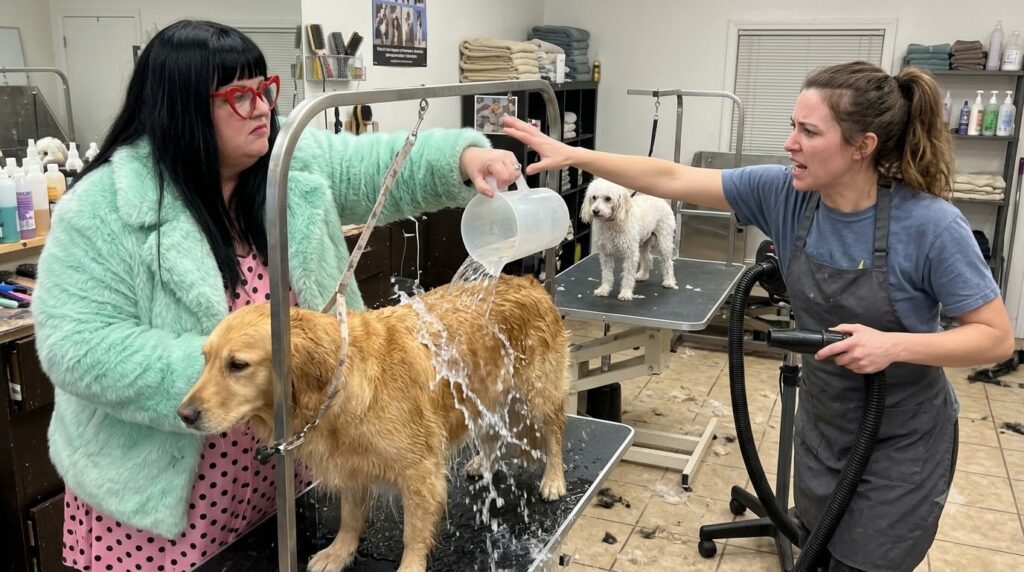
She acknowledged that she had deliberately poured water onto another customer’s dog.
She admitted taking control of grooming equipment without permission.
She confirmed that the salon had been justified in ending her appointment.
And she apologized for presenting an incomplete account that had damaged the business’s reputation.
The statement had been carefully negotiated.
It did not contain extravagant expressions of remorse.
It did not claim Karen had become a different person.
But it corrected the central falsehoods.
Karen also confirmed in writing that she had photographed the appointment clipboard, that she had not shared those photographs with anyone, and that she had deleted them.
The salon had no independent way to verify every aspect of that statement, but Rachel documented the confirmation and the steps Denise had taken to protect affected customers.
Under the settlement, Karen also reimbursed the salon for the additional grooming work required after soaking Buddy and agreed not to return to Rose City Paws.
The payment was modest.
It would not recover every canceled appointment or erase the stress of the previous weeks.
But Denise had never expected a legal agreement to repair everything.
Some damage couldn’t be measured in dollars.
Walter watched the correction with Susan.
When it ended, he turned off the television.
“Well,” he said, “that’s something.”
Susan studied him.
“Do you forgive her?”
Walter considered the question.
He had spent much of his life believing that forgiveness was important.
But he had also learned that forgiveness and trust were not the same.
“I don’t wish her harm,” he said. “But I don’t owe her another chance to treat me that way.”
Susan nodded.
It was an answer Margaret would have appreciated.
Across town, Emily watched the correction on her phone.
She expected to feel victorious.
Instead, she felt tired.
For weeks, she had carried the memory of Karen pouring water over Buddy.
She had replayed the moment when Karen grabbed the dryer.
She had wondered whether strangers believed she was incompetent or cruel.
Now the truth was public.
But the experience had changed her.
She understood that being professional did not mean absorbing unlimited disrespect.
It meant protecting the animals in her care, maintaining reasonable boundaries, and knowing when to end an unsafe interaction.
The following morning, Denise gathered the staff.
She explained several new procedures.
Customers would no longer have access to appointment records.
Only employees would handle powered grooming equipment.
Water pitchers and cleaning supplies would be kept away from customer waiting areas.
And any customer who interfered with another animal’s care would have their appointment ended immediately.
The policies were simple.
They should have been obvious.
But Denise had learned that even familiar businesses needed to revisit their safeguards.
Emily appreciated the changes.
She also appreciated something else.
Denise had never blamed her for Karen’s behavior.
That mattered more than any public statement.
On Saturday morning, the salon opened its doors for the community event.
Denise expected perhaps twenty visitors.
By ten o’clock, more than forty people had arrived.
Some brought dogs.
Others brought donations.
Several longtime customers stopped by simply to offer encouragement.
Patricia Lawson arrived with Oliver and a large container of homemade lemon bars.
Susan came with Walter.
And Buddy entered the salon wagging his tail so enthusiastically that Emily laughed.
He had clearly forgotten the unpleasant incident.
Dogs, she thought, were sometimes wiser than people.
By noon, the donation table held blankets, food, towels, and several hundred dollars for the rescue organization.
A local veterinarian offered to provide a future workshop on caring for aging pets.
Two customers booked recurring appointments.
Another offered to help Denise improve the salon’s website.
The event did not magically restore every lost dollar.
But it gave the staff something they had been missing.
Confidence.
Late that afternoon, as the last visitors departed, Walter approached Denise.
“Looks like you had a good day.”
Denise looked around the salon.
The floor needed cleaning.
The coffee pot was empty.
There were crumbs on the reception counter.
She smiled.
“It was a very good day.”
Walter handed her a small framed photograph.
It showed Buddy standing beside Margaret in their backyard years earlier.
Margaret was laughing, one hand resting on the dog’s head.
On the back, Walter had written:
Thank you for treating our family like family.
Denise held the photograph carefully.
For a moment, she couldn’t speak.
Then she hugged him.