Chapter 5: The Witness Nobody Expected
The email came from a woman named Patricia Lawson.
She was sixty-six, a retired elementary school principal who lived in northeast Portland.
Patricia had visited Rose City Paws that morning to pick up her miniature schnauzer, Oliver.
She had been standing near the reception counter when Karen began arguing with Emily.
Patricia’s message was brief.
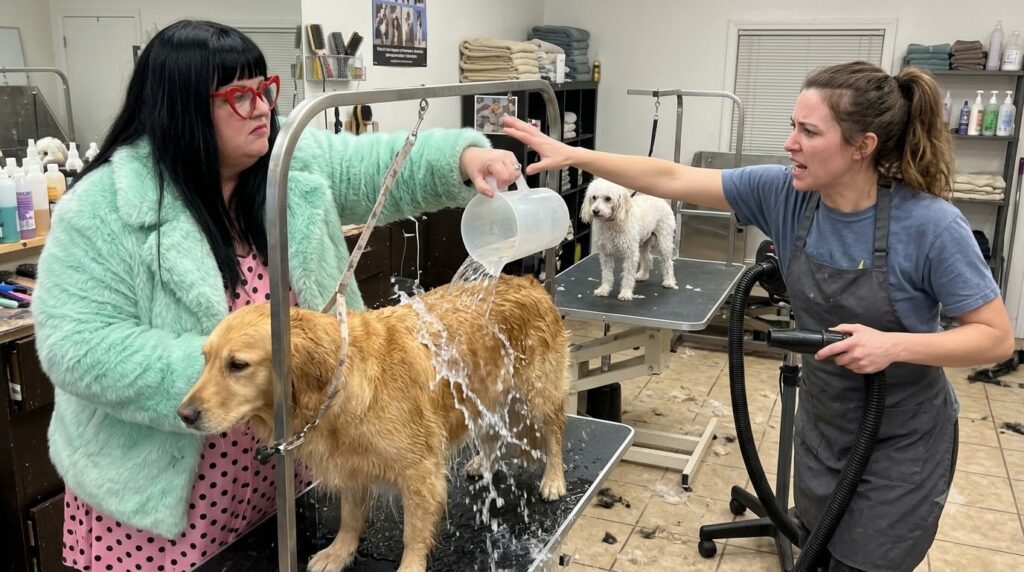
She had seen Karen pour water onto Buddy.
She had also heard Karen demand that her poodle be groomed first.
Most importantly, Patricia had witnessed Karen examining the appointment clipboard.
Denise called her the following morning.
Patricia answered on the second ring.
“I wondered when you’d call.”
Denise thanked her for writing.
Patricia explained that she had recognized Karen’s behavior immediately.
“Thirty-eight years in public education teaches you a few things,” she said. “One is that some people create trouble and then insist they’re the victims.”
Denise almost laughed.
Patricia continued.
“I didn’t want to get involved in a public argument. But when I saw that video, I couldn’t stay quiet.”
She had also noticed something Denise hadn’t.
Karen had been photographing the clipboard before she poured the water.
Patricia remembered because she had initially assumed Karen was checking her own appointment time.
“Then she turned the phone sideways and moved it across the page,” Patricia explained. “It looked like she was taking several pictures.”
Denise felt a cold sensation in her stomach.
The clipboard had contained the names and phone numbers of six customers scheduled that morning.
Walter’s information had been on the page.
So had Patricia’s.
Denise thanked her and ended the call.
She immediately contacted the salon’s attorney, Rachel Kim.
Rachel had advised small businesses in Portland for more than fifteen years.
She was practical, direct, and deeply skeptical of social-media disputes.
After reviewing the footage, Rachel identified two separate concerns.
The first was Karen’s public accusations.
The second was the possible exposure of customer information.
Denise had already removed the clipboard from public view and changed the salon’s procedures so appointment details were no longer displayed where customers could photograph them.
Rachel approved.
“Good,” she said. “Now document what happened and notify anyone whose information may have been exposed.”
Denise nodded.
“What about the video?”
“We can request removal of the material involving Walter. We can also ask Karen to correct the false claims. But don’t publish a full surveillance recording just to win an argument.”
Denise had expected that advice.
She was relieved to hear it.
Rachel helped prepare a short statement.
It explained that the salon had ended a customer’s appointment after deliberate interference with another dog’s grooming and unauthorized handling of professional equipment.
It confirmed that both animals were unharmed.
It also stated that the salon was preserving evidence and addressing customer privacy concerns.
No customer names appeared.
No insults.
No speculation.
Just facts.
The statement went online shortly after noon.
The reaction was mixed.
Some people apologized for their earlier comments.
Others demanded video proof.
A few accused Denise of hiding something.
Then Patricia posted a comment under her own name.
She described what she had witnessed.
Her words were measured and specific.
She did not attack Karen’s appearance or personality.
She simply stated that Karen had deliberately soaked another customer’s dog and taken the dryer.
Several longtime customers recognized Patricia.
They knew her from neighborhood events, school fundraisers, and years of community service.
Her account carried weight.
By evening, the conversation had begun to change.
But Karen was not finished.
At 7:42 p.m., Denise received a message from Karen’s attorney.
It demanded an apology, reimbursement for the unfinished grooming appointment, and compensation for alleged damage to Karen’s reputation.
The message also threatened legal action if the salon continued making statements about the incident.
Denise forwarded it to Rachel.
Ten minutes later, Rachel called.
“Don’t respond directly,” she said.
Denise stared at the screen.
“Is she really going to sue us?”
“Possibly.”
Denise sank into her chair.
Rachel continued.
“But there’s something interesting about this letter.”
“What?”
“It says Karen never touched the dryer.”
Denise looked toward the security monitor.
The footage showed Karen gripping the nozzle with both hands.
Rachel’s voice remained steady.
“That makes our evidence particularly important.”
For the first time since the incident, Denise felt that the truth might have a chance.