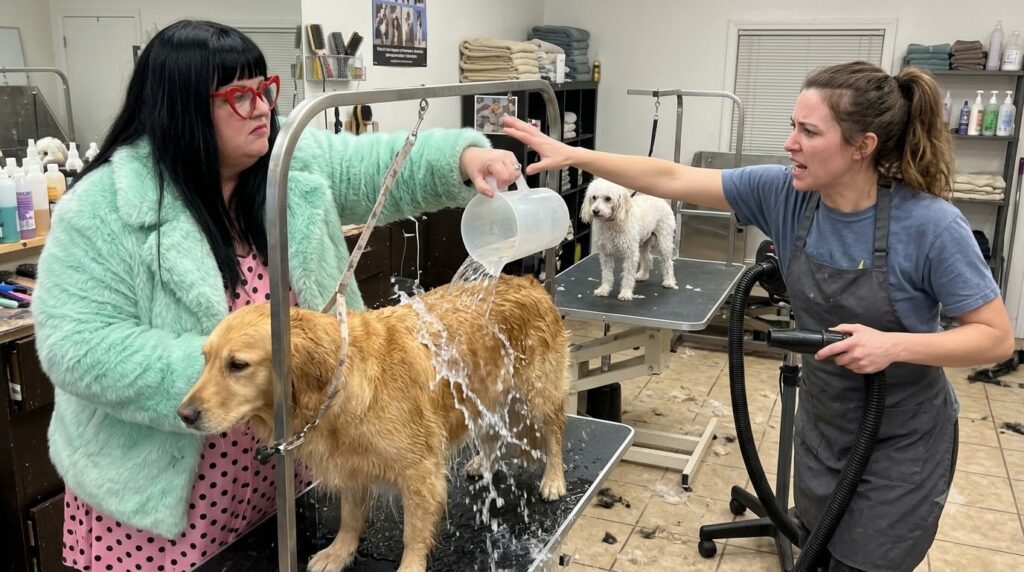
Chapter 2: The Man Waiting for Buddy
Walter Bennett entered the grooming room carrying a folded newspaper beneath one arm.
He was tall but slightly stooped, with silver hair, weathered hands, and the careful movements of a man who had learned to live with persistent pain.
His navy windbreaker bore a small embroidered American flag.
He had driven city buses after leaving the Army and retired eight years earlier. His wife, Margaret, had died three years ago, leaving him with a quiet house, a garden he no longer maintained as carefully, and Buddy.
Buddy had been Margaret’s idea.
She had brought the golden retriever home as a clumsy puppy eleven years earlier, declaring that the house needed more laughter.
Walter had protested.
Then he had spent the next decade pretending Buddy wasn’t his favorite member of the family.
Now, when the house grew too quiet, Buddy followed him from room to room.
The dog was family.
Walter stopped when he saw Buddy’s dripping coat.
His eyebrows drew together.
“Emily, did something happen?”
Emily opened her mouth, but Karen answered first.
“Your dog got wet. These things happen.”
Walter looked toward the empty pitcher on the counter.
Then at Karen, who was still holding the dryer nozzle.
“Wasn’t he here for a bath?”
“He was nearly finished,” Emily said carefully.
Walter noticed the strain in her voice.
He had known Emily for years. She was patient, dependable, and unusually gentle with older dogs.
Something was wrong.
Karen switched off the dryer.
“Look, I have a very important appointment this afternoon. My dog can’t wait around while everyone else gets special treatment.”
Walter glanced at Princess.
The little poodle stood quietly, apparently unaware that her owner had caused a disturbance.
“What appointment?” Walter asked.
Karen straightened.
“That’s none of your business.”
“Fair enough.”
He turned back to Emily.
“Can Buddy still be finished before noon?”
Emily checked the clock.
11:22.
“I’ll do everything I can.”
Karen folded her arms.
“Excuse me. Princess comes first now.”
Walter studied her.
He wasn’t a confrontational man. Decades of military service and public transportation work had taught him that shouting rarely improved a difficult situation.
But he recognized bullying.
He had seen it in schoolyards, workplaces, and occasionally on buses when passengers mistreated elderly riders.
He had also learned that the people who behaved most aggressively often depended on everyone else remaining polite.
“Ma’am,” he said, “I believe we had an appointment before you.”
Karen gave a sharp laugh.
“And I believe my time is more valuable.”
Walter’s expression barely changed.
“That may be what you believe.”
Emily almost smiled.
Karen did not.
She reached into her silver handbag and pulled out her phone.
“This place is going to regret how it’s treating me.”
She began recording.
Emily immediately moved between the phone and the grooming tables.
“Please don’t film our work area without permission.”
Karen ignored her.
“Look at this terrible customer service! They refuse to finish my dog!”
Walter stepped away from the camera.
He disliked being photographed, particularly by strangers. After years of caring for Margaret through her final illness, he had become protective of the little privacy their family had left.
“Please keep me out of your video,” he said.
Karen swung the phone toward him anyway.
“And here’s the man they’re giving special treatment to!”
Emily felt her anger return.
“Stop recording him.”
Karen smiled.
“It’s a free country.”
Walter lowered his eyes briefly.
Then he walked toward Buddy and rested one hand against the dog’s damp shoulder.
Buddy leaned into his touch.
The simple gesture steadied him.
He had come to have his dog groomed, not to become part of a stranger’s online spectacle.
Emily moved to the wall and pressed the button that summoned the salon manager from the office.
Within moments, Denise Morgan appeared.
At sixty-one, Denise had spent twenty-seven years running Rose City Paws. She had built the business with her late husband and survived rising rent, changing neighborhoods, and competition from national pet-store chains.
She knew the difference between an unhappy customer and a dangerous one.
One look at Emily’s face told her this was the second kind.
“What happened?” Denise asked.
Karen immediately launched into a complaint.
Emily waited until she finished.
Then she explained the pitcher, the water, and the dryer.
Denise looked at the soaking golden retriever.
Then at the empty pitcher.
Then at Karen.
“Mrs. Whitmore,” she said, “I’m going to ask you to stop filming and put down our equipment.”
Karen’s smile vanished.
“You should be very careful how you speak to me.”
Denise remained calm.
“Why?”
Karen lifted her phone.
“Because I have twelve thousand followers.”
And for the first time that morning, Denise realized the trouble might not end when Karen walked out the door.