Chapter 10: The Things Worth Protecting
Three months after the incident, Brookhaven Fresh Market looked much as it always had.
The produce displays were neatly arranged.
The bakery smelled of fresh bread.
Shopping carts rattled across the tile floors.
Customers compared prices, checked grocery lists, and searched for their favorite brands.
At checkout lane four, Emily Parker greeted an older couple who were purchasing groceries for a family dinner.
Her repaired hearing aid rested comfortably in her right ear.
She wore her familiar blue polo shirt and name tag.
Her confidence had returned gradually.
Not because she had forgotten what happened.
But because she had learned that one person’s cruelty did not define how everyone else would treat her.
The experience had also changed the way Emily thought about speaking up.
For years, she had tried to make her hearing loss as invisible as possible.
She disliked drawing attention to accommodations.
She worried that explaining her needs might make coworkers uncomfortable.
Now she understood that there was nothing shameful about requiring a hearing aid.
She had earned her position through hard work.
She was good at her job.
And she deserved the same respect as any other employee.
With Daniel’s support, Emily volunteered to help the company review training materials about communicating with customers and coworkers who had hearing differences.
She didn’t want to become the public face of the incident.
She wanted the workplace to become more understanding.
The project was modest.
It included practical guidance about facing someone while speaking, reducing unnecessary background noise when possible, and asking rather than assuming what assistance a person needed.
Emily found the work rewarding.
She had once worried that the confrontation would make her less secure in her job.
Instead, she had discovered a way to contribute beyond the checkout counter.
At home, Linda noticed the difference.
Emily laughed more easily.
She stopped checking her phone every few minutes for updates about the case.
She began making plans with friends again.
On Sundays, she and her mother resumed their tradition of cooking dinner together.
Sometimes Emily’s younger brother joined them.
Sometimes neighbors stopped by.
The conversations were ordinary, warm, and full of the familiar interruptions of family life.
For Linda, those evenings were proof that her daughter was recovering something more important than a hearing aid.
She was recovering peace.
Patricia Whitmore’s life had changed as well.
She no longer chaired the neighborhood committee.
She continued attending her required conflict-management sessions and complied with the court’s conditions.
Her relationship with Caroline remained complicated, but they had begun speaking more openly.
Patricia had started volunteering behind the scenes at a community food pantry, sorting donated goods and assembling grocery bags.
There was no title attached to the work.
No committee to command.
No special recognition.
At first, she found the lack of authority uncomfortable.
But over time, she began to appreciate the simple satisfaction of completing a task without being in charge of anyone else.
She was still impatient.
She still struggled when people disagreed with her.
Change did not come easily after decades of established habits.
But she was learning that other people’s boundaries were not personal insults.
The supermarket’s restriction remained in place.
Patricia did not attempt to challenge it.
She also never received a personal response to her apology letter.
Emily had chosen not to read it.
That decision was respected.
For Patricia, it was an important lesson.
Taking responsibility did not guarantee forgiveness.
And forgiveness, if it ever came, could not be demanded.
One Saturday afternoon, Ruth Bennett visited Brookhaven Fresh Market again.
She had been invited to a small employee appreciation gathering organized by Daniel and Susan.
The event was simple.
Coffee.
Cake.
A few handwritten thank-you cards.
Daniel wanted to recognize the employees who had supported Emily and the customers who had cooperated with the investigation.
He thanked Ruth privately for providing an accurate witness statement while respecting Emily’s privacy.
Ruth accepted the thanks with a modest smile.
She told him that she had spent her career teaching children to stand up for what was right.
It would have been difficult to live with herself if she had ignored that lesson when it mattered.
Emily joined them near the bakery counter.
She was wearing her hearing aid.
Her expression was relaxed.
The three of them spoke for a few minutes about the store, the neighborhood, and Ruth’s grandchildren.
No one needed to revisit the worst moments of the confrontation.
The outcome was already visible.
Emily was working.
Her medical device had been repaired.
Her employer had supported her.
The woman who had mistreated her had faced consequences.
And the people who witnessed the incident had chosen not to look away.
Later that evening, Emily closed her register after a busy shift.
She counted her drawer, organized her station, and collected her belongings.
Outside, the autumn sun was setting behind the parking lot.
Linda was waiting to pick her up.
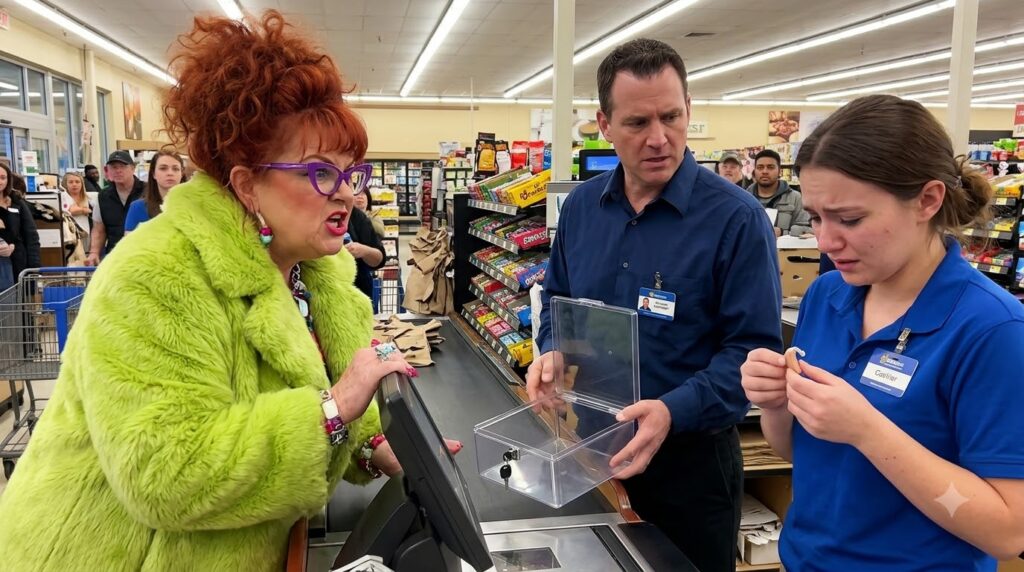
Emily walked toward the entrance, passing the same checkout lane where Patricia had once reached across the counter and taken her hearing aid.
For a moment, she remembered the sound of the security box snapping shut.
That sharp, ugly click.
She remembered the fear of being unable to retrieve something she needed.
She remembered Patricia’s furious expression and the humiliation of being treated as though her disability were a violation.
Then she remembered Daniel unlocking the box.
Susan standing beside her.
Ruth offering her testimony.
Her mother holding her hand at the clinic.
And the quiet determination of people who had refused to let an act of cruelty become the accepted version of events.
Emily stepped through the automatic doors.
The evening air was cool against her face.
She heard a shopping cart rolling across the pavement.
A car door closing.
Her mother calling her from across the parking lot.
She smiled and walked toward the familiar voice.
The world had never been perfectly fair.
Emily knew that.
She had encountered misunderstanding, impatience, and thoughtlessness before.
She would probably encounter them again.
But she had also learned something worth carrying into the future.
Dignity did not depend on wealth, age, social position, or the approval of someone who believed herself important.
It belonged to everyone.
And sometimes protecting it required nothing more extraordinary than a manager willing to say no, a witness willing to tell the truth, and a young woman willing to stand up for herself.
Patricia had believed that locking a hearing aid inside a plastic box would give her control.
Instead, the incident exposed the difference between having power over someone and having the right to exercise it.
The little security box was back in the store’s inventory.
The hearing aid was back where it belonged.
And Emily Parker was going home.
Not as the helpless young cashier Patricia had tried to intimidate.
But as a woman whose dignity had survived the worst moment of an ordinary Tuesday afternoon.
The End.