
Chapter 7: A Different Kind of Neighbor
Three months later, the neighborhood looked different.
Not dramatically.
There were no grand construction projects.
No giant signs.
No speeches.
The changes were smaller.
A cracked curb had been repaired.
A doorway at the community center had been widened.
A confusing parking sign had been replaced.
The accessible route was now clearly marked.
And beside the community center stood a permanent water station.
Marcus still volunteered there.
Karen did too.
Their relationship remained imperfect.
They disagreed about plenty of things.
Sometimes Karen still complained about noise.
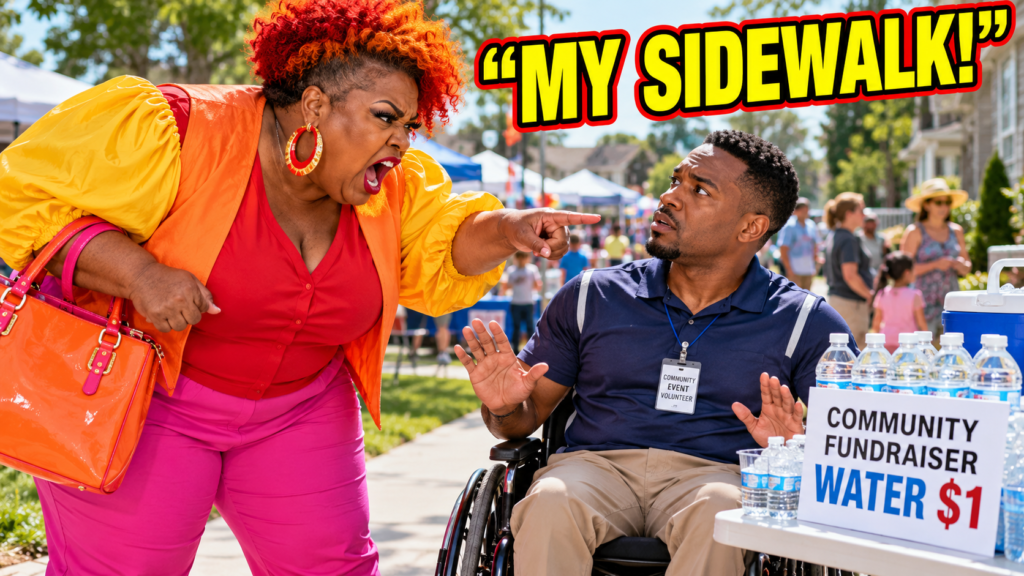
Sometimes Marcus still reminded her that the sidewalk belonged to everyone.
But something important had changed.
Karen no longer pointed at his wheelchair when she was angry.
She pointed at the actual issue.
And Marcus no longer felt that he had to prove he deserved to be there.
One afternoon, an older man approached the community center using a walker.
He stopped at the new ramp.
Then he looked at Marcus.
“Who paid for this?”
Marcus glanced toward Karen.
She was standing several feet away, holding a box of bottled water.
“She did,” Marcus said.
Karen rolled her eyes.
“Don’t make me sound generous.”
The old man laughed.
Karen handed him a bottle.
“No charge.”
Marcus raised an eyebrow.
Karen shrugged.
“Community fundraiser.”
The man smiled.
As he moved up the ramp, Karen watched carefully until he reached the door.
For years, she had thought protecting her neighborhood meant deciding who had the right to use it.
Now she understood something different.
A neighborhood wasn’t a collection of houses.
It was the space between them.
The sidewalks.
The doors.
The ramps.
The places where strangers became neighbors.
The places where someone having a difficult day could stop for a bottle of water and not have to explain why they needed it.
Marcus rolled his chair beside Karen.
“You know,” he said, “you still owe me for that first bottle.”
Karen looked at him in disbelief.
“After everything I’ve done?”
“You drank it.”
She stared at him.
Then, unexpectedly, she laughed.
It was the first time Marcus had heard her laugh without anger behind it.
Karen reached into her enormous neon-orange handbag and pulled out a dollar.
She dropped it into the fundraiser box.
“Keep the change.”
Marcus looked inside.
It was a five-dollar bill.
He smiled.
Around them, the neighborhood continued moving.
Cars passed.
Children ran across the grass.
Older residents walked slowly toward the community center.
And the sidewalk remained what it had always been supposed to be:
A place where everyone could move forward.
Together.








