
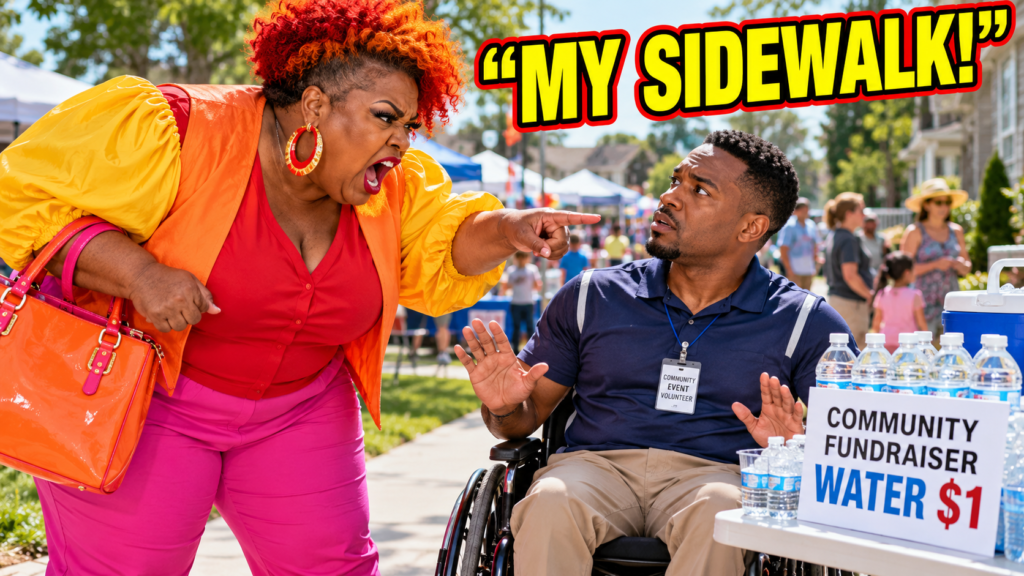
Chapter 2: The Notice Nobody Authorized
By late morning, Marcus had sold almost every bottle of water.
The fundraiser was raising money for a local community-access project, something he had volunteered for after noticing how many older residents struggled with uneven sidewalks, heavy doors, and narrow entrances.
He wasn’t doing it for sympathy.
He was doing it because he knew what it meant to need a little more room in a world that often gave you less.
But the unsigned notice remained under the table.
Marcus took a photograph of it.
Then he walked—or rather, rolled—toward the event coordinator, Linda Harper.
Linda was a retired school administrator in her late sixties. She had organized neighborhood events for years and knew almost everyone.
She read the notice twice.
“I didn’t issue this.”
Marcus handed her the photograph.
“Do you know who did?”
Linda shook her head.
Then she noticed something else.
The paper wasn’t printed on official community-association stationery.
The logo had been copied, but the bottom line was missing the association’s registration number.
Linda’s expression became serious.
Someone had tried to make an unofficial order look legitimate.
She called the association office.
While they waited for an answer, Karen appeared again.
This time she wasn’t alone.
She carried a folder under one arm.
“You were told to move,” she said.
Linda stepped between them.
“No. He was given an approved location.”
Karen opened the folder.
“I have complaints from residents.”
“How many?” Linda asked.
Karen hesitated.
“Several.”
“Names?”
Karen closed the folder.
“People don’t want their names dragged into this.”
Linda knew that answer.
It meant she had no list.
Karen then changed tactics.
“I’ve lived here twenty-two years. I know what this neighborhood needs.”
Marcus quietly replied, “Then you know we need to keep the access route open.”
Karen looked at his wheelchair.
Her expression hardened.
“This isn’t about your wheelchair.”
Marcus nodded.
“Then let’s keep it about the table.”
That answer left Karen with nowhere comfortable to stand.
She turned toward Linda.
“You’re making a mistake.”
Then she walked away.
A few minutes later, the association office called.
There was no complaint on file.
No removal order.
No violation.
And no authorization for the notice.
Linda looked at Marcus.
Someone had fabricated the warning.
That changed everything.
But before they could investigate, another problem appeared.
A volunteer came running from the parking lot.
“Marcus, your van is blocked.”
Marcus followed her gaze.
His accessible van sat behind a vehicle parked diagonally across the loading area.
There was no driver inside.
On the windshield was another handwritten message.
NEXT TIME, FOLLOW THE RULES.
Marcus stared at it.
The conflict was no longer about a bottle of water.
Someone was deliberately trying to make it impossible for him to remain at the event.








