
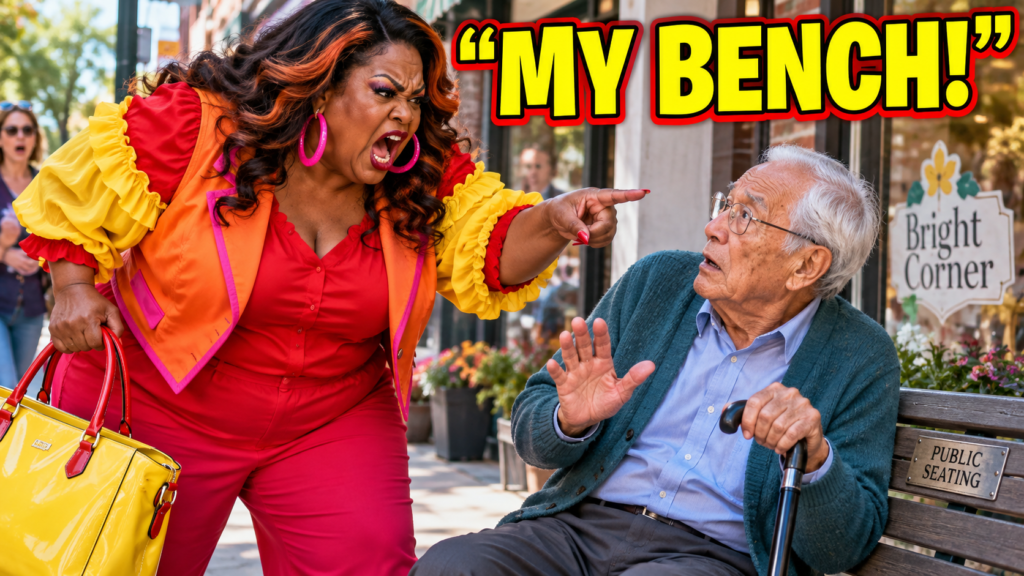
Chapter 6: What the Bench Revealed
The violations were not dramatic by themselves.
A planter placed too close to the walkway.
An unauthorized sign.
A chain attached to a public fixture.
A display extending beyond the permitted boundary.
None of them seemed important alone.
Together, they revealed a habit.
Karen had slowly expanded the invisible border around her business until public space began to look private.
She had treated the sidewalk as an extension of her storefront.
The bench was simply where someone finally challenged the boundary.
Karen was required to remove the barriers.
The new bench was installed several days later.
It had a sturdier seat, a supportive back, and enough room beside it for someone using a cane or walker.
Walter came to see it.
He stood there for a long moment.
Emily waited beside him.
“Go ahead,” she said.
Walter sat.
His shoulders relaxed.
It was only a bench.
But to him, it represented something larger.
A small piece of dignity had been returned.
Then Megan approached.
She had found another job at a nearby bookstore.
She thanked Walter for speaking at the meeting.
Walter shook his head.
“I didn’t do much.”
“You did enough,” she said.
Across the street, Karen stood outside Bright Corner.
She looked at the new bench.
For the first time, there was nothing she could move.
Nothing she could claim.
Nothing she could place a handbag on to make it hers.
She turned toward her storefront.
But the consequences had followed her inside.
Several neighboring businesses had stopped participating in her campaign against the city.
Customers had begun asking questions about the sidewalk notices.
And Megan’s absence had left Bright Corner short-staffed.
Karen still believed she had been treated unfairly.
But she could no longer control the story by controlling the space.
Walter returned to the bench the following week.
This time, another older man was already sitting there.
Walter smiled.
“Mind if I join you?”
The man moved his newspaper.
“Plenty of room.”
Walter sat beside him.
Neither man mentioned Karen.
They didn’t have to.








