
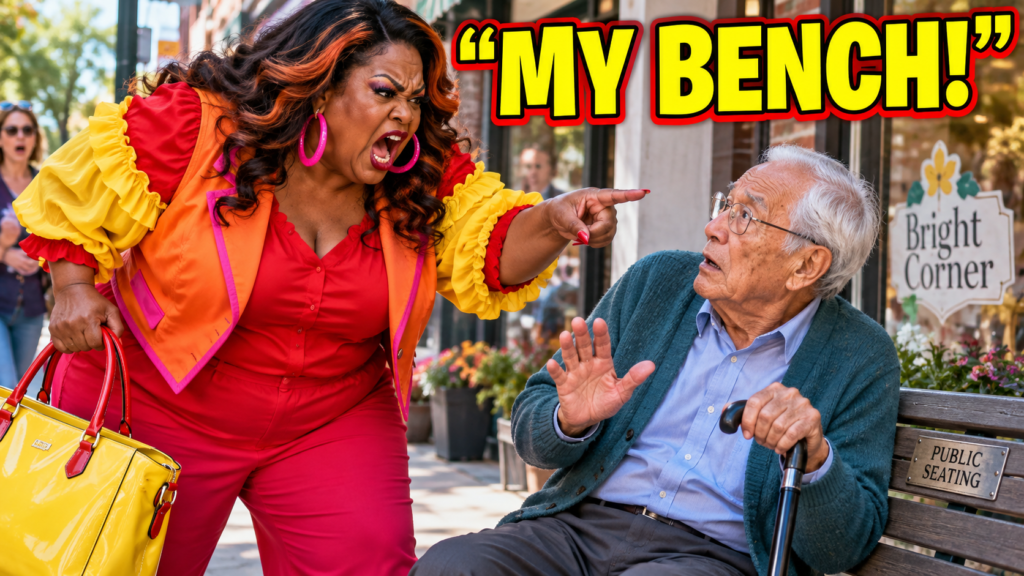
Chapter 2: The Sidewalk Wasn’t Hers
The city employee arrived twenty minutes later.
His name was Daniel Brooks, a public-works inspector in his fifties who had spent years dealing with complaints involving sidewalks, accessibility, parking, and public fixtures.
He examined the bench first.
Then the plaque.
Then the pavement surrounding it.
Karen stood nearby with her arms folded.
“This is ridiculous,” she said. “I have maintained this area for years.”
Daniel remained calm.
“Maintaining an area doesn’t make it private.”
Karen pointed toward the storefront.
“I pay taxes here. I pay for cleaning. I’ve replaced that trash can twice.”
Daniel nodded.
“Those things may be true. But this bench is city property.”
Walter said nothing.
He didn’t need to.
The plaque had already said what he needed.
But Daniel discovered something else.
The bench wasn’t merely public. It had been installed specifically as part of a pedestrian-rest project designed to provide seating for older adults and people who needed a place to stop while walking through the district.
Daniel photographed the bench and the obstruction around it.
Then he looked at Walter.
“Were you prevented from using it?”
Walter nodded.
“Yes.”
Karen immediately interrupted.
“I didn’t prevent him. I told him to move because customers need access to my storefront.”
Daniel measured the distance between the bench and the entrance.
“There is more than enough clearance.”
Karen’s jaw tightened.
Daniel wrote something on his clipboard.
That was when Walter noticed a second problem.
Several small planters had been moved onto the sidewalk beside the bench.
They narrowed the walking path.
One of them had a handwritten sticker:
BRIGHT CORNER — PRIVATE
Walter frowned.
“Were those placed there by the store?”
Karen answered before Daniel could.
“They’re temporary.”
Daniel crouched beside one.
The sticker was fresh.
The planter was heavy.
And its position wasn’t random.
It created a narrow channel that forced pedestrians away from the bench and toward the storefront.
Daniel stood.
“Who moved these?”
Karen said nothing.
Her employee, Megan, looked toward the ground.
That silence told Walter more than an answer would have.
Daniel gave Karen a written notice requiring the planters to be removed.
Karen snatched the paper.
“This is harassment.”
“No,” Daniel said. “This is documentation.”
That word changed everything.
Walter watched Karen fold the notice into her handbag.
She wasn’t backing down.
She was changing tactics.
And that afternoon, she began telling neighboring businesses that Walter had deliberately caused trouble for her store.
By evening, Walter’s phone rang.
It was his daughter, Emily.
Her voice was worried.
“Dad, someone posted your picture online.”
Walter closed his eyes.
The bench had become something much bigger.








