
Chapter 7: The Key
Three months later, the mailbox station looked exactly as it had before.
That was the strange thing.
The same quiet street.
The same trees.
The same afternoon sunlight.
The same row of metal doors.
But Frank knew better now.
Ordinary places could hold extraordinary lessons.
He arrived one afternoon carrying his grocery bag.
At his mailbox, he paused.
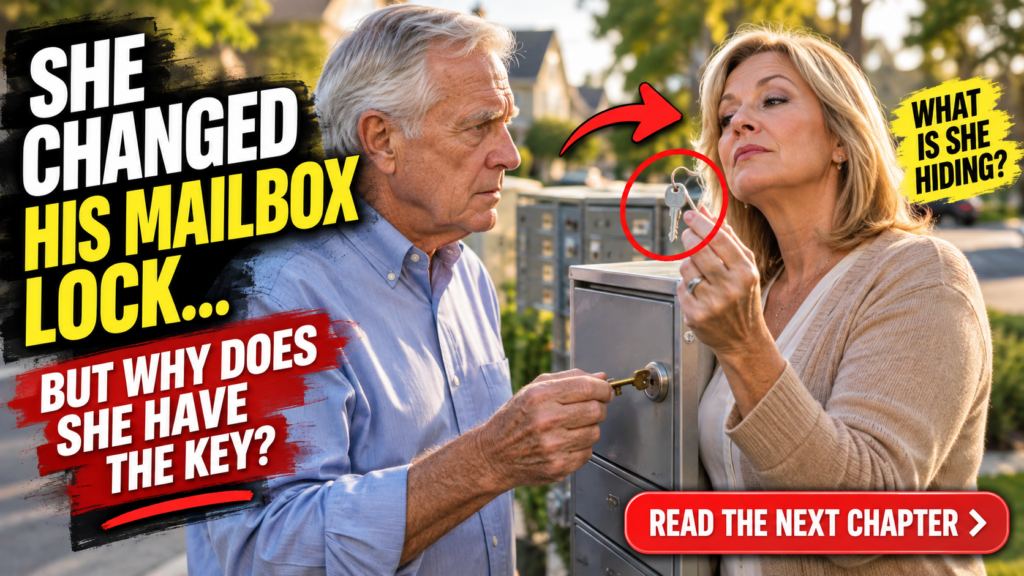
For a moment, he remembered the old brass key scraping uselessly against the unfamiliar lock.
He remembered Karen holding the replacement key.
He remembered her confidence.
I changed the lock.
As though changing the lock had given her the right to decide who belonged on the other side.
Frank opened his mailbox with his new key.
Inside was a birthday card from his daughter.
He smiled.
Then he noticed another envelope.
It was from the HOA.
He opened it.
The board had formally adopted the new mailbox privacy rules.
There was also a handwritten note from Linda Perez.
Thank you for refusing to let this become “just a misunderstanding.”
Frank folded the letter.
He understood what she meant.
A misunderstanding could be dismissed.
A mistake could be forgotten.
But some things required a boundary.
He looked across the mailbox row.
Evelyn was walking toward him.
Harold was behind her.
Walter followed with his cane.
They had begun meeting there once a week.
Not officially.
No committee.
No agenda.
Just neighbors checking on neighbors.
Evelyn smiled.
“Anything interesting?”
Frank held up his daughter’s card.
“The important stuff.”
She laughed.
The four of them stood together beneath the late-afternoon sun.
Nobody talked about Karen.
Nobody needed to.
The community had moved forward.
There had been consequences.
There had been apologies.
There had been legal proceedings and uncomfortable conversations.
But there had also been something better.
People had learned to question authority without losing their manners.
They had learned that kindness did not mean surrendering boundaries.
They had learned that growing older did not mean becoming invisible.
And Frank had learned one final thing.
A key was a small object.
Easy to lose.
Easy to copy.
Easy to hold in someone else’s hand.
But what it represented was much larger.
Access.
Trust.
Permission.
Choice.
Frank slipped his daughter’s card into his jacket pocket.
Then he locked the mailbox.
He turned the key slowly, feeling the mechanism catch.
Click.
This time, the sound was different.
Not the sharp metallic rejection he had heard months before.
It was a quiet confirmation.
The lock opened when he asked it to.
And closed when he chose.
Frank looked down the row of mailboxes before walking home.
For years, he had thought of the mailbox as nothing more than a metal box on a post.
Now he understood that home was not only the place behind your front door.
Home was every small place where you were entitled to feel safe, respected, and in control of what belonged to you.
Sometimes protecting that home meant making noise.
Sometimes it meant asking uncomfortable questions.
And sometimes, it simply meant refusing to accept a key from someone who had never had the right to hold it.








