
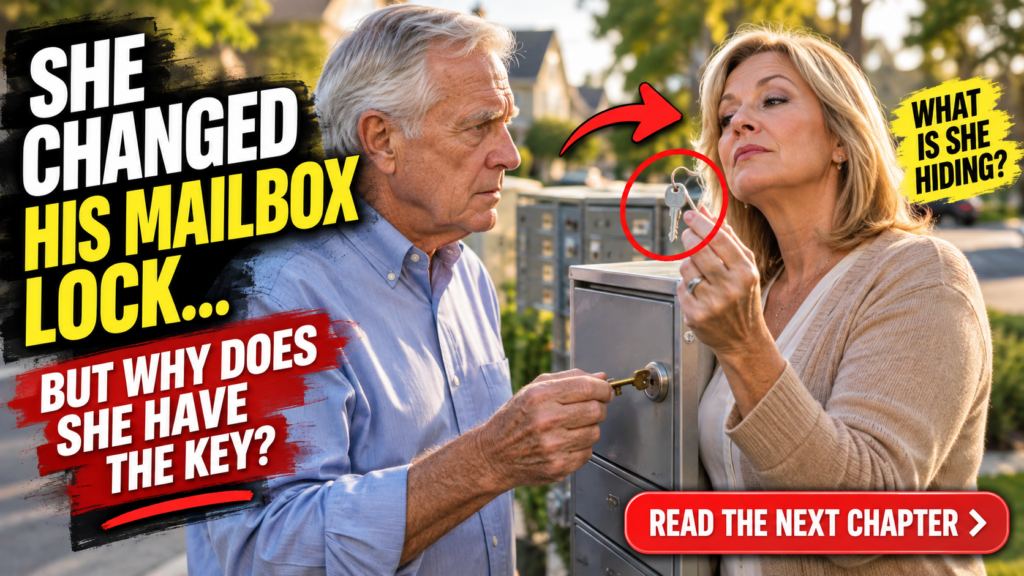
Chapter 4: The Envelope
The HOA hired an independent locksmith the following morning.
The locksmith inspected every mailbox.
His conclusion was unsettling.
The replacement locks were inexpensive residential cabinet-style locks, not the commercial mailbox locks normally used at the station.
They had been installed improperly.
More importantly, several locks could be opened with duplicate keys that appeared to have been cut from the same original pattern.
Frank asked whether that was normal.
The locksmith shook his head.
“No.”
“Could someone have made copies?”
“Easily.”
Frank felt the anger rising again.
But anger was not evidence.
So he kept collecting evidence.
The police were contacted.
They did not immediately treat the matter as a criminal case because there had been no confirmed theft.
Still, an officer took statements from the affected residents.
Evelyn told them about Karen’s questions regarding her bank statements.
Walter explained that he had been unable to access his mail for nearly a week.
Harold admitted that Karen had once asked him whether he was expecting “anything important.”
Then Thomas handed the officer the security footage.
The officer watched it twice.
“Do you know the man?”
“No,” Thomas said.
Frank didn’t either.
Karen had stopped answering calls.
Her house was quiet.
Her car remained in the driveway.
Then, three days into the investigation, something happened that nobody expected.
Evelyn called Frank.
Her voice was shaking.
“Frank, I found something.”
He drove over immediately.
She had discovered an envelope wedged behind a drawer in her hallway cabinet.
It contained photocopies of documents from several residents.
Bank correspondence.
Insurance notices.
Property tax letters.
Mortgage statements.
None belonged to Evelyn.
One had Frank’s name on it.
His heart seemed to stop.
“How did this get here?”
“I don’t know.”
Frank called the police.
The officer arrived within twenty minutes.
The documents were cataloged and collected.
That afternoon, detectives searched Karen’s home with proper authorization.
They found no large stash of mail.
But they found something else.
A notebook.
Inside were names, mailbox numbers, dates, and notes.
Some were ordinary.
Others were not.
Frank Mercer — travels alone. Daughter out of state.
Evelyn Carter — daughter visits twice a month.
Walter Greene — checks mailbox late afternoon.
Harold Bennett — usually away Tuesday mornings.
Frank read the list and felt something inside him go cold.
This wasn’t neighborhood control.
It was information gathering.
Karen had been tracking people’s routines.
The detectives also discovered receipts showing that Karen had purchased multiple locks and duplicate keys.
But the biggest revelation came from the man in the video.
His name was Daniel Whitmore.
Karen’s younger brother.
He had a history of working as a handyman and locksmith’s assistant.
He was questioned.
At first, he denied involvement.
Then investigators confronted him with the footage.
He admitted replacing the locks.
But he insisted Karen had told him she had authorization.
“Why did she want the keys?” the detective asked.
Daniel wouldn’t answer.
Not at first.
Then he finally said:
“She said some people in the neighborhood were leaving valuables in their mailboxes.”
Frank almost laughed.
Almost.
There was nothing funny about it.
The detective asked whether Daniel had opened any boxes.
Daniel looked down.
“I didn’t.”
“Did Karen?”
Another silence.
Then:
“I don’t know.”
But the notebook suggested otherwise.
That evening, Frank returned home and found his mailbox standing open.
The original lock had been removed.
A new commercial-grade lock had been installed by the authorized locksmith.
Inside was his mail.
Nothing appeared missing.
But sitting on top was a plain white envelope.
Frank picked it up.
There was no return address.
Inside was a single photocopy.
It showed the first page of the notebook.
His name was circled.
Underneath it, someone had written:
You were right to keep asking.
For the first time since the ordeal began, Frank felt something other than anger.
He felt fear.
Not because of Karen.
Because someone else had been watching too.








