Chapter 5: The Petition
The signatures were real.
That was the problem.
Karen had not completely fabricated them.
But the wording was different from what she had claimed.
The petition requested that the neighborhood ask the city to review pedestrian safety around the entrance.
It did not authorize Karen to close the gate.
It did not establish resident-only access.
It did not give her enforcement authority.
Several residents admitted they had signed because they believed they were supporting better lighting and safer walking conditions.
One elderly couple had thought they were signing a request for a crosswalk.
A mother had signed because she wanted traffic-calming measures near the entrance.
Karen had apparently presented the petition as evidence that everyone supported her restrictions.
The room fell silent.
The chairman asked her directly whether she had explained the petition’s actual purpose to every signer.
Karen didn’t answer immediately.
That silence said enough.
But Margaret wasn’t interested in humiliating her.
She pointed toward the real problem.
“The safety concerns are legitimate,” she said. “The method isn’t.”
That distinction changed the direction of the meeting.
Instead of simply reversing Karen’s actions, the board created a legitimate safety committee.
Residents could raise concerns.
The city could assess lighting, visibility, pedestrian traffic, and signage.
A formal request could be submitted.
Everything Karen had been trying to accomplish through personal authority could be addressed through proper channels.
Except for one thing.
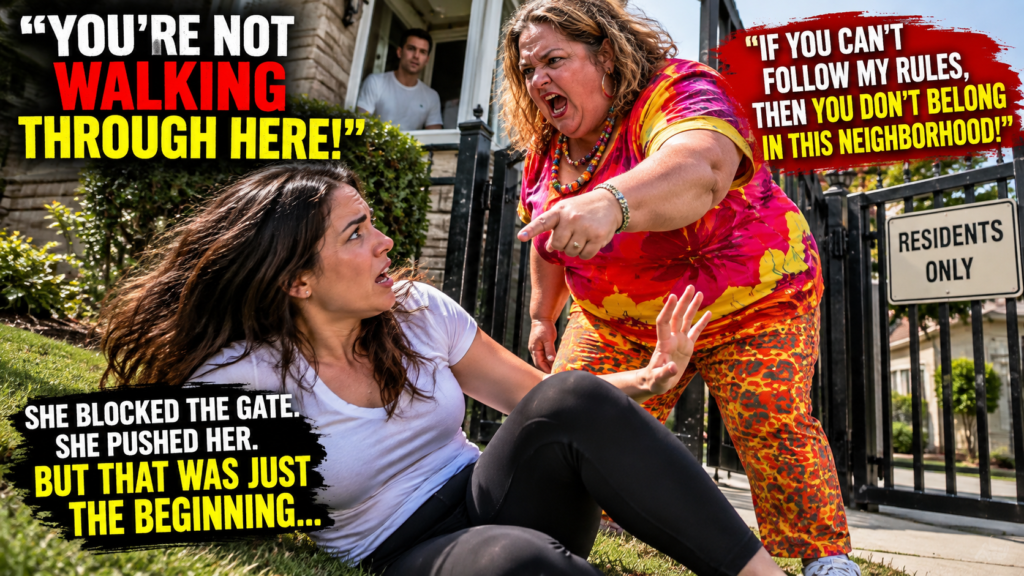
Karen had crossed a line when she physically blocked Emily.
The board could not ignore that.
They recommended a formal warning and instructed Karen not to interfere with access to the public path.
The city separately documented the unauthorized closure.
Karen sat quietly.
For several minutes, she said nothing.
Then Emily noticed something unexpected.
Karen wasn’t angry.
She looked exhausted.
After the meeting, Karen left before everyone else.
Emily stepped outside.
She found Karen standing beside the parking lot.
For once, there was no audience.
Karen didn’t look at her.
“I was trying to keep the neighborhood safe,” she said.
Emily waited.
“I know,” she replied.
Karen finally looked over.
“You don’t believe me.”
“I believe you thought you were helping.”
Karen’s expression tightened.
“And?”
Emily took a breath.
“Good intentions don’t give us the right to control other people.”
Karen looked toward the gate.
For a long moment, neither woman spoke.
Then Karen said something Emily hadn’t expected.
“I’ve lived here twenty years.”
“So have a lot of people.”
“I used to know everyone.”
Emily understood then.
Karen wasn’t only angry about the gate.
She was angry because the neighborhood had changed.
New families had arrived.
Older residents had grown less active.
The street looked different.
People walked through whom Karen didn’t recognize.
The familiar community she remembered was disappearing.
Her fear had turned into control.
Control had turned into confrontation.
And confrontation had finally exposed the difference between caring about a neighborhood and owning it.
Emily could have walked away.
Instead, she said, “If you want to help make it safer, come to the committee.”
Karen looked genuinely surprised.
“After what happened?”
Emily nodded.
“If you can work with everyone else.”
Karen didn’t answer.
But she didn’t walk away either.