Chapter 3: The Complaint That Changed Everything
Three days later, another resident came forward.
His name was Robert Hayes.
Robert was seventy-six and walked with a cane after knee surgery.
He told Margaret that Karen had stopped him at the same gate the previous week.
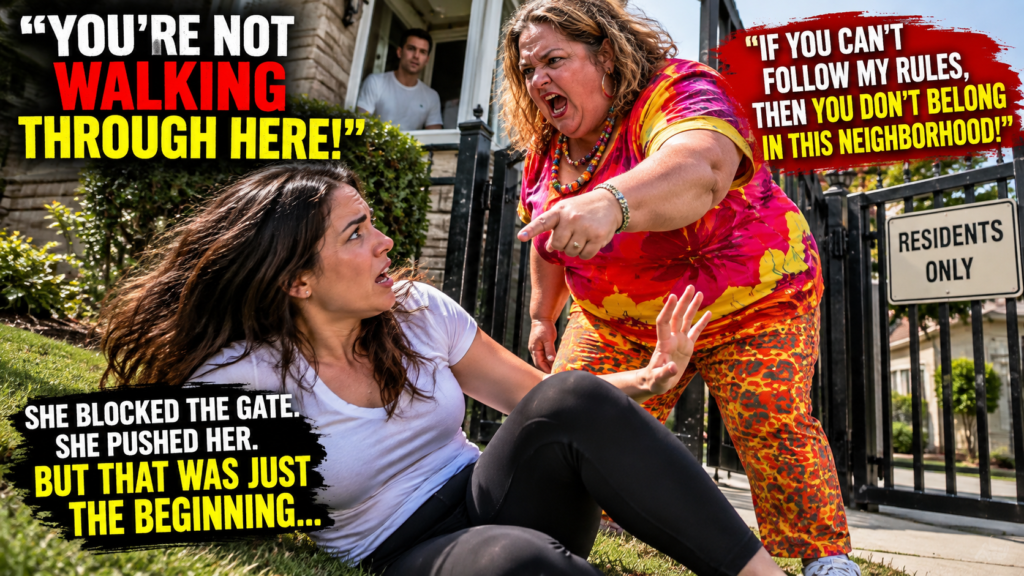
She had told him the walkway was “for residents only.”
Robert had laughed because he was a resident.
Then Karen had demanded to see his house number.
Robert refused.
He had turned around and taken the longer route instead.
That was when Margaret realized the problem was bigger than Emily.
Karen wasn’t simply having a disagreement with one neighbor.
She was creating her own private system of permission.
And people were quietly obeying because they didn’t want trouble.
Emily felt something change inside her when she heard Robert’s story.
The incident at the gate no longer felt like an embarrassing personal confrontation.
It felt like a pattern.
Still, Margaret warned everyone against turning it into a neighborhood war.
“We need facts,” she said.
So they gathered them.
Photographs of the gate.
Copies of the city map.
Old HOA documents.
Previous meeting minutes.
Emails.
Witness statements.
Nobody exaggerated what had happened.
Nobody called Karen names.
They simply recorded what they could prove.
Then, unexpectedly, Daniel discovered something.
The gate had once been scheduled for repairs.
The original project documents showed that the city had specifically required the pedestrian entrance to remain accessible.
The gate had been installed years earlier as a safety measure, not as a private boundary.
That explained why there was no HOA rule.
But it didn’t explain Karen.
Then Robert remembered something.
About six weeks earlier, Karen had complained at a neighborhood meeting about strangers walking through the area.
She had argued that people from outside the neighborhood were using the path.
The board had listened.
But they had not approved her proposal to restrict access.
Margaret remembered the meeting.
Karen had been furious afterward.
“She told me,” Margaret said, “that if the board wouldn’t protect the neighborhood, someone had to.”
Emily looked toward the window.
“So she decided she was that someone.”
Margaret nodded.
“That appears to be what happened.”
But then another detail surfaced.
A resident had taken a photograph of Karen placing a temporary notice near the gate.
The notice wasn’t official.
It simply said:
RESIDENT ACCESS ONLY.
There was no HOA logo.
No city authorization.
No contact information.
Just Karen’s handwritten rule.
Emily looked at the photograph for a long moment.
Then she said something that surprised everyone.
“I don’t want her punished.”
Margaret raised an eyebrow.
“What do you want?”
“I want her to stop deciding who belongs.”
That became the central issue.
Not revenge.
Not humiliation.
Not winning an argument.
Just the right to walk through a gate without asking another neighbor for permission.
But Karen wasn’t finished.
The next morning, the gate was chained shut.