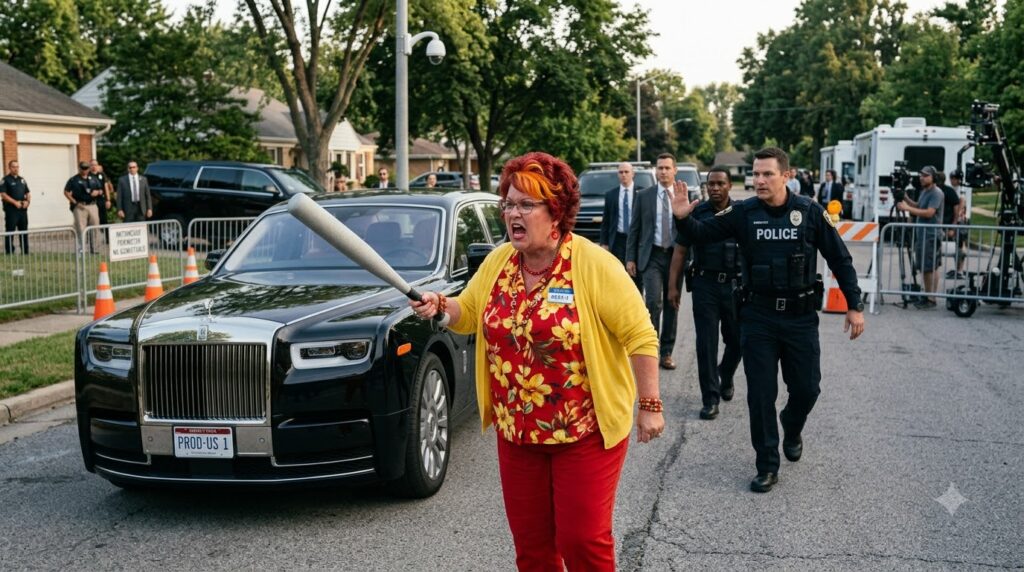
Chapter 4: What Being a Neighbor Meant
The motorcade finally began moving.
The Rolls-Royce rolled forward smoothly, leaving the temporary security area exactly as the officers had planned.
Marjorie stood on the sidewalk and watched it disappear.
Nothing about the vehicle’s departure proved she had been right.
It simply proved the operation had ended.
A security officer approached her after the street began reopening.
“Are you finished here?”
Marjorie looked at him.
“I want to know something.”
He waited.
“If I live here, don’t I have a right to speak up when something happens on my street?”
“Yes.”
“Then why did everyone act like I was wrong for speaking up?”
“Because you didn’t stop at speaking up.”
She looked away.
He continued.
“You could have asked why the street was closed. You could have asked when it would reopen. You could have raised concerns about access. You chose to enter a restricted area and interfere with the vehicle.”
Marjorie remembered her first shout.
Move it.
She had not asked a question.
She had issued an order.
The difference suddenly seemed much larger than it had that morning.
She looked down at her empty hands.
The foam bat was gone.
So was the certainty that had come with holding it.
“I thought they were ignoring the neighborhood,” she said.
“They weren’t.”
Marjorie nodded slowly.
The officer did not push her further.
He simply walked back toward the security team.
Marjorie remained on the sidewalk.
The street was almost normal again.
Cars began moving through the intersection. Residents came out of their homes. The barriers were being removed.
She could have gone home and insisted she had been mistreated.
She could have told the story differently.
She could have said the officers were disrespectful, the security team was unreasonable, and the whole situation had been unnecessary.
Instead, she looked at the place where the temporary sign had stood.
She had seen it.
She had understood it.
She had simply believed her own status as a resident outweighed it.
That was the part she could no longer explain away.
Before leaving, Marjorie turned toward the officer.
“I still don’t like being told what I can do on my own street.”
He gave a small nod.
“You don’t have to like it.”
She almost smiled.
Almost.
Then she said, “But I have to follow it.”
“Yes.”
She walked home.
The neighborhood was still hers in the only sense that had ever truly mattered.
It was where she lived.
It was not hers to command.