
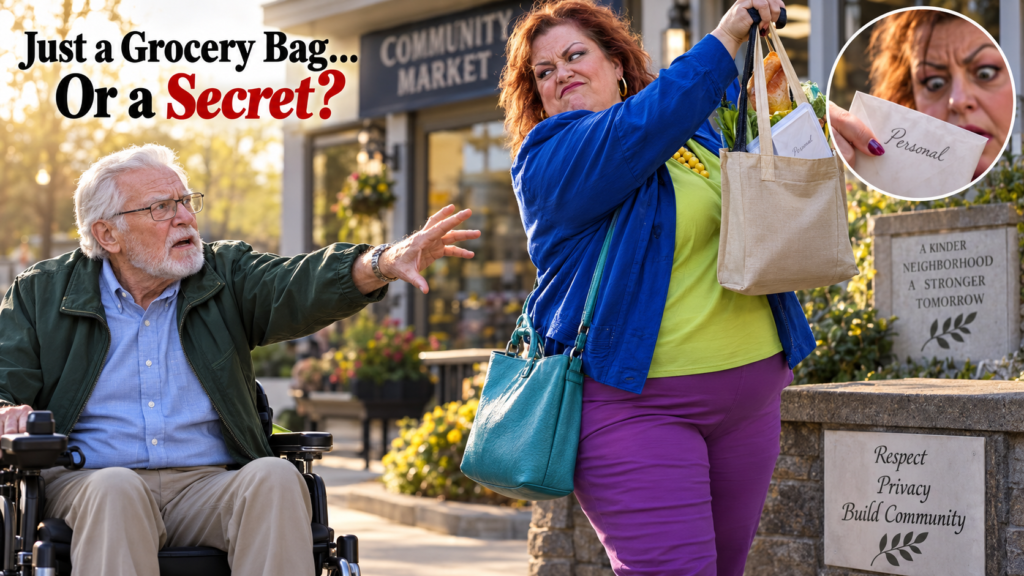
Chapter 2: The Name on the Envelope
Karen had spent years believing that knowing what happened in the neighborhood was the same as having a right to know.
She knew which homeowners were planning to sell.
She knew whose children had moved away.
She knew which houses had received repair crews and which residents had complained about the community board.
If a delivery truck stopped outside someone’s house, Karen noticed.
If a neighbor received an unfamiliar visitor, Karen remembered.
And if someone tried to keep something private, Karen considered that suspicious.
The older homeowner had learned this about her long ago.
He had simply never expected her to take it this far.
He reached for the grocery bag again.
Karen held it tightly.
“Put it down.”
“Tell me what’s in the envelope.”
“No.”
The answer was immediate.
Calm.
Final.
Karen’s face tightened.
“You’re making this much worse than it needs to be.”
The irony was almost unbearable.
She was the one holding his property.
She was the one blocking his access to it.
Yet she spoke as though he were responsible for the confrontation.
The homeowner looked around the walkway.
There were no witnesses close enough to hear the conversation clearly. The neighborhood was quiet, the community room nearby nearly empty.
He could have shouted.
He didn’t.
Instead, he took a breath and said, “You took something that doesn’t belong to you. Give it back.”
Karen ignored him.
Her attention remained fixed on the envelope.
The handwritten name was partially covered by the folds of the bag, but she had already seen enough.
It belonged to someone she knew.
Someone who had once been connected to the neighborhood association.
Someone Karen had been asking about for weeks.
The homeowner noticed the change in her expression.
“You know that name.”
Karen’s eyes snapped toward him.
“I know a lot of names.”
“Then you also know this has nothing to do with you.”
She scoffed.
“That’s what people say when they don’t want anyone asking questions.”
He stared at her.
“This isn’t your business.”
Karen finally lowered the bag.
For one hopeful second, he thought she might return it.
Instead, she placed it on top of the waist-high planter ledge.
Not on the wheelchair.
Not in his hands.
On the ledge.
Still out of reach.
The man looked at the bag.
Then at Karen.
“You did that on purpose.”
She shrugged.
“You can get it when you calm down.”
His jaw tightened.
“I am calm.”
“No, you’re not.”
“I was calm until you took my property.”
Karen folded her arms.
The older man looked at the bag again.
He could have attempted to reach for it.
But the angle was awkward, and he knew it.
Karen knew it too.
The moment was no longer about groceries.
It was about control.
And Karen had decided she was entitled to it.
She glanced toward the sealed envelope.
“Who’s it from?”
The man said nothing.
Karen’s confidence returned.
“That name,” she said quietly. “I’ve seen it before.”
Still nothing.
Her eyes sharpened.
“So that’s why you’ve been avoiding everyone.”
The homeowner slowly turned his wheelchair toward her.
“I have avoided no one.”
“You think people don’t notice?”
“People notice plenty.”
“Exactly.”
“And sometimes,” he said, “they notice things that aren’t theirs to discuss.”
That sentence struck harder than an insult.
Karen’s face reddened.
She reached toward the bag.
The homeowner moved his hand over the envelope through the opening.
“Don’t.”
Karen froze.
For the first time, she seemed unsure of what he might do.
He didn’t threaten her.
He simply looked at her with quiet determination.
“I don’t care what you think you know,” he said. “That envelope is private.”
Karen stared at him.
Then she looked down at the bag.
The name was still there.
And now she remembered exactly where she had seen it.
It had been on an old community document.
A document Karen had once tried to obtain.
A document that had disappeared before she could read it.
Her curiosity suddenly became something more dangerous.
Because if the envelope was connected to that document, this might not be gossip.
It might be information.
And Karen had never been good at leaving information alone.








