
Chapter 7: What Stayed After the Water Returned
A month later, the neighborhood had mostly forgotten the excavation.
The road had been repaired.
The utility markings had faded.
The city trucks were gone.
But something had changed.
Karen no longer treated the access lane as an extension of her driveway.
She had also started attending neighborhood meetings.
At first, people were cautious around her.
Frank was the first to speak to her again.
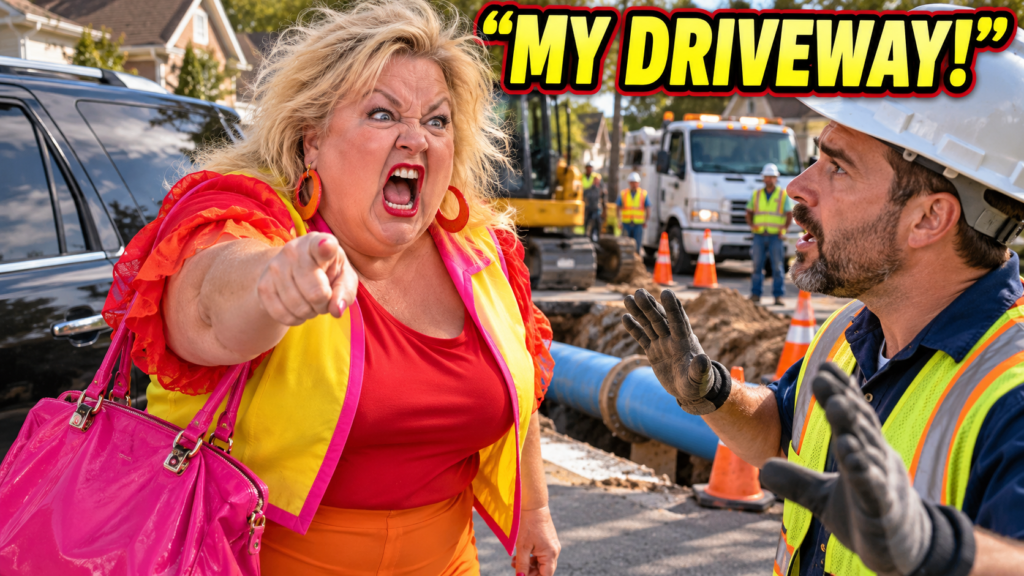
One Saturday morning, he found her standing near the curb while a delivery truck passed through the access corridor.
She watched it go.
Then she laughed quietly.
“You know,” she said, “I used to think everyone was trying to take something from me.”
Frank looked at her.
“And now?”
Karen glanced toward her house.
“Now I think sometimes I was holding on so tightly that I couldn’t see what something was actually for.”
Frank nodded.
Neither of them made a speech.
There was no dramatic apology in front of the entire neighborhood.
There didn’t need to be.
The real change was smaller.
Karen began leaving the access route clear.
She stopped confronting workers before checking their permits.
She asked questions instead of assuming she already knew the answer.
And when the city eventually replaced another section of aging infrastructure several months later, Karen stood on her porch and watched the crew work.
This time, she brought them water.
Daniel happened to be supervising.
He looked at the bottles.
Then at Karen.
She shrugged.
“Don’t make a big deal out of it.”
He smiled.
“I wasn’t going to.”
She hesitated.
“Daniel?”
“Yes?”
“I still think that old map was confusing.”
“It was.”
“And I still think the city could explain these things better.”
“We probably could.”
Karen nodded.
That answer seemed to satisfy her.
She walked back toward her house.
The neighborhood had not become perfect.
People still disagreed.
Residents still argued about parking, construction, property lines, and noise.
But Karen had learned something more useful than simply learning that she was wrong.
She had learned that dignity didn’t require winning every confrontation.
Sometimes dignity meant admitting when a belief no longer matched reality.
And sometimes fairness meant understanding that the space outside your home could still belong to something larger than you.
Months later, Daniel’s utility truck passed Karen’s house during another routine inspection.
The camera above the windshield was still there.
Karen noticed it.
She looked up.
Then she laughed.
This time, she waved.
Daniel waved back.
The truck continued down the street.
Behind it, the access lane remained completely clear.
And for the first time, Karen didn’t see that lane as something being taken away from her.
She saw it for what it had always been:
a path meant to remain open when someone else needed to get through.








