
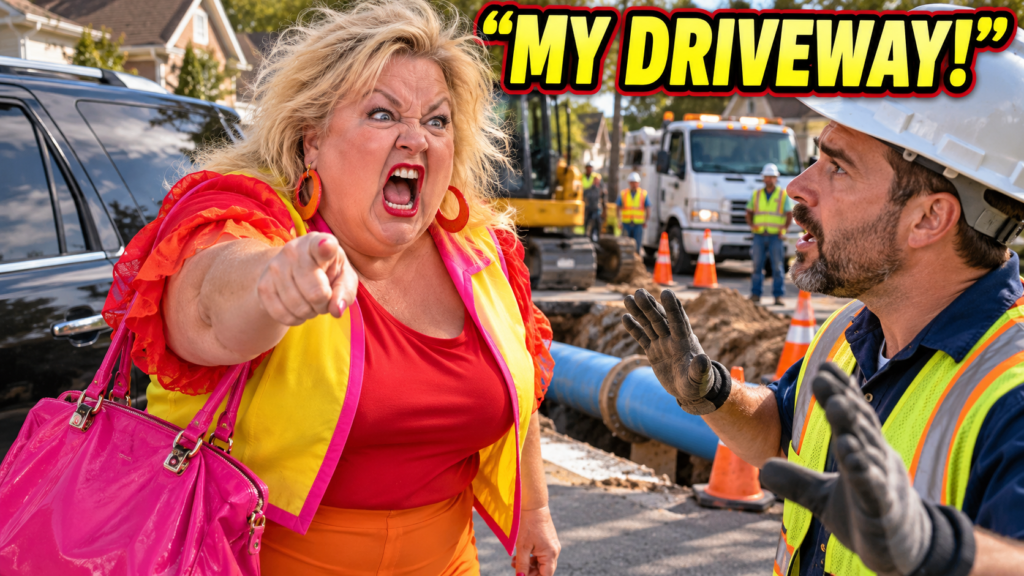
Chapter 4: The Neighborhood Starts Paying the Price
By the third day, the unfinished repair was no longer invisible.
Several homes had experienced reduced water pressure.
An elderly couple at the far end of the street had postponed a planned family gathering because their kitchen plumbing was unreliable.
A nearby resident, Frank Delaney, had lived in the neighborhood for thirty-two years.
He knew what it meant when a simple municipal repair turned into a prolonged dispute.
Frank walked over to Daniel while the crew prepared to return.
“How long until you can finish?”
“If we get access, a few hours.”
Frank looked toward Karen’s house.
“And if we don’t?”
Daniel hesitated.
“We’ll have to secure the area again and come back.”
Frank sighed.
At seventy-one, he had learned that inconvenience became expensive when everyone waited for someone else to solve it.
He walked to Karen’s house.
She opened the door cautiously.
Frank didn’t yell.
He didn’t accuse her.
He simply said, “Karen, my wife and I have lived here longer than most of these houses have had their current owners. I don’t care about your argument with the city. I care about getting the water fixed.”
Karen crossed her arms.
“They can fix it without blocking me.”
“They’ve explained why they can’t.”
“They’re choosing not to.”
Frank looked at her.
“No. You’re choosing not to move the car.”
Karen closed the door.
Frank walked away.
Later that afternoon, Daniel received an unexpected call.
It was from a city engineer who had reviewed the repair plans.
The engineer explained that the damaged pipe ran beneath a corridor serving several homes.
The excavation couldn’t simply be relocated without creating another problem.
Daniel understood the significance immediately.
The city now had two choices: wait for the dispute to resolve or find a different access strategy.
The second option would cost additional time and money.
Neither was ideal.
That evening, Patricia received another message.
The city attorney wanted the complete footage.
Not because of Karen’s insults.
Because the footage showed something else.
When Karen repositioned her SUV, one of her tires had crossed into the marked work-access area.
That detail mattered.
It demonstrated that the blockage wasn’t accidental.
But the city still wanted to resolve the situation without turning a neighborhood disagreement into a legal battle.
Patricia proposed one final attempt.
A meeting.
Karen agreed.
But she arrived with her attorney.
And she brought something of her own.
A folder of property documents.
She placed it on the table and said quietly:
“I think you’re all looking at the wrong piece of paper.”
Daniel opened the folder.
The first page appeared ordinary.
The second wasn’t.
It contained an old property map.
And one faded line ran directly through the area where the crew had been trying to work.








