
Chapter 6: The Meeting
The association called an emergency meeting.
Daniel arrived with the original survey.
Linda was already there.
For the first time, she looked genuinely uncertain.
Daniel didn’t accuse her of stealing anything.
He didn’t need to.
He simply placed the original survey on the table.
Thomas explained what the county records showed.
The association’s newer map had no legal authority to change Daniel’s recorded property boundary.
The proposed access project depended on the disputed strip.
Without control of that land, the proposal could not proceed as originally designed.
Linda finally spoke.
She claimed she had only been trying to protect the neighborhood.
Some residents believed her.
Others did not.
Daniel didn’t challenge her motives.
He focused on the documents.
That was enough.
Then Thomas revealed something unexpected.
The association’s former attorney had advised the board years earlier that the original survey should be reviewed before any access agreement was approved.
That review never happened.
Instead, the newer map was circulated.
No formal vote had changed Daniel’s deed.
The room became quiet.
The issue was no longer whether Daniel had been difficult.
It was whether a community had allowed an assumption to become accepted as fact.
Daniel looked at Linda.
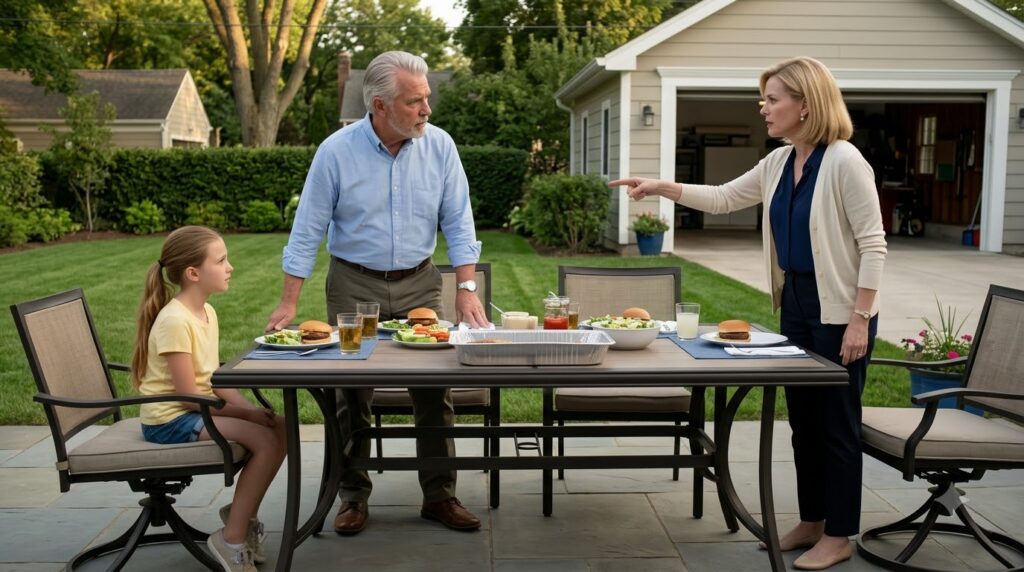
“You came into my backyard because you thought I had something you needed.”
Linda said nothing.
“You tried to take control of my dinner because you thought you could pressure me.”
Still nothing.
“And you questioned why my granddaughter was here because you needed someone else to look guilty.”
Linda’s expression hardened.
Daniel stopped there.
He didn’t need to humiliate her.
The documents spoke for themselves.
The association voted to suspend the access proposal and conduct an independent review of the property records.
The boundary would remain under Daniel’s ownership unless legally established otherwise.
The meeting ended without applause.
It wasn’t that kind of victory.
It was quieter.
The kind that came from finally putting facts where assumptions had been.
As Daniel gathered his papers, Linda approached him.
“I never meant for this to become personal.”
Daniel looked at her.
“It became personal when you walked into my home and decided my family didn’t belong at my table.”
Linda looked down.
For several seconds, neither spoke.
Then she walked away.
Daniel left the room carrying Margaret’s survey.
For the first time, the old document didn’t feel like a burden.
It felt like closure.








