Chapter 3: What the Family Had Been Trying to Protect
After the service paused for a short reception, Emily disappeared into a side room.
Daniel followed.
She sat at a small table with the photograph in front of her.
“What did Dad mean?” she asked.
Daniel read the note again.
Neither of them knew.
Their father had been a private man. He rarely explained himself when a simple gesture could say what he meant.
Margaret entered carrying a small cardboard box.
“I found this behind the memorial display,” she said.
Inside were several envelopes.
They had been placed there the previous evening.
Emily recognized her father’s handwriting immediately.
They were letters.
Not dramatic letters. Not secret confessions.
Simple notes he had written to his children over the years.
One was for Daniel.
One was for Emily.
One was for their mother.
Margaret explained that Robert had asked the family to place them near the photographs, but the box had been pushed behind the display when the room was rearranged.
Emily opened hers.
She read silently.
Her expression changed.
“What does it say?” Daniel asked.
She hesitated.
“Dad said he hoped I would remember that being strong doesn’t mean letting people walk over you.”
Daniel looked down.
It was not a message about Karen.
It was about life.
But the timing made it impossible not to feel the connection.
Outside, the reception continued.
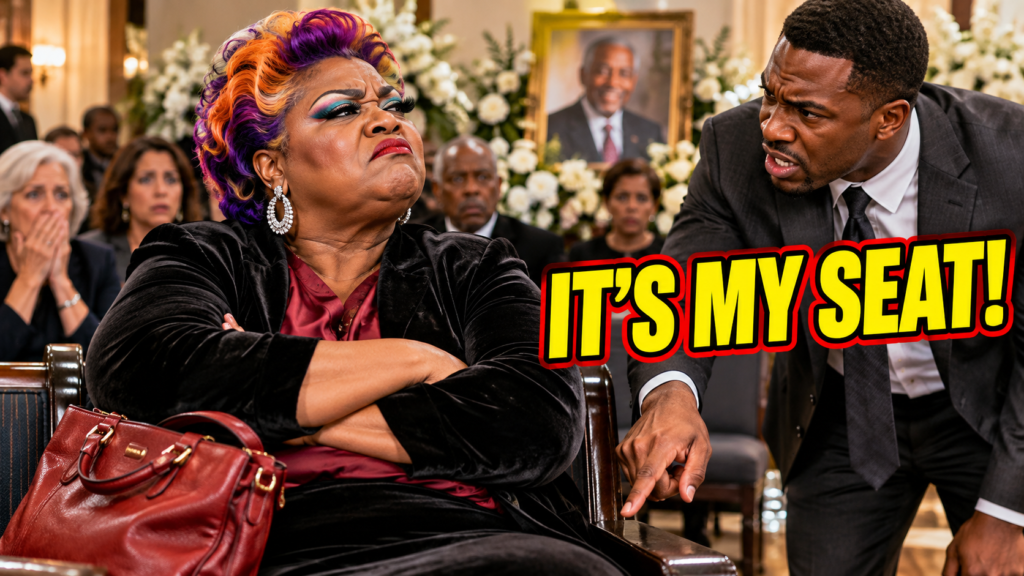
Karen had moved from the front-row chair to a standing table near the entrance.
She was speaking to another guest.
Daniel didn’t hear the conversation.
Then Karen noticed him.
She approached.
“I don’t understand why everyone is acting like I committed some terrible offense.”
Daniel looked at her.
“You took a reserved family seat during a funeral.”
“I sat in an empty chair.”
“You threw away the reservation card.”
“It was paper.”
“You knocked over photographs.”
“I didn’t knock anything over deliberately.”
Daniel said nothing.
Karen folded her arms.
“I came here because I knew Robert. I shouldn’t have to be treated like an outsider.”
That stopped Daniel.
It was the first time she had said something that sounded personal.
“You knew my father?”
Karen nodded.
“Years ago.”
Daniel waited.
She did not explain.
He remembered something.
His father had spent years helping people through community projects, neighborhood associations, and local charities. There were hundreds of people who might reasonably say they knew him.
But Karen’s certainty bothered him.
“What was your relationship with him?”
Karen looked toward the portrait.
“He helped me once.”
Daniel waited for more.
She didn’t offer it.
Instead, she said, “That’s why I came.”
Then she walked away.
Daniel watched her.
For the first time, the conflict became more complicated.
Karen was still wrong about the seat.
But perhaps she had not arrived at the funeral simply because she wanted a better chair.
Later that afternoon, Daniel found his father’s old address book among the belongings brought from the house.
One name was circled.
Karen Mills.
There was a phone number beside it.
And beneath the name, Robert had written a single sentence:
“If she ever calls, listen before you judge.”
Daniel stared at the page.
He had no idea why his father had written it.
But now he needed to know.