Chapter 6: The Crossing
Three months later, Daniel returned from the park on a warm Thursday afternoon.
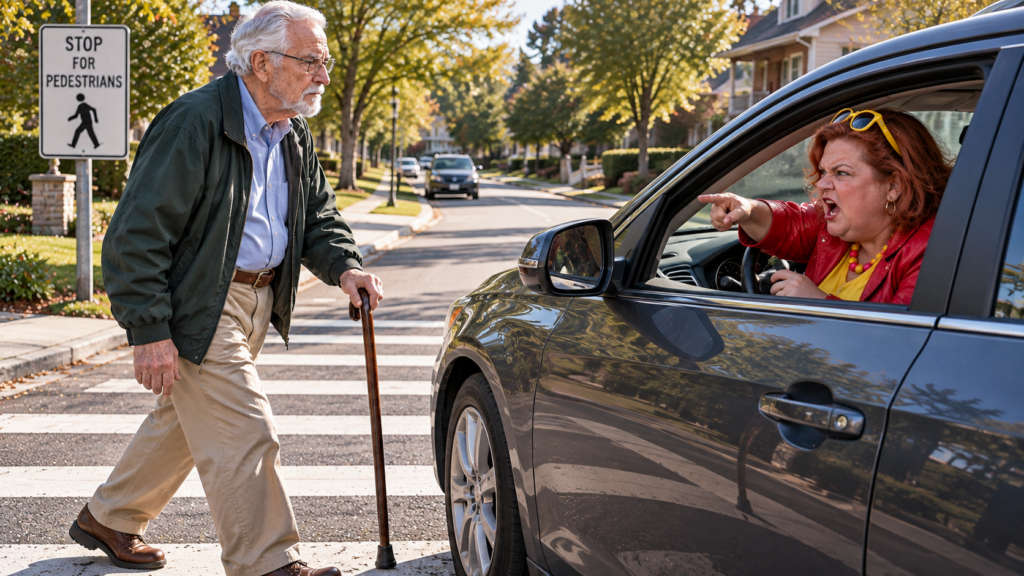
He reached the same crosswalk.
The white stripes were brighter now.
A new pedestrian sign stood beside the sidewalk.
Daniel smiled.
He placed the cane down.
Tap.
Step.
Halfway across, he heard an engine approaching.
He looked up.
A dark-gray SUV slowed.
It was Karen.
For a moment, Daniel wondered whether history was about to repeat itself.
The SUV stopped well before the crosswalk.
Karen lowered her window.
She didn’t honk.
She didn’t wave impatiently.
She simply waited.
Daniel continued.
Tap.
Step.
Tap.
Step.
When he reached the opposite curb, Karen remained stopped.
Daniel turned.
Karen looked embarrassed.
“I owe you an apology,” she said.
Daniel waited.
“I was wrong.”
Those three words seemed difficult for her.
She swallowed.
“I thought you were making me wait.”
Daniel looked at the street.
“You were.”
Karen almost smiled.
Then Daniel added, “Waiting isn’t the same as being wronged.”
Karen nodded.
“I know that now.”
She glanced at the crosswalk.
“The county approved the safety changes.”
“I heard.”
“I helped with some of it.”
“I heard that too.”
Karen smiled faintly.
Then she looked at his cane.
“I hope you don’t mind me saying something.”
Daniel raised an eyebrow.
“What?”
“You walk pretty fast for a man who supposedly takes all day.”
Daniel laughed.
It was the first time they had laughed together.
Karen laughed too.
The traffic behind her remained stopped.
Nobody honked.
Nobody shouted.
Nobody treated the moment as an inconvenience.
Daniel stepped away from the curb.
Before he continued toward home, Karen called after him.
“Mr. Harper?”
He turned.
“Next Thursday?”
Daniel smiled.
“Same time.”
Karen nodded.
“I’ll wait.”
Daniel continued down the sidewalk.
The neighborhood looked ordinary again.
Cars moved.
Trees shifted in the afternoon wind.
People walked their dogs.
A child rode a bicycle along the far sidewalk.
Nothing dramatic happened.
And perhaps that was the most important part.
Because dignity was rarely restored through grand speeches.
Sometimes it happened when a driver simply stopped.
Sometimes justice meant a false complaint being corrected.
Sometimes respect meant recognizing that another person’s pace was not an attack on your own.
And sometimes an old man with a wooden cane only needed one thing from the world:
Enough room to cross the street safely.
Daniel reached his house and paused at the gate.
He looked back toward the intersection.
Karen’s SUV was already gone.
The crosswalk remained.
The white stripes stretched across the asphalt exactly as they had that afternoon.
But now, when someone approached them, drivers stopped.
They waited.
And Daniel knew that somewhere behind those ordinary painted lines was a lesson the whole neighborhood had finally learned:
A few extra seconds of patience can protect far more than someone’s right of way. Sometimes, it protects their dignity.