
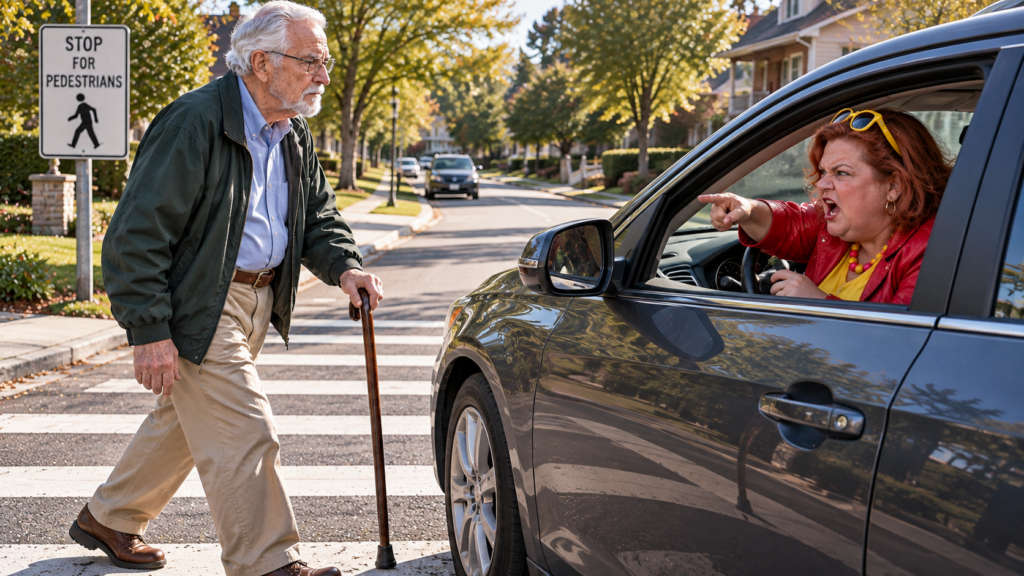
Chapter 3: The Complaint
Daniel woke before sunrise.
He made coffee, opened the curtains, and watched the neighborhood slowly come alive.
Nothing looked different.
That was the strange thing about trouble.
It rarely announced itself.
His phone rang at 8:17.
It was his daughter, Emily.
“Dad, are you okay?”
Daniel paused.
“I’m fine.”
“You’re sure?”
“Yes.”
Emily exhaled.
“Then why did someone send me a video of you being nearly run over?”
Daniel closed his eyes.
He knew immediately.
“Who sent it?”
“Marcus Bell.”
Daniel sat down at the kitchen table.
Emily was forty-six and lived about thirty minutes away. She had always worried about her father, even though Daniel had repeatedly reminded her that being seventy-eight did not make him helpless.
“I didn’t nearly get run over,” he said.
“You were in front of an SUV that was creeping toward you.”
“It stopped.”
“After you stopped.”
Daniel said nothing.
Emily softened her voice.
“Dad.”
“I’m okay.”
“That isn’t the point.”
Daniel understood.
The point was that she loved him.
But another message arrived before they could continue.
It was from the community association.
A complaint had been filed against him.
The accusation was astonishingly simple:
Pedestrian obstruction and unsafe crossing behavior.
Daniel read it twice.
Then a third time.
Karen had apparently claimed that Daniel had deliberately stopped in front of her vehicle, refused to move, and created an unnecessary traffic hazard.
She had attached a statement claiming that the elderly man had acted aggressively by raising his cane toward her vehicle.
Daniel stared at the screen.
His first emotion wasn’t anger.
It was sadness.
He had raised the cane as a boundary.
Nothing more.
But Karen had turned it into something else.
Emily called again.
“Dad?”
“I’m here.”
“Did you raise your cane at her?”
“Yes.”
“Why?”
“Because she kept moving the car toward me.”
Emily was quiet.
Then she said, “Send me the complaint.”
Daniel forwarded it.
Ten minutes later, Emily called back.
“Dad, there’s a problem.”
“What?”
“The complaint says there were no witnesses.”
Daniel looked toward the window.
He remembered Marcus.
“There was.”
“Who?”
“Marcus Bell.”
Emily paused.
“Then why would she say there weren’t?”
Daniel didn’t know.
That question stayed with him all morning.
By noon, another neighbor had contacted him.
Then another.
People had seen the video.
Some had seen Karen’s complaint.
And slowly, something strange began to happen.
People who had never spoken to Daniel started telling him their own stories.
A woman named Ruth said Karen had yelled at her husband for using a walker.
A retired firefighter said Karen had complained about his truck blocking the street while he was unloading medical equipment.
A young mother said Karen had once shouted at her for stopping at a crosswalk with a stroller.
None of those incidents had seemed important enough to report.
People had simply swallowed their irritation and moved on.
But now the stories were coming out.
Not because Daniel wanted revenge.
Because one small confrontation had given everyone permission to admit that they had noticed the same pattern.
That evening, Daniel sat alone on his porch.
His cane rested against the chair.
He wondered whether he should fight the complaint or simply let it disappear.
Then Emily arrived.
She sat beside him.
“Dad,” she said gently, “you taught your students that history isn’t just about what happened. It’s about what people choose to do after it happens.”
Daniel smiled.
“You remember too much.”
“I had a good teacher.”
For the first time that day, Daniel laughed.
Then his phone buzzed.
It was a message from Marcus.
You should come to the association meeting tomorrow. Karen is going to speak.
Daniel looked at his daughter.
Emily saw his expression.
“What?”
Daniel turned the phone around.
She read the message.
Then she looked at him.
“You’re going.”
Daniel sighed.
“I was afraid you’d say that.”








