
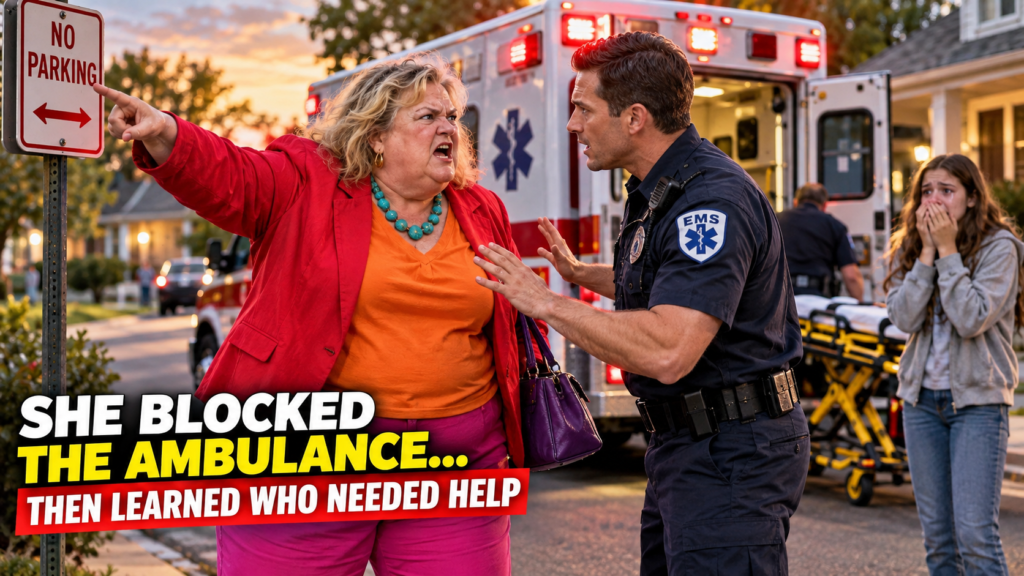
Chapter 1: The Ambulance Was “Breaking the Rules”
Karen Whitmore slapped the palm of her hand against the hood of the ambulance hard enough to make the sound echo down the quiet suburban street.
“Back that ambulance up!” she shouted. “You’re blocking a restricted curb, and I am NOT letting you sit here!”
The white emergency vehicle stood beside the curb with its red warning lights flashing. Its engine was running. Its rear doors were closed.
Karen stood directly in front of it.
There was no hesitation in her posture. She had the stance of someone who believed the entire street belonged to her.
Her scarlet-red blazer was impossible to miss. Underneath it was a neon-orange blouse, paired with hot-magenta pants and sunshine-yellow sneakers. A chunky turquoise necklace rested against her chest, while a bright purple handbag hung from one arm.
She pointed toward the curb.
A small parking-restriction sign stood nearby.
To Karen, that was enough.
She had spent years watching what happened on her street. Whose trash cans were left out too long. Whose lawn grew too high. Whose guests parked too close to a driveway.
Rules, in Karen’s mind, were simple.
They were meant to be enforced.
And she had decided that she was the person who would enforce them.
The driver’s door opened.
A paramedic hurried around the front of the ambulance.
He was in his late thirties, wearing a navy EMS uniform, black boots, and a medical utility belt. A radio was clipped near his shoulder.
“Ma’am, move now,” he said firmly. “We’re responding to an emergency.”
Karen didn’t move.
Instead, she pointed past him toward the curb.
“I don’t care what uniform you’re wearing! The rules still apply to you!”
The paramedic stared at her for half a second, clearly trying to understand whether she was serious.
Karen stepped sideways.
The ambulance moved nowhere.
“You don’t get special parking privileges just because you’ve got flashing lights!” she snapped.
The paramedic’s expression hardened.
Behind him came a loud mechanical sound.
CLACK.
The rear ambulance doors swung open.
Karen’s face changed.
Only slightly.
But it changed.
A stretcher appeared inside.
For the first time, she saw the medical equipment packed into the vehicle.
For the first time, the flashing lights meant something more than an inconvenience.
The paramedic grabbed the stretcher.
“We’re here for a patient.”
Karen looked at it.
Then she looked back at him.
Her confidence flickered.
But instead of stepping aside, she lifted her chin.
“Then take them somewhere else.”
The paramedic stopped.
He looked toward a nearby house.
Karen followed his gaze.
Her eyes narrowed.
“Whose house are you going into?”
“That’s private medical information.”
Karen’s grip tightened around her purple handbag.
Something about the answer made her more suspicious, not less.
She looked at the house again.
Then at the ambulance.
Then back at the paramedic.
“Wait,” she said. “Why THAT house?”
The paramedic said nothing.
Karen stepped closer.
“What aren’t you telling me?”
He moved the stretcher around her.
Karen immediately followed.
“I’m asking a simple question!” she shouted. “Who called you?”
The paramedic stopped.
“Someone who needs help.”
Karen’s expression hardened.
She pointed toward the house.
Then toward the ambulance.
Her voice dropped into a cold, bitter accusation.
“If they need that ambulance so badly, why didn’t they bother asking the neighborhood before wasting our emergency services?”
The paramedic stared at her.
And for once, Karen was the only person on the street who didn’t seem to understand what was happening.








