
CHAPTER 4: The Ghost Address
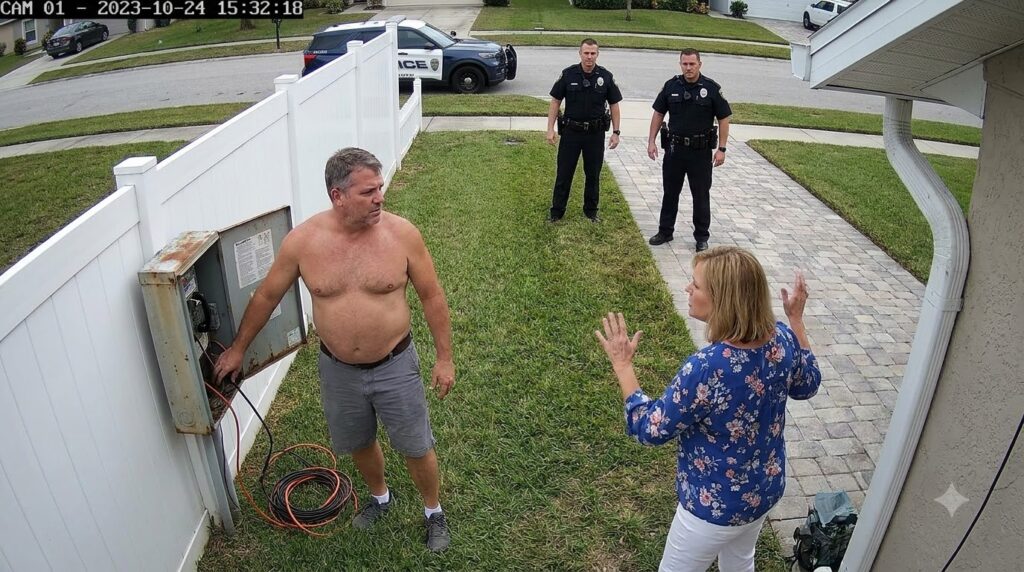
The patrol car stopped beside Daniel’s driveway, its flashing lights painting the front of the house in alternating red and blue.
Daniel scrambled to his feet and waved toward the driver.
“Officer! Over here. These people have been tampering with my electrical service.”
The deputy who emerged from the car had graying temples and the cautious demeanor of someone accustomed to arriving in the middle of disputes. He surveyed the yard, then looked toward the open utility box.
Daniel turned to point out the two intruders.
They were gone.
The man in the gray windbreaker and the woman who had been cutting the cable had vanished from the front yard. Daniel heard no departing engine and saw no vehicle pulling away. The curb was empty, and the sidewalk offered no sign of where they had gone.
“Where did they go?” he demanded.
The deputy glanced down the street.
“Who are we looking for, sir?”
“The two people standing right here. She was cutting the cable, and he was operating some kind of electronic device. They were working on that box.”
The deputy took a clipboard from the patrol car.
“Dispatch reported a line-tampering complaint at 3412 Elmwood Terrace. Tell me what happened.”
Daniel explained the cutting, the sparks, the unfamiliar corporate label, and the vibration that had come from beneath the house. He described the two intruders’ claims about an underground communications trunk and their insistence that the property belonged to an infrastructure system.
He expected the deputy to regard the explanation as unusual. He did not expect the officer to dismiss it before inspecting the equipment.
The deputy approached the utility box and shone a flashlight inside.
The vapor had almost disappeared.
The housing was empty.
Daniel stared at it.
The secondary junction box was gone. So was the thick bundle of black cables, the unfamiliar serial number, and the equipment that had been connected to the exposed line. All that remained was the ordinary residential meter, its dusty surface and weathered hinges exactly as Daniel remembered them.
“That’s impossible,” Daniel said.
The deputy moved the flashlight across the interior.
“I don’t see any cut lines.”
“You were here less than a minute after they left. You saw the lights and heard the siren. They were working right here.”
“Sir, I’m looking at the equipment.”
Daniel stepped beside him and pointed toward the hinge where he had seen the reflective green tape.
“The label was right there. It had a corporate logo. There was another box behind the meter.”
The deputy examined the housing again.
“There isn’t another box.”
Daniel felt the familiar certainty of his surroundings beginning to give way. He knew what he had seen. The sparks had been real. He had smelled burned copper, watched the woman squeeze the cutters, and felt the concrete vibrate beneath his feet.
Now the physical evidence had disappeared.
The deputy returned to his clipboard.
“According to the county assessor’s database, this address was cleared from the zoning registry in 2006.”
Daniel looked at him.
“What?”
“This parcel is classified as an industrial drainage easement. There’s no residential structure recorded here.”
Daniel let out a disbelieving breath.
“I’ve lived here for seven years.”
The deputy’s expression changed. He was no longer merely impatient; he was studying Daniel as though the conversation had taken an unexpected turn.
“The county map shows no residence on this block for nearly twenty years,” he said. “The tract was cleared for a municipal fiber-optic trunk installation during the dot-com expansion.”
“That’s not true. My house is standing right behind you.”
“There is no residential structure registered at this address. I can’t find a record of you or a residential utility account attached to this parcel.”
Daniel felt his hands begin to shake.
He had a deed in his kitchen drawer. He had tax receipts, utility bills, mortgage papers, and photographs taken throughout the seven years he had lived in the house. His possessions were inside. His furniture stood in the rooms. The house had not materialized out of nowhere.
“Come inside,” he said. “I’ll show you the documents.”
The deputy did not immediately agree.
Daniel turned toward the front door, desperate to put something tangible between himself and the official record. The brass numbers, 3412, were fixed beside the entrance. The welcome mat lay exactly where he had left it that morning.
Then he noticed the door.
The grain of the oak did not look right.
Daniel had seen the pattern countless times, but the knots now seemed shifted to one side. He stepped closer, trying to convince himself that the flashing emergency lights had distorted his perception.
He reached for the door handle, then stopped.
The wood appeared to be a surface laid over something flatter and colder. He could not explain why it looked that way, only that the familiar entrance no longer seemed entirely solid.
Behind him, the deputy continued reading the county record.
Daniel returned to the utility box, searching for some physical proof that the afternoon had happened as he remembered it. Near the mounting bracket, in a narrow space that had not been visible before, he found a small piece of blue paper.
He pulled it free.
It was a county demolition permit stub.
The paper bore a date from twenty years earlier, the same period identified in the deputy’s records. Yet the ink looked crisp, as though the document had been printed recently.
Daniel held it between his fingers.
The paper was warm.
A faint vibration ran through it, barely perceptible but unmistakable against his skin.
The deputy looked over.
“What have you got there?”
Daniel stared at the date.
For the first time, he could not immediately form an answer. The official record denied the existence of his home, and a document from that same record system had appeared inside the utility housing after the equipment vanished.
He closed his hand around the permit stub.
“I need to check something inside.”
The deputy remained near the curb, watching him return to the house.
Daniel had gone outside to stop an unauthorized disconnection. He was now walking back into a home that the county insisted had been demolished twenty years before.
And the only physical clue he had found was a document that should not have existed in the place where he found it.








