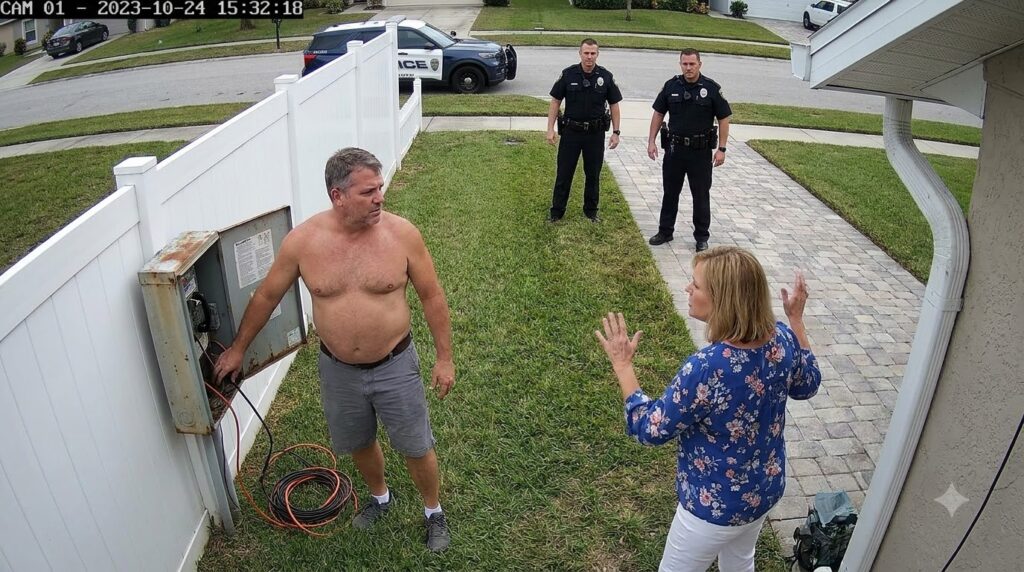
CHAPTER 2: The Standoff at the Meter Box
The dispatcher asked Daniel to confirm his address again.
“Thirty-four twelve Elmwood Terrace,” he said. “Please send someone. She’s still here, and I don’t know what she’s connected to.”
Across the walkway, the woman reached for a yellow-handled tablet attached to her utility belt. She moved slowly, making no effort to reassure him or cooperate with his demand for identification.
“You’re wasting your breath,” she said. “By the time anyone gets here, the tie-in will be permanently severed.”
Daniel stared at her.
“What tie-in?”
“Your legacy analog copper is interfering with the primary trunk.”
The language sounded rehearsed, as if she had memorized a technical explanation for a problem that ordinary homeowners were never supposed to question. Yet she had provided no company name, no work order, and no proof that she had permission to touch the equipment.
“I’m asking you one more time. What company do you work for?”
“The work order is in the cloud.”
“Then show it to me.”
“You don’t have the clearance credentials to view the proprietary metadata.”
Daniel felt anger rising into something colder. The woman’s refusal was no longer a minor inconvenience. She was claiming that he lacked the right to inspect a work order for an operation that could interrupt service to his home.
He glanced at the phone. The dispatcher continued asking questions, but the woman’s statements had made him look more carefully at the open housing.
The standard meter collar was still in place. Behind it, however, he could see a second junction box painted almost exactly the same beige as his siding. Its surface looked new, and its screws lacked the weathering visible on the older equipment. A small serial number had been stamped into the metal.
NEX-CORP-L3.
Daniel had never seen that designation on a county utility diagram or on any paperwork associated with his property.
He looked from the serial number to the green corporate label.
“You’re not with the power company.”
The woman did not deny it.
Instead, she rested her fingers on the cable cutters.
“I’m updating the regional bandwidth architecture. Your legacy analog copper is causing interference on the primary trunk. We’re clearing the right-of-way.”
“You’re cutting an electrical line to fix a data network?”
“We aren’t burying anything,” she said. “We’re unearthing what was already buried.”
She paused, watching him absorb the words.
“Your house is sitting directly on top of the primary junction node.”
Daniel glanced down at the concrete beneath his shoes. For seven years, he had understood his home as a straightforward piece of property: a house on a residential lot, connected to public utilities and surrounded by neighboring homes. The idea that it concealed some major communications junction was absurd.
But the unfamiliar box was real. So were the cutters and the damaged cable.
“You can’t just decide that my property belongs to your company,” he said. “If there’s infrastructure here, show me the easement. Show me the authorization. You don’t get to destroy my electrical service because somebody says there’s a network underneath the lawn.”
The woman looked almost amused.
“Property rights assume the land beneath your foundation belongs to the surface deed.”
Daniel felt his stomach tighten.
She continued as if explaining an ordinary administrative procedure.
“Section twelve of the 1994 municipal infrastructure amendment grants right-of-way privileges to pre-existing subsurface digital arteries.”
“That’s not an answer.”
“Your house was built directly over the primary trunk line connecting an old military-industrial relay to the downtown grid.”
Daniel shook his head.
“You’re telling me there’s a military communications line underneath my kitchen, and you expect me to let you cut into it without showing me a single document?”
“I’m telling you that your house occupies a node we need to reclaim.”
He looked toward the street, hoping to see a legitimate utility vehicle or another worker who could confirm any part of her explanation. There was nothing that made the situation more understandable.
Then the ground beneath his shoes shuddered.
It was subtle at first, a low vibration traveling through the concrete walkway and into his legs. The metal utility housing trembled against the wall. A faint, mechanical hum rose from somewhere below the foundation.
Daniel stopped speaking.
The vibration did not feel like an ordinary truck passing along the street. It seemed to come from beneath the house itself.
He lifted the phone closer to his ear.
“Did you hear that?”
The dispatcher began to respond, but a sudden hiss of static swallowed the voice. A high-pitched digital shriek burst through the speaker, forcing Daniel to pull the phone away. He dropped it onto the concrete.
For an instant, the woman watched the device rather than him.
Then she smiled.
“The trunk is already live.”
She tightened her hands around the cutters.
Daniel’s attention snapped back to the exposed cable. Whatever the underground system was, the vibration and the sudden interference had begun at the same time as the unauthorized work. He could not prove a connection, but he could no longer dismiss the possibility that the woman was activating something beneath his home.
He stepped toward the utility box.
“Put the tool down.”
She began to squeeze the handles.
Daniel knew he could not allow her to continue. But the evidence of an unauthorized installation, the unexplained vibration, and the phone that had suddenly become useless had left him with a problem larger than a trespassing complaint.
He needed to stop her without making the situation more dangerous.
As he moved closer, another sound came from the street.
A car door slammed.
Daniel turned toward the driveway, and the woman did not look surprised.
Someone else had arrived.